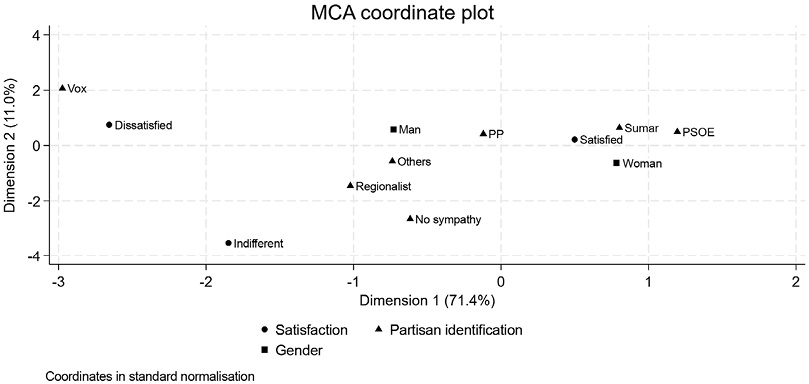
Figure 1. MCA between party identification, gender and satisfaction with victory
Source: Prepared by the authors based on CIS (2023).
doi:10.5477/cis/reis.194.139-150
Beyond the Pitch: Party Identification and Dissatisfaction with the Victory of the Spanish National Women’s Football Team
Más allá del campo: identificación partidista e insatisfacción tras el triunfo de la selección española femenina de fútbol
Julia Duro, Ángela Mesa-Pedrazas, Paloma Egea-Cariñanos, Lucía Granda, Fátima Pineda-Urbano and Samara López-Ruiz
|
Key words #SeAcabó
|
Abstract The Spanish national team’s victory at the 2023 FIFA Women’s World Cup took place alongside institutional controversy following the inappropriate behaviour by the head of the Spanish Football Federation (RFEF) towards a female player. This reignited the debate on gender and power in sport. Despite the national team’s achievement, 17.6 % of the Spanish population expressed either indifference or dissatisfaction, which raised questions about the perception of women’s sporting success. Based on data from the CIS Barometer, this study uses multiple correspondence analysis and multinomial regressions to analyse the role of political and socio-demographic variables in the public’s dissatisfaction with the victory. Gender and party identification—especially with Vox—were found to be the main determinants. It is suggested that this dissatisfaction may be linked to the symbolic feminist loading of the victory in a political context marked by ideological polarisation. |
|
Palabras clave #SeAcabó
|
Resumen La victoria de la selección española en la copa mundial femenina de la FIFA 2023 estuvo acompañada de una controversia institucional tras el comportamiento inapropiado del presidente de la RFEF hacia una jugadora, lo que reavivó el debate sobre género y poder en el deporte. Pese al logro, un 17,6 % de la población manifestó indiferencia o insatisfacción y planteó interrogantes sobre la percepción de los éxitos deportivos femeninos. A partir de datos del barómetro del CIS, este estudio analiza el papel de variables políticas y sociodemográficas en la insatisfacción con la victoria mediante análisis de correspondencias múltiples y regresiones multinomiales; sexo e identificación partidista –especialmente con Vox– son los principales determinantes. Se sugiere que esta insatisfacción puede estar vinculada a la carga simbólica feminista del triunfo en un contexto político marcado por la polarización ideológica. |
Citation
Duro, Julia; Mesa-Pedrazas, Ángela; Egea-Cariñanos, Paloma; Granda, Lucía; Pineda-Urbano, Fátima; López-Ruiz, Samara (2026). “Beyond the Pitch: Party Identification and Dissatisfaction with the Victory of the Spanish National Women’s Football Team”. Revista Española de Investigaciones Sociológicas, 194: 139-150. (doi: 10.5477/cis/reis.194.139-150)
Julia Duro: Harvard University (Cambridge, MA) | julia_jimenezduro@gsd.harvard.edu
Ángela Mesa-Pedrazas: Universidad de Granada | angelamp@ugr.es
Paloma Egea-Cariñanos: Universidad de Granada | palomaegeac@ugr.es
Lucía Granda: Universidad de Granada | lgranda@ugr.es
Fátima Pineda-Urbano: Universidad de Granada | fatimapineda@ugr.es
Samara López-Ruiz: Universidad de Granada | samara@ugr.es
Football is the most universally recognised, followed and practised sport in contemporary society. With billions of fans and participants, it acts as a powerful emotional bond, capable of symbolically representing and reinforcing social identities (González, 2014; Chung, 2023). This representation is understood as a process of self-categorisation whereby individuals distinguish between “us” and “them”, as shown by research that linked sporting victories to greater national pride (Rosenzweig and Zhou, 2021; Seippel, 2017; González, 2014). However, not all social groups experience the same level of pride or identification in response to these victories, as differences have been observed according to gender or ethnicity (Elling, Hilvoorde and Dool, 2012; Denham, 2010).
In the case of Spain, one of the key variables that has been proven to generate this form of collective identification with different football teams is territorial difference (Rodríguez, 2015; Llopis, 2019). Relevant sources, such as the Sports Habits Survey [Encuesta de Hábitos Deportivos (CIS, 2010)], have also shown that 11 % of the population did not feel proud of the achievements of Spanish sportspeople. This percentage was higher among women and people who placed themselves on the ideological left, which also indicates differentiated perceptions depending on socio-demographic and political factors. Moreover, despite the prominence of football in Spain’s socio-cultural landscape, the existing theoretical literature on this phenomenon remains limited and focuses primarily on the impact of victories by men’s teams (for example, González-Gómez and Picazo-Tadeo, 2010), thereby further sidelining the analysis of the satisfaction generated by the achievements of women’s teams (Llopis, 2017). An illustrative case is that of the Spanish women’s national football team, which has traditionally been the subject of much less research, media and social attention than the men’s team (Abuín-Penas and Fontenla-Pedreira, 2020).
On August 20, 2023, the Spanish women’s national football team won the FIFA Women’s World Cup, a victory that was a major step towards their visibility and recognition. The road has been long and not without conflict, as women footballers had been protesting against discriminatory treatment since the early twentieth century and connected their demands with those of the feminist movement (Torrebadella-Flix, 2016). As Hargreaves (2004) pointed out, the participation of women in football is in itself a political act to achieve equality and legitimise their own space in a traditionally masculinised world.
The first direct precedent for this struggle in Spain was the women footballers’ strike called in 2019, which paved the way for a preliminary agreement to be reached that culminated in the so-called ‘F League’ becoming professionalised in 2022 (Moscoso-Sánchez, 2023). Despite these advances, the pre-World Cup climate was not without controversy either, as it was marked, among other things, by the resignation of fifteen players from the national team after UEFA Women’s Euro 2022 due to discriminatory treatment by the Spanish Football Federation (RFEF) (Jiménez, 2023).
With their 2023 victory, the players not only achieved sporting but also media recognition, as they managed to bring 5.5 million people in Spain together in front of their television sets (RTVE, 2023). It is noteworthy that this victory was associated with the previous controversy over unequal working conditions and the assault1 involving the then head of the RFEF, Luis Rubiales, who kissed the footballer Jenni Hermoso without her consent during the medal ceremony following the World Cup final. The assault resulted in legal proceedings being instituted, coach Jorge Vilda being dismissed and Luis Rubiales resigning as head of the RFEF (Castro-Martínez and Torres-Martín, 2024). This incident rapidly spread across various media outlets and social networks through the #SeAcabó movement, which condemned the silence in the face of abuse and violence against women in football (Moreira and Gutiérrez-Chico, 2023). In addition to the worldwide media debate it generated, support for the players became a political issue.
Although the victory of the national team in the 2023 FIFA Women’s World Cup was a milestone in the history of Spanish sport, data from the October 2023 CIS Barometer show that 9.7 % of the Spanish population expressed little or no satisfaction with this victory, while 6.14 % said they were indifferent. The aforementioned incident that occurred during the victory celebration overshadowed the sporting achievement, divided public opinion and prompted differing responses from political parties. Its significance was such that the European Parliament condemned Luis Rubiales’ actions, although there was a dissenting note by Vox (RTVE/EFE, 2023).
Building on previous evidence that has shown variations in satisfaction with sporting victories due to socio-demographic and political factors, and drawing on data from the October 2023 CIS Barometer—which focuses on Spain’s World Cup victory—, this research note provides an initial analysis of the dissatisfaction surrounding the victory of a women’s national team in Spain.
The aim is to identify the socio-demographic profiles associated with the different degrees of dissatisfaction generated by the victory of the Spanish women’s national football team in the 2023 Women’s World Cup. To this end, data from this barometer were analysed using multiple correspondence analysis and multinomial regression, with party identification serving as the primary analytical dimension.
Party identification was found to be the main explanatory variable for this dissatisfaction. Respondents who identified with Vox—a party characterised by a clear anti-gender discourse (Cabezas, Pichel and Grau, 2023)—showed the highest levels of dissatisfaction, followed by those who identified with the PP. This may be linked to the broader context of demands for gender equality and to the symbolic feminist significance that this victory acquired, as women were generally less likely than men to express dissatisfaction with the win. This research contributes to the field of sociological studies by exploring the relationship between sport and politics, and points to the need to create new frameworks for analysing women’s sporting success.
The study analysed secondary data from the October 2023 CIS Barometer (ECIS3423). The STATA statistical software was used to analyse the data. Table 1 shows the political variable and the five socio-demographic variables that were included as independent variables. Previous research (Hallmann, Breuer and Kühnreich, 2013; Elling, Hilvoorde and Dool, 2012) has highlighted that different segments of the population react differently to sport victories when taking into account factors such as gender, educational level and country of origin. Socio-demographic variables were therefore used as control variables in this study. Football has historically been a sphere where emotions and politics converge, thereby rendering it as a tool used to promote nationalist ideologies (Rodríguez, 2015; Llopis, 2017). In light of this, and given the high degree of party politicisation surrounding the World Cup final and the related controversies, the party identification variable was the main focus of the analysis and corresponded to the vote+sympathy question in the Barometer. The data were recoded to show identification with the main parties. Because of sample size limitations, minor parties (Others) were grouped together under one category, and regionalist or pro-independence parties under another category. It should be noted that the “No sympathy” category included the choices of those who did not state any party affiliation.
The dependent variable was the degree of satisfaction with the victory of the Spanish national football team in the World Cup. Originally, this variable had five response categories, ranging from “Not at all satisfied” to “Very satisfied”. For ease of interpretation, it was recoded for the multiple correspondence analysis (MCA). In this process, the values of “Doesn’t know/Doesn’t answer” were identified as missing; the first two and last two values were grouped as “dissatisfaction” and “satisfaction”, respectively; and a third category was created that recoded the central category as “indifference”.
A multiple correspondence analysis (MCA) was conducted using the variables gender and party identification to classify an initial profile linked to the degree of satisfaction with winning the 2023 Women’s World Cup. This technique provided an initial graphical representation of how the independent variables related to the three categories within the satisfaction dimension (satisfaction, indifference and dissatisfaction) with a view to meeting the research objective. The structure of the plotted dimensions explained 82.4 % of the total variance in the data.
While this approach to the results revealed clearly defined socio-demographic and political profiles across the three categories of the dependent variable, this preliminary finding was further tested by using a multinomial logistic regression with two successive models. The first included only socio-demographic variables, whereas the second incorporated the political dimension to enhance the model’s explanatory power. The Akaike Information Criterion (AIC) and Bayesian Information Criterion (BIC) were evaluated for this purpose. Finally, a marginal effects analysis was run to test for intra- and inter-party gender differences.
The majority of the population were satisfied with the victory achieved by the women’s national team (84.16 %); however, the focus of the study was on analysing the factors associated with dissatisfaction. There were three different profiles in relation to satisfaction with the Spanish national team’s victory, as shown by the MCA (see Figure 1). Firstly, satisfaction was not evenly distributed between men and women, as it was more prevalent among voters and sympathisers of parties from the progressive spectrum (PSOE and Sumar) and, to a lesser extent, among supporters of the Popular Party.
Secondly, indifference was mainly associated with voters of regionalist parties. This finding was consistent with previous research (Llopis, 2017) which had found the following of regional teams to be associated with the construction of nationalist identities in the Basque Country and Catalonia. This could explain the absence of a sense of pride in the victory of a Spanish national team. Indifference was also found among those who did not identify with any party.
Finally, dissatisfaction was mainly concentrated among people who identified with Vox, which suggests a connection with the feminist symbolism that this victory came to be associated with in the wider context of gender equality and ideological polarisation debates. These preliminary results highlighted the need to delve deeper into the political and identity dynamics that influence the perception of women’s sporting success in Spain.
Among those who declared themselves dissatisfied with or indifferent to the victory, the results confirmed that perceptions of the victory were significantly shaped by socio-demographic variables—particularly gender—and that the model’s explanatory power increased when the partisan identity variable was introduced (Table 2). Only socio-demographic variables were included in the first stepwise multinomial logistic regression model; in particular, negative coefficients for age (-0.011*; -0.010**, respectively) and gender (-0.289*; -0.462***) suggested that younger people and women were less likely to have an indifferent or dissatisfied response to the sporting victory. A change in the model’s fit was observed in the second model, which included the political variable in addition to the socio-demographic variables. A comparison of both regression models, taking into account the AIC and BIC estimators, showed that both had a better fit than the null model. Nevertheless, the values of the AIC and BIC were lower in the second model than in the one in which only control variables were included. Therefore it can be argued that the latter offered a better balance between fit and complexity due to its higher log-likelihood.
In this extended model, gender maintained its statistical significance, as it smoothed the difference between men and women in terms of indifference (-0.272*) and dissatisfaction (-0.390**). This association was particularly revealing: women were significantly less likely to express dissatisfaction with the victory. In a similar vein, Hallam, Breuer, and Kühnreich (2013) found that women reported the greatest satisfaction with and pride in a national sporting success during the 2011 Women’s World Cup held in Germany. This suggests an alternative reading in which the victory was not only perceived as a sporting achievement at the national level, but also as an achievement for the female gender of the national team.
Regarding the categories of the party identification variable, the estimated coefficients showed no significant differences between the left-wing parties (PSOE and Sumar), indicating a broadly consistent and predominantly positive attitude towards the victory. However, both indifference and dissatisfaction increased significantly among those who identified with the PP (0.618** for indifference; 0.741*** for dissatisfaction), Vox (1.055*** and 1.488, respectively) and regionalist parties (1.356*** and 0.919***).
These results are of remarkable interest. Given the constant assertions in praise of Spanish nationalism by Vox, one might intuitively assume that this party would be the most satisfied with a national victory in such a major event as a World Cup football tournament. In this case, two main factors appear to explain the radical right’s lower level of satisfaction with the victory. The first is that it concerned the Spanish women’s national team, with which they identified less strongly; the second relates to the controversies surrounding gender-equality claims and non-consensual kissing of world champion Jenni Hermoso by Luis Rubiales during the medal ceremony. In fact, this last incident and the subsequent public debate on whether the kiss was considered sexual assault or an expression of euphoria gave rise to social confrontation and clear positioning by political parties. PSOE, Sumar and PP were in agreement in calling for the resignation of the RFEF head (Público, 2023). Vox (2023), for its part, issued a statement on social media in which, while portraying the action as being rude, it charged against “the hypocrisy of false feminism” and “the political and media hounding to which Mr Rubiales has been personally subjected”. As a result, polarised positions may have overshadowed the sporting victory and politicised the perception and meaning of the victory for the public as a whole. A sizeable group was added to the previously identified profiles: those who declared no sympathy for any political party, who also showed a higher likelihood of expressing either indifference (1.364***) or dissatisfaction (0.983***).
These results could suggest the presence of two distinct forms of symbolic rejection: an ideological one, in which the right—particularly the radical right represented by Vox—distanced itself from the feminist message and the demand-driven side of the victory; and a territorial-identity one, in which regionalist or peripheral nationalist sectors might have felt only a weak sense of identification with the achievements of a team representing the State.
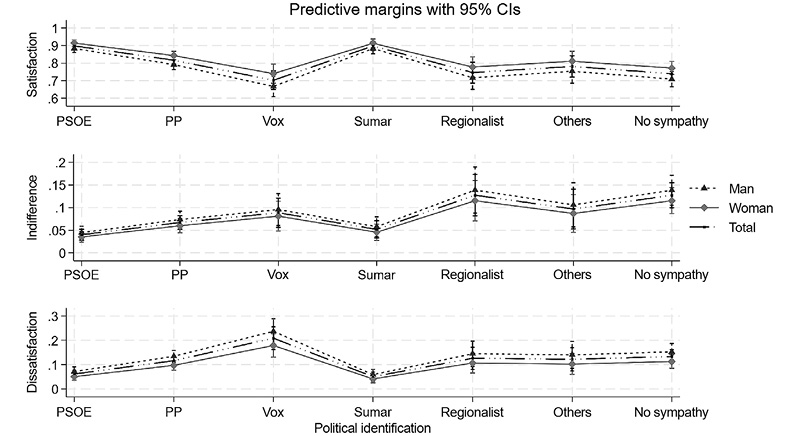
The marginal effects analysis (see Figure 2) also revealed a strong relationship between party identification and the likelihood of showing satisfaction or dissatisfaction with victory or indifference to it, differentiated by gender. The analysis showed that both men and women who supported Sumar or PSOE were more likely to express satisfaction, with women slightly more likely to be satisfied overall. In contrast, the degree of satisfaction in the case of both Vox and the PP was significantly lower and gender differences appeared to be more marked. On the other hand, those who identified themselves as regionalists displayed similar levels of satisfaction to those expressed by the Spanish right.
The principal group classified under indifference consisted of those who identified with regionalist parties and those who declared no party identification. Moreover, men were slightly and consistently more likely to be indifferent across all parties, this difference being slightly more marked in the case of regionalist parties. Finally, people who identified with right-wing parties were more likely to show dissatisfaction and men consistently scored higher, regardless of the party. The differences were again most noticeable in the parties on the right of the ideological spectrum and in regionalist parties.
This analysis reaffirms that, while partisan identity was more influential than gender in shaping feelings of dissatisfaction, gender proved to be a more significant explanatory factor on the right side of the political spectrum than on the left. Thus, right-wing women, especially those who identified with Vox, seemed to have been more influenced by the fact that the protagonists of the sporting victory were women than by party identification. Differences in satisfaction with the victory by party therefore did not only occur on the basis of the ideological position of the party with which individuals identified; rather, gender identification partially transcended party alignment.
In this respect, it is important to emphasise the symbolic feminist loading carried by the very fact that women footballers attain visibility and success in a male-dominated sphere. Previous research has linked the support of women’s football to expressions of solidarity with the feminist movement (Pfister, 2015) or women’s empowerment (Prinz et al., 2016). In fact, these supporters perceive themselves as playing an active part in a battle that women footballers wage in order to achieve equality, at least in the sphere of football (Allison and Pope, 2021).
Secondly, the feminist loading is also evident in the social support shown after the sexist aggression against Jenni Hermoso, both in the stance taken by most political parties and in the social response through movements such as #SeAcabó, which gained international momentum. The controversy brought to the centre of public debate the struggle that women footballers around the world have been waging for decades to put an end to the abuse, violence and structural inequalities that still persist in the masculinised world of football (Conde Colmenero, 2020).
In parallel with the struggle of women footballers in Spain, recent years have witnessed the spread of anti-gender discourses led by Vox, mobilising the far-right electorate against gender equality and feminism (Cabezas, Pichel and Grau, 2023). Thus, the symbolic feminist loading of the victory, together with the social reactions and the responses of various leaders and political parties, may help explain why those who identified with Vox were the most likely to feel dissatisfied. However, in terms of national identity, it is contradictory that parties such as Vox, which tend to show a high patriotic identification as part of their ideology and a discourse of “us” (Spanish) versus “them” (non-Spanish) (Corrochano, 2022), were the most dissatisfied with a national victory.
This study explores the profile associated with dissatisfaction with the victory of the women’s national football team in the World Cup, where party identification is the central focus of analysis. Data from the October 2023 CIS Barometer were used to this end. The main findings include that the most explanatory variables for dissatisfaction were party identification and gender. Thus, despite the fact that the vast majority of the population was proud of the victory of the women’s national team, those who showed the greatest dissatisfaction were men identified with Vox or, to a lesser extent, with the Popular Party. Beyond dissatisfaction, the data underscore the role of both the absence of party identification and territorial identity in explaining indifference towards this victory, as some sectors of the population may feel only a weak connection to the achievements of a national team.
The issue arises as to whether the question about satisfaction with the national team’s victory may subliminally reflect social attitudes towards gender equality in sport or towards the sexual assault incident that occurred during the World Cup celebration. This is particularly relevant in light of two factors: first, the obvious differences in satisfaction levels between men and women; and second, the fact that the data were collected in October 2023, simultaneously to the court proceedings (and media “trial”) on the Rubiales case. For this reason, it is suggested that the victory of the women’s national team may have acquired symbolic feminist loading due to the demands for equal conditions and the social movement in response to the non-consensual kissing of Hermoso. When considered alongside other studies that have linked football played by women to feminism, it is possible to explain why those who identified with Vox tended to express greater dissatisfaction, as it was this party that avoided condemning the assault and has upheld an anti-gender discourse for years.
Ultimately, football and the sporting victory of the Spanish women’s football team unfortunately took a back seat in the national and international press after these events occurred. There was a discrepancy between the expected social response to a national sporting victory and the situation observed in this study. However, while data availability is limited, the results suggest that these victories could provide a space to continue fighting for gender equality, as well as promoting nationalist sentiments as in the cases of victories by male teams. In football, it is unclear whether a sense of (a female) “them” was constructed during the last Women’s World Cup but, among some sectors, there was certainly no (female) “us”.
The main limitation is the grouping of pro-independence and regionalist parties into a single category, which provides a somewhat simplistic portrayal of a diverse territorial situation and may include a combination of opposing tendencies. In particular, this methodological strategy, adopted for reasons of sample size limitation, reduces the ability to understand the phenomenon of indifference to the victory analysed of those who identified with these parties.
Abuín-Penas, Javier and Fontenla-Pedreira, Julia (2020). “Representación de género en la comunicación en Twitter de la Selección Española de Fútbol”. Comunicación y Género, 3(2): 139-149. doi: 10.5209/cgen.68677
Allison, Rachel and Pope, Stacey (2021). “Becoming Fans: Socialization and Motivations of Fans of the England and US Women’s National Football Teams”. Sociology of Sport Journal, 39(3): 287-297. doi: 10.1123/ssj.2021-0036
Cabezas Fernández, Marta; Pichel Vázquez, Alexandre and Grau Enguix, Begonya (2023). “El marco ‘antigénero’ y la (ultra)derecha española. Grupos de discusión con votantes de Vox y del Partido Popular”. Revista de Estudios Sociales, 85: 97-114. doi: 10.7440/res85.2023.06
Castro-Martínez, Andrea and Torres-Martín, José L. (2024). “La gestión del machismo en el ámbito deportivo. La crisis de la RFEF con las campeonas del mundial de fútbol y su impacto en la Marca España”. AdComunica, 27: 255-260.
Chung, Sanho (2023). “Because Hongkongers Should Support Hong Kong: Entanglement of National Identity, Political Ideology, and Football Fandom in Hong Kong”. Journal of Sport and Social Issues, 47(3): 203-227. doi: 10.1177/01937235231171372
CIS (2010). Encuesta Hábitos deportivos en España IV. Estudio 2833. Available at: https://www.cis.es/documents/d/cis/Es2833pdf, access May 10, 2025.
CIS (2023). Barómetro de octubre. Estudio 3423. Available at: https://www.cis.es/-/disponible-el-estudio-3423-barometro-de-octubre-2023, access April 7, 2024.
Conde Colmenero, Pilar (2020). “A vueltas con el primer convenio colectivo de las futbolistas. La controvertida lista de compensación por formación: Comentario a la Sentencia de la Audiencia Nacional 55/2020, de 21 de julio”. Revista de Trabajo y Seguridad Social, 453: 216–224. doi: 10.51302/rtss.2020.896
Corrochano, David (2022). “La normalización de Vox y su ideología del día a día. Nacionalismo banal y cotidianeidad desbordada”. Revista de Estudios Políticos, 197: 167-201. doi: 10.18042/cepc/rep.197.06
Denham, Bryan E. (2010). “Correlates of Pride in the Performance Success of United States Athletes Competing on an International Stage”. International Review for the Sociology of Sport, 45(4): 457-473. doi: 10.1177/1012690210373540
Elling, Agnes; Hilvoorde, Ivo van and Dool, Remko van den (2014). “Creating or Awakening National Pride through Sporting Success: A Longitudinal Study on Macro Effects in the Netherlands”. International Review for the Sociology of Sport, 49(2): 129-151. doi: 10.1177/1012690212455961
González, Manuel E. (2014). “Prensa deportiva e identidad nacional: España en el Mundial de fútbol de Sudáfrica 2010”. Política y Sociedad, 51(2): 337-366. doi: 10.5209/rev_POSO.2014.v51.n2.43077
González-Gómez, Francisco and Picazo-Tadeo, Andrés J. (2010). “Can We Be Satisfied With Our Football Team? Evidence From Spanish Professional Football”. Journal of Sports Economics, 11(4): 418-442. doi: 10.1177/1527002509341020
Hallmann, Kirstin; Breuer, Christoph and Kühnreich, Benedikt (2013). “Happiness, Pride and Elite sporting success: What Population Segments Gain Most from National Athletic Achievements?”. Sport Management Review, 16(2): 226-235. doi: 10.1016/j.smr.2012.07.001
Hargreaves, Jennifer (2004). Querying Sport Feminism: Personal or Political? In: Giulianotti, R. (ed.). Sport and Modern Social Theorists. London: Palgrave Macmillan. doi: 10.1057/9780230523180_13
Jiménez, Mayca (2023). “España no puede escapar a la pregunta que repiten una y otra vez los extranjeros en el Mundial: ¿Qué pasó con ‘Las 15’?”. Relevo, 20 de agosto. Available at: https://www.relevo.com/futbol/mundial-femenino/paso-juegan-espana-respuestas-conflicto-20230720100443-nt.html, access May 8, 2024.
Llopis, Ramón (2017). “Football and Politics in Spain: An Empirical Analysis of the Social Base of the Main Football Club”. Studia Iberica et Americana: journal of Iberian and Latin American literary and cultural studies, 1(4): 79-100.
Llopis, Ramón (2019). “La identificación con clubes de fútbol en España. Un análisis sociológico de su evolución de 1984 a 2014”. Revista Española de Sociología, 28(3): 475-488. doi: 10.22325/fes/res.2019.12
Moreira, Verónica and Gutiérrez-Chico, Fernando (2023). “Más que un ‘piquito’ una lucha transnacional”. Sociología del Deporte, 4(2): 1-3. doi: 10.46661/socioldeporte.9436
Moscoso-Sánchez, David (2023). “¡Se acabó! La reivindicación histórica que marcó un antes y un después en el fútbol femenino español”. Sociología del Deporte, 4(2): 1-4. doi: 10.46661/socioldeporte.9431
Pfister, Gertrud (2015). “Assessing the Sociology of Sport: On Women and Football”. International Review for the Sociology of Sport, 50(4-5): 563-569. doi: 10.1177/1012690214566646
Prinz, Aloys; Bollacke, Steffen; Bunger, Bjorn; Langen, Martin and Roesler, Maik (2016). “Who’s Afraid of Women’s Football? Gender Inequality and Football Success”. SSRN Electronic Journal, 1-27. doi: 10.2139/ssrn.2781089
Rodríguez, Vicente (2015). “Soccer, Nationalism and the Media in Contemporary Spanish Society: La Roja, Real Madrid & FC Barcelona”. Soccer & Society, 17(4): 628-643. doi: 10.1080/14660970.2015.1067793
Rosenzweig, Leah R. and Zhou, Yang-Yang (2021). “Team and Nation: Sports, Nationalism, and Attitudes Toward Refugees”. Comparative Political Studies, 54(12): 2123-2154. doi: 10.1177/0010414021997498
RTVE/EFE (2023). “La Eurocámara muestra su crítica casi unánime al caso Rubiales, con la nota discordante de Vox”. 14 de septiembre. Available at: https://www.rtve.es/deportes/20230914/eurocamara-critica-beso-rubiales-jenni-hermoso-con-excepcion-vox/2455971.shtml, access May 8, 2024.
RTVE (2023). “La victoria de España en el Mundial, máximo histórico de todas las competiciones femeninas de fútbol”. 21 de agosto. Available at: https://www.rtve.es/rtve/20230821/victoria-espana-mundial-maximo-historico-todas-competiciones-femeninas-futbol/2454292.shtml, access May 8, 2024.
RTVE (2025). “Jenni Hermoso recurrirá la sentencia que condena a Rubiales por el beso y le absuelve por las coacciones”. 20 de febrero. Available at: https://www.rtve.es/noticias/20250220/jenni-hermoso-anuncia-recurrira-sentencia-caso-rubiales/16459638.shtml, access May 12, 2025.
Seippel, Ørnulf (2017). “Sports and Nationalism in a Globalized World”. International Journal of Sociology, 47(1): 43-61. doi: 10.1080/00207659.2017.1264835
Torrebadella-Flix, Xavier (2016). “Fútbol en femenino. Notas para la construcción de una historia social del deporte femenino en España, 1900-1936”. Investigaciones Feministas, 7(1): 313-334. doi: 10.5209/rev_INFE.2016.v7.n1.52710
Vox (2023). ¿Qué piensa VOX sobre el Caso Rubiales? [X post], 30 de agosto. Available at: https://x.com/vox_es/status/1696847520226254992, access April 3, 2024.
1 In February 2025, the defendant was convicted of sexual assault, although both parties have appealed the sentence (RTVE, 2025).
Table 1. Sample description and distribution
|
|
Average/Percentage |
|
Socio-demographic variables |
|
|
Age |
50.872% |
|
Gender (ref.: Male) |
51.77% |
|
Size of municipality |
|
|
Rural |
17.65% |
|
Small urban |
37.19% |
|
Medium urban |
25.46% |
|
Large urban |
19.70% |
|
Education Level |
|
|
Primary school or lower |
4.77% |
|
Secondary |
46.65% |
|
Higher Education |
48.57% |
|
Activity |
|
|
Employees |
58.58% |
|
Inactive |
22.72% |
|
Unemployed |
10.01% |
|
Students |
3.53% |
|
Others |
5.16% |
|
Political variables |
|
|
Vote and sympathy |
|
|
PP |
26.66% |
|
PSOE |
28.63% |
|
Vox |
7.21% |
|
Sumar |
13.38% |
|
Regionalist |
5.34% |
|
Others |
4.43% |
|
No sympathy |
14.34% |
|
Sport-related variables |
|
|
Level of satisfaction with the victory of the Spanish women’s national football team in the World Cup |
|
|
Satisfied |
82% |
|
Indifferent |
7.29% |
|
Dissatisfied |
10.37% |
Source: Prepared by the authors based on CIS (2023).
Figure 1. MCA between party identification, gender and satisfaction with victory
Source: Prepared by the authors based on CIS (2023).
Table 2. Multinomial logistic regression on indifference and dissatisfaction with the Women’s World Cup victory
|
|
Model 1 |
Model 2 |
||||||
|
|
Indifferent |
Dissatisfied |
Indifferent |
Dissatisfied |
||||
|
|
B |
S.E. |
B |
S.E. |
B |
S.E. |
B |
S.E. |
|
Age |
-0.011* |
0.006 |
-0.010** |
0.005 |
-0.010 |
0.006 |
-0.010* |
0.005 |
|
Gender (Ref.: Male) |
-0.289* |
0.129 |
-0.462*** |
0.112 |
-0.272* |
0.132 |
-0.390** |
0.115 |
|
Level of education (ref.: Primary school or lower) |
|
|
|
|
|
|
|
|
|
Secondary |
-0.171 |
0.306 |
0.327 |
0.332 |
-0.189 |
0.311 |
0.304 |
0.335 |
|
Higher Education |
-0.4018961 |
0.314 |
0.191 |
0.336 |
-0.394 |
0.320 |
0.216 |
0.340 |
|
Activity (ref.: Employee) |
|
|
|
|
|
|
|
|
|
Inactive |
-0.122 |
0.220 |
-0.314 |
0.194 |
-0.079 |
0.223 |
-0.248 |
0.197 |
|
Unemployed |
0.171 |
0.197 |
-0.094 |
0.186 |
0.166 |
0.200 |
-0.110 |
0.189 |
|
Students |
-0.762 |
0.419 |
-0.379 |
0.305 |
-0.682 |
0.423 |
-0.289 |
0.310 |
|
Others |
-0.002 |
0.321 |
0.300 |
0.257 |
-0.037 |
0.323 |
0.275 |
0.259 |
|
Size of municipality (ref.: Rural) |
|
|
|
|
|
|
|
|
|
Small urban |
-0.189 |
0.171 |
0.127 |
0.161 |
-0.181 |
0.173 |
0.124 |
0.163 |
|
Medium urban |
-0.206 |
0.186 |
0.197 |
0.170 |
-0.161 |
0.188 |
0.215 |
0.172 |
|
Large urban |
-0.296 |
0.205 |
0.136 |
0.182 |
-0.256 |
0.207 |
0.164 |
0.184 |
|
Party identification (ref.: PSOE) |
|
|
|
|
|
|
|
|
|
PP |
|
|
|
|
0.618** |
0.204 |
0.741*** |
0.165 |
|
Vox |
|
|
|
|
1.055*** |
0.265 |
1.488*** |
0.200 |
|
Sumar |
|
|
|
|
0.261 |
0.258 |
-0.196 |
0.240 |
|
Regionalist |
|
|
|
|
1.356*** |
0.269 |
0.919*** |
0.252 |
|
Others |
|
|
|
|
1.033** |
0.307 |
0.834** |
0.269 |
|
No sympathy |
|
|
|
|
1.364*** |
0.207 |
0.983*** |
0.185 |
|
Constant |
-1.216** |
0.438 |
-1.632*** |
0.431 |
-2.020*** |
0.473 |
-2.344 |
0.455 |
|
N |
3856.000 |
|
|
|
3856.000 |
|
|
|
|
Null log. Only constant |
-2259.291 |
|
|
|
-2259.291 |
|
|
|
|
Log model. Complete model |
-2225.842 |
|
|
|
-2154.745 |
|
|
|
|
Pseudo R2: |
0.015 |
|
|
|
0.046 |
|
|
|
|
AIC |
4499.684 |
|
|
|
4381.490 |
|
|
|
|
BIC |
4649.861 |
|
|
|
4606.756 |
|
|
|
* p < 0,10; ** p < 0,05; *** p < 0,01.
Source: Prepared by the authors based on CIS (2023).
Figure 2. An analysis of average marginal effects of gender by party identification for each category of satisfaction with victory
Source: Prepared by the authors based on CIS (2023).
RECEPTION: May 14, 2024
REVIEW: December 17, 2024
ACCEPTANCE: July 28, 2025