doi:10.5477/cis/reis.194.45-62
Administrative Burden and Digital Administration: A Theoretical and Empirical Approach to the Citizen Experience with respect to Administration
Carga administrativa y administración digital: un enfoque teórico
y empírico sobre la experiencia ciudadana frente a la Administración
Francisco Ferraioli
|
Key words Digital Administration
|
Abstract This article aims to contribute to the development of research on “administrative burden” in the Spanish context and to extend its application to digital interactions with public administration. We have reviewed its research lines and considered citizens’ experiences and perceptions in their interactions with digital administration in this country. A structural equation model was used to analyze a survey from the Center for Sociological Research. It was found that older citizens, those with lower incomes, and those with lower educational levels experience and perceive greater learning, compliance, and psychological costs in their digital interactions with the administration. These results highlight the heterogeneous experiences of citizens with digital administration, contributing to the inequality of access to public services. |
|
Palabras clave Administración digital
|
Resumen Este artículo busca contribuir al desarrollo del estudio de la «carga administrativa» en el ámbito español y, asimismo, expandir su aplicación a las interacciones digitales con la Administración. Recorremos sus líneas de investigación para, a continuación, abordar la experiencia y percepciones ciudadanas en la interacción con la administración digital en España. Analizamos una encuesta del Centro de Investigaciones Sociológicas (CIS) con modelo de ecuaciones estructurales y encontramos que los ciudadanos de mayor edad, menores ingresos y menor nivel educativo experimentan y perciben mayores costes de aprendizaje, cumplimiento y psicológicos en las interacciones digitales con la Administración. Estos resultados evidencian la heterogénea experiencia de los ciudadanos frente a la administración digital, contribuyendo a la desigualdad en el acceso a servicios públicos. |
Citation
Ferraioli, Francisco (2026). “Administrative Burden and Digital Administration: A Theoretical and Empirical Approach to the Citizen Experience with respect to Administration”. Revista Española de Investigaciones Sociológicas, 194: 45-62. (doi: 10.5477/cis/reis.194.45-62)
Francisco Ferraioli: Universitat Pompeu Fabra | francisco.ferraioli@upf.edu
Administrative procedures and formalities are essential elements of the interaction between individuals and the state. However, they may significantly affect both citizens and public employees (Madsen, Mikkelsen and Moynihan, 2022). Frustration produced by administrative problems is a determining factor in the implementation of policies. This frustration may result in citizens being unable to correctly complete processes (Halling and Baekgaard, 2023; Herd and Moynihan, 2018). It may also affect the motivation and individual performance of public employees (Bozeman and Youtie, 2020; Burden et al., 2012; Ferraioli, 2025; Stanica et al., 2022).
Within the framework of public administration research, the concept of administrative burden is the study of “onerous experiences of citizens in their encounter with the administration” (Burden et al., 2012: 741). This literature suggests that an experience becomes onerous when it involves high learning, compliance, or psychological costs for individuals (Moynihan, Herd and Harvey, 2015).
A debate exists regarding the similarities and differences between the concept of administrative burden and that of red tape which may be translated as useless or excessive bureaucracy (Campbell, Pandey and Arnesen, 2023; Madsen, Mikkelsen and Moynihan, 2022). Useless bureaucracy has been defined as rules and procedures that entail a compliance burden without contributing to the legitimate purposes for which they were intended (Bozeman, 2000). Some authors (Campbell, Pandey and Arnesen, 2023) have proposed a broader definition of excessive bureaucracy that encompasses all of the rules and procedures that are negative for public organizations. However, most studies of useless bureaucracy focus on rules and procedures that consume organizational resources in an unnecessary or dysfunctional manner (Bozeman and Feeney, 2011; George et al., 2021; Loon et al., 2016).
Unlike useless bureaucracy, studies of administrative burden analyze the negative experience of individuals in their interaction with the administration, regardless of the role of the procedures and formalities in the organization’s functioning. They focus on the subjective costs experienced (Madsen, Mikkelsen and Moynihan, 2022). Using this perspective, a more integral view is obtained of the factors influencing successful encounters between citizens and the administration, as well as the obstacles that may arise (Halling and Baekgaard, 2023). Furthermore, studies have begun on citizens’ experiences in digital interactions with the administration, permitting the integration of research in this area (Peeters, 2023).
Initially, research on administrative burden focused on revealing the political use of administrative procedures to exclude some of the population that is potentially eligible to receive public services from their access to the same (Moynihan, Herd and Ribgy, 2016; Herd and Moynihan, 2018). More recently, other factors generating more or less administrative burden have been examined, including the attitudes and personal experiences of public employees or their ideology (Bell et al., 2021). The same type of reasoning has been applied to politicians (Baekgaard, Moynihan and Thomsen, 2021) and even to citizens (Halling, Herd and Moynihan, 2023). Furthermore, loads that are unintentionally generated due to design or implementation errors have also been studied (Peeters, 2020; Peeters and Widlak, 2018).
In Spain, the public administration is a pioneer in the digitization of procedures and processes for both citizens and businesses. This places Spain amongst the seven countries having the highest level of digitization of procedures in Europe (European Commission, 2023). The Spanish population has a high level of basic or above-basic digital skills, with almost two-thirds of the total population being skilled in this area. The problem is that digital skills decline significantly among citizens with less education, older people, the unemployed, the inactive, or retirees (European Commission, 2023). The transition of an administration towards the digitization of procedures may produce costly experiences for these segments of the population, which tend to be the same ones who most need public services.
The aim of this article is to promote the development of administrative burden studies in Spain and, at the same time, expand their application to digital interactions. A literature review has been performed, examining the different lines of research in this area and discussing the aspects that continue to require further development. This theoretical framework is then used to address citizens’ experiences and perceptions in their encounters with digital administration. This contributes empirically to the understanding of the extent to which electronic administration may increase the various costs associated with the administrative burden and how sociodemographic factors influence the citizen experiences and perceptions.
The data for the analysis comes from the CIS Survey on Quality of Public Services (November 2023), which includes 10 306 citizens and is representative of the seventeen autonomous communities and the fifty-two provinces of Spain. The survey questions focus on citizens’ experiences and perceptions of Spanish digital administration. The study uses confirmatory factor analysis (CFA) to assess the reliability of our theoretical construct. Structural equation models (SEM) are used to link demographic characteristics with experience with digital administration and, subsequently, with general perceptions regarding digital administration.
The article is structured as follows: first, a literature review is carried out; second, the empirical case study is presented; finally, the implications of this theory and the specific features of digital administration in Spain are considered.
Administrative action and individual experiences
The administrative burden is the result of citizens’ encounter with both formal and informal aspects of public policy implementation (Baekgaard and Tankink, 2022). Formal requirements include laws, rules, and requirements for accessing public services, such as the number of forms to be filled out, requirements, documents to submit, or the number of appointments to attend (Halling and Baekgaard, 2023). Studies such as that of Deshpande and Li (2019) have demonstrated that formal medical and non-medical requirements for access to disability benefits create onerous experiences for people in the US. On the other hand, Baekgaard et al. (2021) have found that a reduction in requirements for actively seeking employment or training activities may decrease the psychological costs incurred in Denmark.
Informal aspects of implementation relate to the practices of public officials that influence citizens’ experiences. Public officials with heavy workloads (Brodkin and Majmundar, 2010), high stress levels (Mikkelsen, Madsen and Baekgaard, 2024) or administrations with few capacities and resources (Ali and Altaf, 2021) result in a more complex citizen experience, by offering them less collaboration and less empathy. Similarly, the simplification of communication (Linos, Reddy and Rothstein, 2022), the use of more colloquial categories (Moynihan et al., 2022) or the sending of reminders via text messages may facilitate the completion of these procedures (Lopoo, Heflin and Boskovski, 2020).
Administrative actions are burdensome when they generate extensive learning, compliance, or psychological cost for individuals (Moynihan, Herd and Harvey, 2015). The cost of learning refers to the time and effort spent searching for information on programs, eligibility criteria, access procedures, and other aspects of public policy. The cost of compliance stems from the effort and resources necessary to meet the administration’s demands (Herd and Moynihan, 2018). Psychological cost refers to the resulting mental states and negative emotions derived from an encounter (or from moments prior to the encounter [Baekgaard and Madsen, 2024]) with the administration. This includes the stigma of enrolling in certain programs, the frustration and anger of dealing with the enrollment processes, the feeling of loss of autonomy, stress or disempowerment, among others (Halling and Baekgaard, 2023; Hattke, Hensel and Kalucza, 2020).
The scope of these costs, however, remains to be further developed. For example, various forms of psychological cost have been progressively incorporated into the literature, although they did not appear in the initial definitions (Halling and Baekgaard, 2023). Furthermore, new dimensions of the psychological cost continue to be proposed, such as uncertainty, feelings of emptiness, or a lack of meaning that may be generated from the administration encounters (Baekgaard and Tankink, 2022). Some authors have suggested other potential costs, such as the cost of error (Widlak and Peeters, 2020) or redemption costs (Barnes, 2021). Nisar and Masood (2022) and Pierre-Marc Daigneault (2024) proposed a complete reformulation of costs to better capture the burdensome experience. They only maintained the psychological cost and raising the dimensions of time, money, and effort. However, the vast majority of workers continue to approach the onerous experience through the learning, compliance, and psychological costs initially coined in the literature by Herd et al. (2013) and Moynihan, Herd and Harvey (2015).
Finally, the difficulty of differentiating these costs in practice has been noted. Several authors have argued that, in many cases, the different types of administrative burden overlap or are difficult to distinguish and operationalize (Baekgaard and Tankink, 2022; Moynihan, Herd and Harvey, 2015). For example, overly complex and strict rules may generate psychological costs in applicants, such as stress or a feeling of exclusion (Baekgaard et al., 2021), as well as other costs derived from the errors committed by the administration (Widlak and Peeters, 2020).
Distributive impact of administrative burdens
When the provision of public services requires active citizen participation, its implementation inevitably entails costs for them. However, perceived costs vary from person to person (Herd and Moynihan, 2018) and depend on social resources, material resources and personal characteristics. They may also depend on the cultural values of the society where the individual lives. These factors mediate between the actions of the administration and individual experience and cause the same policy to have higher costs for one segment of the population than for others (Masood and Azfar Nisar, 2021). This distributive argument is central to this literature, since it seeks to highlight the inequalities generated by administrative burdens (Moynihan, Herd and Ribgy, 2016).
Psychological strengths are individual characteristics that may provide or limit the necessary skills required to interact with the administration. These strengths include the perception of self-efficacy (Thomsen, Baekgaard and Jensen, 2020) or the feeling of lacking (Christensen et al., 2020), educational level (Chudnovsky and Peeters, 2021; Collie, Sheehan, McAllister and Grant, 2021) or the state of physical and mental health (Bell et al. 2023; Collie et al., 2021). Age and cognitive decline also play a relevant role (Christensen et al., 2020) as well as the material resources available to take on the proceedings (Chudnovsky and Peeters, 2021; Collie et al., 2021).
On the other hand, repeated encounters with bureaucracy generate an individual asset called “administrative capital” (Masood and Azfar Nisar, 2021) or “administrative competence” (Döring and Madsen, 2022; Döring, 2021). These act as preliminary training to allow for the understanding of official communications and administrative forms, to know where to find the most appropriate programs for each citizen or to simply understand the structure of the administration, its procedures and timelines (Masood and Azfar Nisar, 2021; Döring and Madsen, 2022; Döring, 2021).
Some cultural characteristics of societies can complicate encounters with the administration for specific groups. Certain ethnic minorities, such as Muslims, are more frequently denied access to public services in Denmark (Olsen, Kyhse-Andersen and Moynihan, 2022). Women face additional cultural barriers when requesting maternity leave permission in Pakistan (Masood and Azfar Nisar, 2021) or when accessing disability assistance in Australia (Yates et al., 2021).
With respect to social relationships, families or friends may help carry out the procedures, reducing the costs incurred (Masood and Azfar Nisar, 2021). However, family relationships can also be the source of problems, as seen in the case of transgender groups in India, where families may hinder their legal identification (Nisar, 2018) or in the case of women whose ex-husbands obstruct their applications for child benefits (Cook, 2021).
Finally, third sector organizations may support vulnerable population groups in their interactions with public services (Nisar, 2018; Herd and Moynihan, 2018). Similarly, they can influence policymakers to change policy implementation and improve the citizen experience (Herd and Moynihan, 2018).
Consequences of the administrative burden
The most frequently studied effect is the limitation in a population’s access to a policy from which they should benefit. These limitations may arise because individuals cannot correctly complete the procedures, abandon them during the process, or do not initiate them due to lack of knowledge or ability (Fox, Stazyk, and Feng, 2020; Heinrich, 2016; Lopoo, Heflin and Boskovski, 2020; Herd et al., 2013; Daigneault and Macé, 2020; Bell et al., 2023; Chudnovsky and Peeters, 2021; Jenkins and Nguyen, 2022).
Another closely related effect is the limitation of the exercising of individual rights. In the US, for example, administrative burden is used to restrict the issuance of birth certificates to children of mothers born in Mexico by changing the forms of identification accepted for these procedures (Heinrich, 2018). Other studies explain how in some states, abortions are reduced through procedures aimed at making women change their minds, such as arbitrary waiting times between requesting and receiving the pills, requiring the women to take the medication in front of doctors, or requiring them to view an ultrasound before the procedure (Herd and Moynihan, 2018). Another well-known use of administrative burden reduces voter participation by certain citizens by making it difficult for them to pre-register for elections. This limits their possibilities for early voting, restricting voting to weekdays, or requiring voters to present an updated identification document (Herd and Moynihan, 2018).
An interesting line of research that has yet to be sufficiently explored is the influence of administrative burdens on citizens’ attitudes (Halling and Baekgaard, 2023; Christensen et al., 2020). The costs associated with implementing policies may reduce trust in institutions, the perception of political ineffectiveness, or citizen participation in the public sphere. The effect of administrative burden on public service employees may also be studied further (Bozeman and Youtie, 2020; Ferraioli, 2025; Stanica et al., 2022). The reference work was carried out by Burden et al. (2012). It demonstrated how an increased workload for officials increased their perception of policies as being problematic and increased their wish to pass responsibilities on to others.
Measure of the administrative burden
Measuring the costs of learning, compliance, and the psychologists who shape the experience of administrative burden is still under discussion. Some authors have developed items to address all three costs (Madsen, Baekgaard and Kvist, 2023; Bell et al., 2023; Johnson and Kroll, 2020) while others have worked specifically on the psychological costs of stress, stigma and loss of autonomy (Baekgaard et al., 2021; Döring and Madsen, 2022; Thomsen, Baekgaard and Jensen, 2020). Recently, Jilke et al. (2024) proposed a measure of administrative burden having one item per cost, to be replicated in future studies: “How difficult was the process of finding information about the program, how to apply, or what you needed to do to renew your benefit?” (learning costs); “How was the process of completing the forms, providing proof of eligibility and/or attending interviews?” (compliance costs); “Please, describe how you felt during these experiences” (psychological costs). They validated the scale with users of US healthcare programs, revealing that citizens with poorer health, less education, who are younger and have short-term financial problems experience higher levels of administrative burden (Jilke et al., 2024).
A frequently used approach is the indirect measurement of the administrative burden. This approach relates certain characteristics of policy implementation to a greater or lesser access to programs, and infers the costs incurred. For example, Herd et al. (2013) and Moynihan, Herd and Harvey (2015) revealed how changes in the implementation of health care policies in the US, such as the creation of an enrollment helpline, the presumption of eligibility while awaiting a response, or the possibility of applying for multiple programs using the same form, have served to increase participation. More recent studies have shown how improved communication impacts program registration using methods such as early communication (Linos, Quan and Kirkman, 2020), the use of postcards (Hock et al., 2021), or text messages (Lopoo, Heflin and Boskovski, 2020).
Finally, studies linking the costs experienced by citizens to the outcomes of their interactions with government remain scarce. Most cost measurements relate to the state actions that generate them, rather than specifically to the consequences for citizens. Some exceptions to this approach include qualitative works such as that of Daigneault and Macé (2020). These authors analyzed access to a social assistance program in Quebec. Another study by Masood and Azfar Nisar (2021) examined the costs and effects on requests for maternity leave in Pakistani hospitals. Understanding these links would permit an improved understanding of the relationship between different types of costs, which in practice are usually interrelated. In many cases, one of these costs precedes or amplifies another (Baekgaard et al., 2021; Baekgaard and Tankink, 2022).
Digital administration
and citizen experience
Citizens’ experience with government has changed with the introduction of digital means, which are often either mandatory or the fastest way to access services. The skills required for this interaction vary between segments of society. Therefore, burdens are not experienced equally by all citizens. Recent qualitative studies have shown that some costs increase while others decrease (Madsen, Lindgren and Melin, 2022; Heggertveit et al., 2022; Peeters, 2023; Giest and Samuels, 2023).
In terms of learning costs, digital interaction requires independently identifying which benefits or programs are appropriate for the individual and which authority or organization they should be linked to. Working independently may also give rise to difficulties in understanding the language used by management and in using digital tools. Some specific processes are especially costly due to their occasional nature, causing citizens to forget the knowledge that they have previously learned. In general, these costs are reduced when there are websites with clear information on the processes and when the citizens have the so-called administrative capital produced by repeated encounters with the administration (Madsen, Lindgren and Melin, 2022; Heggertveit et al., 2022; Peeters, 2023).
Compliance costs associated with digital interactions may be on the rise because citizens are held responsible for performing tasks such as scanning and uploading documents to systems. But they can also be reduced by not having to go to the offices in person and by avoiding waiting times. This cost may be especially reduced when the administration has an efficient exchange of information between offices that facilitates the uploading of information by citizens (Madsen, Lindgren and Melin, 2022; Heggertveit et al., 2022; Peeters, 2023).
Some psychological costs may increase, such as stress and insecurity, due to a lack of support from government staff when completing procedures, or due to the lack of empathy of this staff when negotiating aspects of administrative management. Similarly, uncertainty about the status of a request after submission can also generate insecurity regarding its proper handling and the treatment of personal information. Conversely, digital interaction may reduce feelings of stigmatization, given that these procedures tend to be carried out privately (Madsen, Lindgren and Melin, 2022; Heggertveit et al., 2022; Peeters, 2023).
Digital administration in Spain
Spain is one of the European countries with the highest level of digitization of procedures with the public administration, both for citizens and for companies. According to data from the European Commission (2023), 85.4 % of the citizen procedures can be carried out digitally, while 91 % of the procedures for businesses can be performed online. Spain is also situated above the European mean in the adoption of digital infrastructure, with extensive coverage of homes having fixed broadband Internet service and with citizens having mobile phone services (European Commission, 2023).
Interactions with digital administration require certain digital skills. In Spain, 64 % of all citizens have basic or above-basic digital skills. However, among those with lower levels of education, the level of digital skills drops to 38.03 %. Among citizens aged fifty-five to seventy-five it falls to 40.57 %. The rate for the unemployed reaches 61.80 %. Furthermore, when combining different sociodemographic characteristics, the percentage is even lower. The rate is only 34 % for the basic skills of individuals having at least two of the following three characteristics: fifty-five to seventy-four years old; low educational level; unemployed, inactive or retired (European Commission, 2023).
Spain’s problem lies at the intersection of highly digitized public services and a population lacking basic skills or in need of public services due to their vulnerability. Given that Spain is the fourth country in Europe in terms of people at risk of poverty or social exclusion (26.65 %), the first in unemployment (11.9 %) and the fourth having the highest level of population with low education (between primary and the first cycle of secondary education) (37.7 %), the provision of public services using digital interaction may be problematic (European Commission, 2023).
It is likely that citizens with lower digital skills, fewer material resources and computer infrastructure, and more feelings of scarcity that condition their decision-making and emotional states will have a more difficult experience with digital administration. Thus, the hypothesis proposes that citizens with lower education levels, older age, precarious employment situations, and lower incomes will experience higher learning costs, as evidenced by their difficulty in understanding the processes and uses of digital interactions. Furthermore, they will face high compliance costs due to the new responsibilities and tasks associated with completing applications, the lack of technological devices to perform the procedures, or potential problems with government websites and applications. Finally, they will experience a greater psychological cost, as a result of the uncertainty generated by the anonymous or automated processing of requirements, the lack of human contact, and the feeling of loss of autonomy and empowerment in the face of the possible inability to properly comply with the processes.
To address the problem raised, this analysis relies on the CIS Survey on the Quality of Public Services in Spain (November 2023). The nationally representative sample includes 10 306 citizens, with quotas for age, gender, and size of municipality. The questionnaire primarily gathers data on experiences with digital administration, as well as perceptions and levels of satisfaction with public services in general, along with sociodemographic variables and political attitudes. Table 1 presents the main descriptive statistics for the variables detailed below.
To measure compliance costs, three items are used, asking the respondents if they have faced any of the following difficulties when interacting electronically with the administration:“Incompatibility with browsers, devices, or operating systems” (x4), “Website or application malfunction” (x5) and “Difficulty accessing, authenticating, or identifying oneself” (x6). To evaluate the learning costs, they are asked about the following difficulties: “Lack of knowledge of the steps to follow” (x1), “Being unaware of which website or application to visit” (x2) and “Difficulty understanding language” (x3). Each mention is coded as 1 and the absence of a mention as 0.
For psychological costs, the degree of agreement with the following statements about digital administration is used: “It promotes transparency in the administration” (x7), “It encourages citizen participation” (x8), “It makes procedures and inquiries difficult due to a lack of telephone and in-person support” (x9) (inverted). The variables are coded as follows: 1-Completely agree, 2-Agree somewhat, 3-Neither agree nor disagree, 4-Disagree somewhat, 5-Strongly disagree.
Regarding these measures of psychological cost, although these items do not directly reflect the intrinsic experience of citizens, the literature suggests that certain characteristics of digital administration can generate emotional distress. Specifically, the lack of transparency may cause uncertainty and concern due to the unawareness of how personal data are processed and used in the administration’s digital system. Similarly, if increased participation in digital administration implies greater involvement in e-governance (either through the use of online public services or by contributing to decision-making), then a higher level of participation may suggest greater autonomy and empowerment in dealings with the administration. However, the inability to easily contact public staff through telephone or in-person channels has been identified as a source of psychological cost, since it may lead to a lack of empathy and frustration at the inability to resolve doubts or administrative problems (Moynihan, Herd and Harvey, 2015).
Finally, the different costs of the administrative burden are related to the respondents’ general perception of digital administration. This is measured through the following question: “Do you believe that the electronic administration has more advantages than disadvantages, or more disadvantages than advantages?” (digital administration assessment). Responses were coded as follows: 1-“More advantages than disadvantages”, 2-“Neither one nor the other” and 3-“More disadvantages than advantages”.
Table 1. Descriptive analysis of variables
|
Variable |
Mean |
SD |
Range |
|
x1 |
0.440 |
0.496 |
0.000 – 1.000 |
|
x2 |
0.242 |
0.428 |
0.000 – 1.000 |
|
x3 |
0.448 |
0.497 |
0.000 – 1.000 |
|
x4 |
0.330 |
0.470 |
0.000 – 1.000 |
|
x5 |
0.315 |
0.465 |
0.000 – 1.000 |
|
x6 |
0.515 |
0.500 |
0.000 – 1.000 |
|
x7 |
3.503 |
1.361 |
1.000 – 5.000 |
|
x8 |
2.811 |
1.379 |
1.000 – 5.000 |
|
x9 |
2.718 |
1.383 |
1.000 – 5.000 |
|
Age |
47.248 |
13.959 |
18.000 – 90.000 |
|
Sex |
0.447 |
0.497 |
0.000 – 1.000 |
|
Employment |
0.247 |
0.431 |
0.000 – 1.000 |
|
Income |
3.241 |
1.402 |
1.000 – 6.000 |
|
Education |
0.085 |
0.279 |
0.000 – 1.000 |
|
DA Assessment |
1.551 |
0.880 |
1.000 – 3.000 |
Note: DA refers to the digital administration.
Source: Own elaboration based on the CIS survey.
The independent variables are the population’s sociodemographic characteristics: sex (male-1, female-0), age (continuum), education (1 if only reached secondary school level, 0 for the rest), income (net household income: 1-over 5000 €; 2-between 3901 and 5000 €; 3-between 2701 and 3900 €; 4-between 1801 and 2700 €; 5-between 1100 and 1800 €; 6-less than 1100 €), employment (1 if does not work, 0 if works or studies).
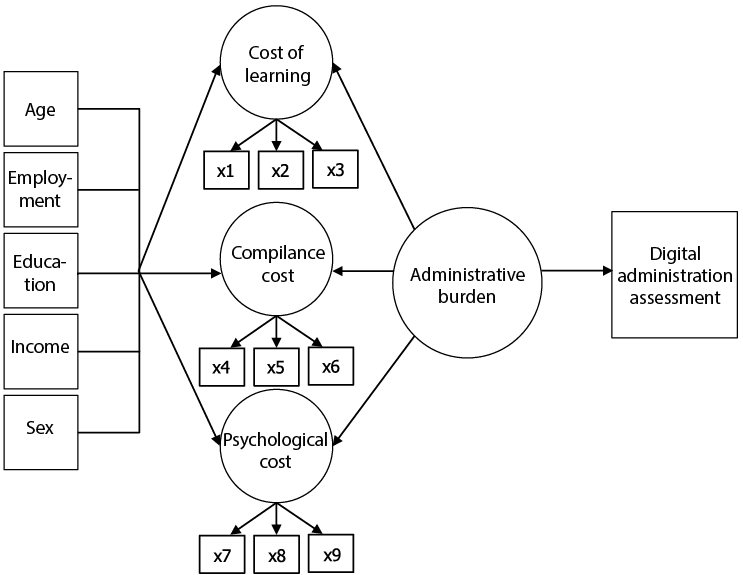
In this study, AFC and MES are used to analyze how the sociodemographic variables influence administrative burden. Administrative burden is defined as a second-order latent variable, consisting of three first-order latent dimensions: learning, compliance, and psychological costs. Then, we included an exogenous variable of general perception about digital administration, relating it to the administrative burden in order to examine the model’s theoretical and empirical coherence. Since we lack previously validated measures, this approach is especially useful. The structural equations test our theoretical construct, estimating measurement errors and the structure of the theoretical dimensions. This ensures a more reliable analysis than concepts built with averages of indicators.
In our MES model, we use the Weighted Least Squares Mean and Variance adjusted, ensuring a robust analysis for the ordinal and dichotomous variables, such as those obtained in the survey, minimizing bias and improving the validity of the conclusions (Brown, 2015; Kline, 2016). To evaluate the model’s fit, we use absolute indices such as the mean squared error of approximation (RMSEA) and the standardized residual mean square root (SRMR). In both indices, the closer the value is to 0, the better the model fit, with a value below 0.08 considered acceptable. In addition, incremental indices such as the comparative fit index (CFI) and the Tucker-Lewis index (TLI) are used. Here, values closer to 1 indicate a better fit of the model. Values above 0.90 are considered acceptable. Our analysis was performed in R (version 4.4.0), using the Lavaan package (version 0.6-18) (Jorgensen et al., 2022; Rosseel, 2012).
The administrative burden concept is evaluated using the CFA. An acceptable fit of the concept to the data is found, with the scalar goodness-of-fit indices supporting its validity: RMSEA 0.037, SRMR 0.035, CFI 0.97 and TLI 0.95. All of the loaded factors and latent variables are statistically significant (p < 0.01) and have acceptable explanatory power. These initial results demonstrate the validity of the data and the method for constructing the concept of administrative burden as the second order of the three cost dimensions, each measured by three specific indicators. These initial results also indicate that the costly experience with digital administration is mainly due to learning costs (β 0.86), followed by compliance costs (β 0.77) and finally, psychological costs (β 0.54).
The complete model of the relationship between sociodemographic variables and administrative burden, and subsequently, the general perception of e-government, is presented in Figure 1. The model typically converges after sixty-five iterations and with forty-eight degrees of freedom. It shows an acceptable fit with values of RMSEA (0.043), SRMR (0.065), CFI (0.90) and TLI (0.939). Table 2 shows the standardized coefficients of the load factors in relation to their latent variables, all of which are significant at a level of p < 0.01. In the full model, the administrative burden costs also display the highest factor loadings, followed by the learning cost, compliance cost, and finally, the psychological cost. These findings are consistent with existing literature, which highlights the importance of learning costs in digital interactions, especially for the most vulnerable populations.
Table 3 shows the regression results of sociodemographic variables on the costs of the administrative burden. We observe that age, income, and education have a significant effect on the learning, compliance, and psychological costs. This implies that older people, those with lower incomes, and those with lower levels of education are more likely to have a burdensome experience with electronic administration. Employment status is not significantly associated with administrative burden. Sex displays a mixed pattern: men are more likely to experience psychological costs but are less likely to experience learning costs.
Furthermore, the results show that age is the largest factor influencing the cost of learning, followed by income and, finally, education. This may indicate that in digital skills and understanding, formal studies are not as important as everyday life and a native connection with these media. This same situation is evident in the psychological costs, which indicate that older people, followed by those with lower incomes, are the most cautious regarding what happens in the “black box” of digital administration. They are also the ones placing the greatest importance on human attention, which may be a source of emotional distress. They are also the ones who view digital administration as a limitation on citizen participation.
Regarding compliance costs, the impact of sociodemographic variables is minor, and there are no significant differences between them. This may be because the additional effort and time required for digital interactions, as well as inherent system difficulties such as browser or application problems, affect all users similarly. In other words, the new workloads faced by citizens due to the digitization of procedures, with specific information architecture, may generate a larger compliance burden, but one that is more homogeneous across the population than in-person procedures.
Finally, Table 3 reveals that the administrative burden affects perceptions of digital administration. Those experiencing a greater administrative burden in their digital interactions with government agencies conclude that digital administration has more disadvantages than benefits.
Citizens’ experiences with government administrations are crucial to the effectiveness of public policies. Procedures and processes are not neutral, and they have diverse effects on citizens. Based on subjective experiences, the literature on administrative burden has analyzed how the costs associated with interactions with the government administrations affect citizens’ behavior toward public programs. This article has explored how digital administration influences different segments of the population, thereby contributing to the expansion of the literature on administrative burden in the context of digital interactions.
Learning, compliance, and psychological costs are fundamental elements of the theory. They permit focus attention on the experience of citizens, regardless of the functionality of the administration. Therefore, these studies open up the possibility of analyzing public policies and services from a perspective that extends beyond the legal or procedural justification of administrative actions. Furthermore, they contribute to understanding citizens’ behavior towards the administration not only from an instrumental rationality perspective but also considering biased decisions arising from various social situations and emotional states.
Despite significant progress made over the last decade, literature on administrative burden continues to need to delve deeper into the conceptual definition of the onerous experience it addresses. The costs shaping this experience must be defined more precisely to avoid overlaps both among themselves and with other concepts discussed in the literature on public administration. One potential redefinition of costs could focus on capturing citizens’ experiences in a more neutral way, instead of focusing solely on governmental actions. Furthermore, a clearer conceptual definition would permit better operationalization of the concepts, contributing to the literature and offering a stronger integration with other related theoretical approaches.
In Spain, the approach taken with respect to the problems generated by the administration from the perspective of the administrative burden has been limited to the analysis of the input of social programs. In a context of high digitization of public administration, the literature on administrative burden reveals its potential to understand citizens’ experiences in other situations in which there is an interaction with the administration. Therefore, this study has empirically analyzed the digitization of public administration from the perspective of administrative burden. This represents a significant contribution to the literature in this area.
The results indicate that learning costs are the most significant factor in the burdensome experience of digital administration, followed by compliance costs and, finally, psychological costs. These findings are consistent with those of considerable literature on digital administration, which suggests that, although some dimensions of costs may vary, the learning cost is the most decisive. Furthermore, this study has revealed that the most relevant sociodemographic variables related to the costs experienced are age and income. This highlights the idea that familiarity and daily use of digital media have a greater impact than formal education. Another significant finding is that sociodemographic variables have a limited impact on the compliance cost. This may suggest that the new tasks faced by citizens, and the problems related to administrative services, do not vary significantly between different sociodemographic segments, since they all share a similar resource base to perform the procedures.
This study has significant limitations in its empirical approach, especially with respect to the psychological cost. Because a survey administered by a government agency is used, it fails to accurately capture the experiences being analyzed. The strategy followed is an indirect analysis, similar to that used in much of the literature on administrative burden, which suggests that certain characteristics of administration give rise to specific types of experiences for citizens. Future research should focus on directly capturing the costs experienced by citizens, which would permit a more detailed and accurate analysis of the relationship between citizens and digital administration.
Ali, Sameen and Altaf, Waleed (2021). “Citizen Trust, Administrative Capacity and Administrative Burden in Pakistan’s Immunization Program”. Journal of Behavioral Public Administration, 4(1).
Baekgaard, Martin; Mikkelsen, Kim Sass; Madsen, Jonas Krogh and Christensen, Julian (2021). “Reducing Compliance Demands in Government Benefit Programs Improves the Psychological Well-Being of Target Group Members”. Journal of Public Administration Research and Theory, 31(4): 806-821.
Baekgaard, Martin; Moynihan, Donald P. and Thomsen, Mette Kjærgaard (2021). “Why Do Policymakers Support Administrative Burdens? The Roles of Deservingness, Political Ideology, and Personal Experience”. Journal of Public Administration Research and Theory, 31(1): 184-200.
Baekgaard, Martin and Tankink, Tara (2022). “Administrative Burden: Untangling a Bowl of Conceptual Spaghetti”. Perspectives on Public Management and Governance, 5(1): 16-21.
Baekgaard, Martin and Madsen, Jonas Krogh (2024). “Anticipated Administrative Burdens: How Proximity to Upcoming Compulsory Meetings Affect Welfare Recipients’ Experiences of Administrative Burden”. Public Administration, 102(2): 425-443.
Barnes, Carolyn Y. (2021). “‘It Takes a While to Get Used to’: The Costs of Redeeming Public Benefits”. Journal of Public Administration Research and Theory, 31(2): 295-310.
Bell, Elizabeth; Ter-Mkrtchyan, Ani; Wehde, Wesley and Smith, Kylie (2021). “Just or Unjust? How Ideological Beliefs Shape Street-Level Bureaucrats’ Perceptions of Administrative Burden”. Public Administration Review, 81(4): 610-624.
Bell, Elizabeth; Christensen, Julian; Herd, Pamela and Moynihan, Donald (2023). “Health in Citizen-state Interactions: How Physical and Mental Health Problems Shape Experiences of Administrative Burden and Reduce Take-up”. Public Administration Review, 83(2): 385-400.
Bozeman, Barry (2000). Bureaucracy and Red Tape. Upper Saddle River, N.J.: Prentice Hall.
Bozeman, Barry and Feeney, Mary K. (2011). Rules and Red Tape: A Prism for Public Administration Theory and Research. London: Routledge. (1st edition). doi: 10.4324/9781315701059
Bozeman, Barry and Youtie, Jan (2020). “Robotic Bureaucracy: Administrative Burden and Red Tape in University Research”. Public Administration Review, 80(1): 157-162.
Brodkin, Evelyn Z. and Majmundar, Malay (2010). “Administrative Exclusion: Organizations and the Hidden Costs of Welfare Claiming”. Journal of Public Administration Research and Theory, 20(4): 827-848.
Brown, Timothy A. (2015). Confirmatory Factor Analysis for Applied Research. New York: The Guilford Press. (2nd ed.).
Burden, Barry C.; Canon, David T.; Mayer, Kenneth R. and Moynihan, Donald P. (2012). “The Effect of Administrative Burden on Bureaucratic Perception of Policies: Evidence from Election Administration”. Public Administration Review, 72(5): 741-751.
Campbell, Jesse W.; Pandey, Sanjay K. and Arnesen, Lars (2023). “The Ontology, Origin, and Impact of Divisive Public Sector Rules: A Meta-narrative Review of the Red Tape and Administrative Burden Literatures”. Public Administration Review, 83(2): 296-315.
Christensen, Julian; Aarøe, Lene; Baekgaard, Martin; Herd, Pamela and Moynihan, Donald P. (2020). “Human Capital and Administrative Burden: The Role of Cognitive Resources in Citizen-State Interactions”. Public Administration Review, 80(1): 127-136.
Chudnovsky, Mariana and Peeters, Rik (2021). “The Unequal Distribution of Administrative Burden: A Framework and an illustrative Case Study for Understanding Variation in People’s Experience of Burdens”. Social Policy and Administration, 55(4): 527-542.
Collie, Alex; Sheehan, Luke; McAllister, Ashley and Grant, Genevieve (2021). “The Learning, Compliance, and Psychological Costs of Applying for the Disability Support Pension”. Australian Journal of Public Administration, 80(4): 873-890.
Cook, Kay (2021). “Gender, Malice, Obligation and the State: Separated Mothers’ Experiences of Administrative Burdens with Australia’s Child Support Program”. Australian Journal of Public Administration, 80(4): 912-932.
Daigneault, Pierre-Marc (2024). “Reconceptualizing Administrative Burden Around Onerous Experiences”. Perspectives on Public Management and Governance, 7(4): 124-136.
Daigneault, Pierre-Marc and Macé, Christian (2020). “Program Awareness, Administrative Burden, and Non-Take-Up of Québec’s Supplement to the Work Premium”. International Journal of Public Administration, 43(6): 527-539.
Deshpande, Manasi and Li, Yue (2019). “Who Is Screened Out? Application Costs and the Targeting of Disability Programs”. American Economic Journal: Economic Policy, 11(4): 213-248.
Döring, Matthias (2021). “How-to Bureaucracy: A Concept of Citizens’ Administrative Literacy”. Administration and Society, 53(8): 1155-1177.
Döring, Matthias and Madsen, Jonas Krogh (2022). “Mitigating Psychological Costs–The Role of Citizens’ Administrative Literacy and Social Capital”. Public Administration Review, 82(4): 671-681.
European Commission (2023). DESI 2023 dashboard for the Digital Decade. Available at: https://digital-decade-desi.digital-strategy.ec.europa.eu/datasets/desi/charts, access May 9, 2024.
Ferraioli, Francisco (2025). “Exploring the Relationship of Administrative Burden with Doctors’ Motivation and Patients’ experience of Care: Evidence from Primary Healthcare in Catalonia”. International Review of Administrative Sciences, 91(2): 167-183.
Fox, Ashley M.; Stazyk, Edmund C. and Feng, Wenhui (2020). “Administrative Easing: Rule Reduction and Medicaid Enrollment”. Public Administration Review, 80(1): 104-117.
George, Bert; Pandey, Sanjay K.; Steijn, Bram; Decramer, Adelien and Audenaert, Mieke (2021). “Red Tape, Organizational Performance, and Employee Outcomes: Meta-analysis, Meta-regression, and Research Agenda”. Public Administration Review, 81(4): 638-651.
Giest, Sarah and Samuels, Annemarie (2023). “Administrative Burden in Digital Public Service Delivery: The Social Infrastructure of Library Programs for E-inclusion”. Review of Policy Research, 40(5): 626-645.
Halling, Aske and Baekgaard, Martin (2023). “Administrative Burden in Citizen–State Interactions: A Systematic Literature Review”. Journal of Public Administration Research and Theory, 34(2): 180-195.
Halling, Aske; Herd, Pamela and Moynihan, Donald (2023). “How Difficult Should It Be? Evidence of Burden Tolerance from a Nationally Representative Sample”. Public Management Review, 25(11): 2053-2072.
Hattke, Fabian; Hensel, David and Kalucza, Janne (2020). “Emotional Responses to Bureaucratic Red Tape”. Public Administration Review, 80(1): 53-63.
Heggertveit, Ida; Lindgren, Ida; Madsen, Christian Østergaard and Hofmann, Sara (2022). Administrative Burden in Digital Self-service: An Empirical Study About Citizens in Need of Financial Assistance. In: R. Krimmer; M. Rohde Johannessen; T. Lampoltshammer; I. Lindgren; P. Parycek; G. Schwabe and J. Ubacht (eds.). Electronic Participation (pp. 173-187). Cham: Springer Nature Switzerland.
Heinrich, Carolyn J. (2016). “The Bite of Administrative Burden: A Theoretical and Empirical Investigation”. Journal of Public Administration Research and Theory, 26(3): 403-420.
Heinrich, Carolyn (2018). “Presidential Address: ‘A Thousand Petty Fortresses’: Administrative Burden in U.S. Immigration Policies and Its Consequences”. Journal of Policy Analysis and Management, 37(2): 211-239.
Herd, Pamela; DeLeire, Thomas; Harvey, Hope and Moynihan, Donald P. (2013). “Shifting Administrative Burden to the State: The Case of Medicaid Take-Up”. Public Administration Review, 73(s1): S69-S81.
Herd, Pamela and Moynihan, Donald P. (2018). Administrative Burden. Russell Sage Foundation. Available at: http://www.jstor.org/stable/10.7758/9781610448789, access August 18, 2022.
Hock, Heinrich; Jones, John; Levere, Michael and Wittenburg, David (2021). “Using Behavioral Outreach to Counteract Administrative Burden and Encourage Take-up of Simplified Disability Payment Rules”. Journal of Behavioral Public Administration, 4(1).
Jenkins, Jade Marcus and Nguyen, Tutrang (2022). “Keeping Kids in Care: Reducing Administrative Burden in State Child Care Development Fund Policy”. Journal of Public Administration Research and Theory, 32(1): 23-40.
Jilke, Sebastian; Bækgaard, Martin; Herd, Pamela and Moynihan, Donald (2024). “Short and Sweet: Measuring Experiences of Administrative Burden”. Journal of Behavioral Public Administration, 7.
Johnson, Donavon and Kroll, Alexander (2020). “What Makes us Tolerant of Administrative Burden? Race, Representation, and Identity”. Journal of Behavioral Public Administration, 4(1).
Jorgensen, Terrence D.; Pornprasertmanit, Sunthud; Schoemann, Alexander M. and Rosseel, Yves (2022). “SemTools: Useful Tools for Structural Equation Modeling”. R package, version 0.5-6. Available at: https://CRAN.R-project.org/package=semTools, access March 3, 2025.
Kline, Rex B. (2016). Principles and Practice of Structural Equation Modeling. New York: The Guilford Press. (4th ed.).
Linos, Elizabeth; Quan, Lisa T. and Kirkman, Elspeth (2020). “Nudging Early Reduces Administrative Burden: Three Field Experiments to Improve Code Enforcement”. Journal of Policy Analysis and Management, 39(1): 243-265.
Linos, Elizabeth; Reddy, Vikash and Rothstein, Jesse (2022). “Demystifying College Costs: How Nudges can and Can’t Help”. Behavioural Public Policy, 8(3): 497-518.
Loon, Nina M.; Leisink, Peter L. M.; Knies, Eva and Brewer, Gene A. (2016). “Red Tape: Developing and Validating a New Job-Centered Measure”. Public Administration Review, 76(4): 662-673.
Lopoo, Leonard M.; Heflin, Colleen and Boskovski, Joseph (2020). “Testing Behavioral Interventions Designed to Improve on-time SNAP Recertification”. Journal of Behavioral Public Administration, 3(2).
Madsen, Christian Østergaard; Lindgren, Ida and Melin, Ulf (2022). “The Accidental Caseworker–How Digital Self-service Influences Citizens’ Administrative Burden”. Government Information Quarterly, 39(1): 101653.
Madsen, Jonas K.; Mikkelsen, Kim S. and Moynihan, Donald P. (2022). “Burdens, Sludge, Ordeals, Red tape, Oh My!: A User’s Guide to the Study of Frictions”. Public Administration, 100(2): 375-393.
Madsen, Jonas Krogh; Baekgaard, Martin and Kvist, Jon (2023). “Scarcity and the Mindsets of Social Welfare Recipients: Evidence from a Field Experiment”. Journal of Public Administration Research and Theory, 33(4): 675-687.
Masood, Ayesha and Nisar, Muhammad Azfar (2021). “Administrative Capital and Citizens’ Responses to Administrative Burden”. Journal of Public Administration Research and Theory, 31(1): 56-72.
Mikkelsen, Kim Sass; Madsen, Jonas Krogh and Baekgaard, Martin (2024). “Is Stress among Street-level Bureaucrats Associated with Experiences of Administrative Burden among Clients? A Multilevel Study of the Danish Unemployment Sector”. Public Administration Review, 84(2): 248-260.
Moynihan, Donald; Giannella, Eric; Herd, Pamela and Sutherland, Julie (2022). “Matching to Categories: Learning and Compliance Costs in Administrative Processes”. Journal of Public Administration Research and Theory, 32(4): 750-764.
Moynihan, Donald; Herd, Pamela and Harvey, Hope (2015). “Administrative Burden: Learning, Psychological, and Compliance Costs in Citizen-State Interactions”. Journal of Public Administration Research and Theory, 25(1): 43-69.
Moynihan, Donald P.; Herd, Pamela and Ribgy, Elizabeth (2016). “Policymaking by Other Means: Do States Use Administrative Barriers to Limit Access to Medicaid?”. Administration and Society, 48(4): 497-524.
Nisar, Muhammad A. (2018). “Children of a Lesser God: Administrative Burden and Social Equity in Citizen–State Interactions”. Journal of Public Administration Research and Theory, 28(1): 104-119.
Nisar, Muhammad A. and Masood, Ayesha (2022). “Are all Burdens Bad? Disentangling Illegitimate Administrative Burdens through Public Value Accounting”. Asia Pacific Journal of Public Administration, 45(4): 385-403.
Olsen, Asmus Leth; Kyhse-Andersen, Jonas Høgh and Moynihan, Donald (2022). “The Unequal Distribution of Opportunity: A National Audit Study of Bureaucratic Discrimination in Primary School Access”. American Journal of Political Science, 66(3): 587-603.
Peeters, Rik (2020). “The Political Economy of Administrative Burdens: A Theoretical Framework for Analyzing the Organizational Origins of Administrative Burdens”. Administration and Society, 52(4): 566-592.
Peeters, Rik (2023). “Digital Administrative Burdens: An Agenda for Analyzing the Citizen Experience of Digital Bureaucratic Encounters”. Perspectives on Public Management and Governance, 6(1): 7-13.
Peeters, Rik and Widlak, Arjan (2018). “The Digital Cage: Administrative Exclusion Through Information Architecture – The Case of the Dutch Civil Registry’s Master Data Management System”. Agile Government and Adaptive Governance in the Public Sector, 35(2): 175-183.
Rosseel, Yves (2012). “lavaan: An R Package for Structural Equation Modeling”. Journal of Statistical Software, 48(2): 1-36.
Stanica, Cristina M.; Balica, Dan; Henderson, Alexander C. and Ţiclău, Tudor C. (2022). “The Weight of Service Delivery: Administrative and Rules Burdens in Street-level Bureaucracy”. International Review of Administrative Sciences, 88(1): 240-257.
Thomsen, Mette Kjærgaard; Baekgaard, Martin and Jensen, Ulrich Thy (2020). “The Psychological Costs of Citizen Coproduction”. Journal of Public Administration Research and Theory, 30(4): 656-673.
Widlak, Arjan and Peeters, Rik (2020). “Administrative Errors and the Burden of Correction and Consequence: How Information Technology Exacerbates the Consequences of Bureaucratic Mistakes for Citizens”. International Journal of Electronic Governance, 12(1): 40-56.
Yates, Sophie; Carey, Gemma; Hargrave, Jen; Malbon, Eleanor and Green, Celia (2021). “Women’s Experiences of Accessing Individualized Disability Supports: Gender Inequality and Australia’s National Disability Insurance Scheme”. International Journal for Equity in Health, 20(1): 243.
Figure 1. MES of sociodemographic variables over administrative burden and digital administration assessment
Source: By author.
Table 2. Standardized factor loadings
|
Latent factor |
Indicator |
Load |
95 % IC |
sig |
p-value |
|
Administrative burden |
Compliance |
0.754 |
0.707 – 0.801 |
*** |
0.000 |
|
Administrative burden |
Learning |
0.797 |
0.754 – 0.840 |
*** |
0.000 |
|
Administrative burden |
Psychological |
0.572 |
0.535 – 0.609 |
*** |
0.000 |
|
Learning |
x1 |
0.831 |
0.799 – 0.862 |
*** |
0.000 |
|
Learning |
x2 |
0.589 |
0.553 – 0.625 |
*** |
0.000 |
|
Learning |
x3 |
0.617 |
0.585 – 0.649 |
*** |
0.000 |
|
Compliance |
x4 |
0.420 |
0.381 – 0.460 |
*** |
0.000 |
|
Compliance |
x5 |
0.742 |
0.701 – 0.783 |
*** |
0.000 |
|
Compliance |
x6 |
0.576 |
0.539 – 0.613 |
*** |
0.000 |
|
Psychological |
x7 |
0.525 |
0.499 – 0.550 |
*** |
0.000 |
|
Psychological |
x8 |
0.718 |
0.696 – 0.741 |
*** |
0.000 |
|
Psychological |
x9 |
0.691 |
0.668 – 0.713 |
*** |
0.000 |
Note: Learning, compliance and psychological refer to costs. DA refers to the digital administration.
Source: Own elaboration based on the CIS survey.
Table 3. Regression parameters of the structural model
|
Predictor |
Dependent variable |
β |
95 % CI |
Sig |
p-value |
|
Age |
Learning |
0.109 |
0.071 – 0.148 |
*** |
<0.001 |
|
Employment |
Learning |
0.016 |
−0.021 – 0.053 |
|
0.388 |
|
Education |
Learning |
0.041 |
0.008 – 0.074 |
* |
0.016 |
|
Income |
Learning |
0.094 |
0.060 – 0.128 |
*** |
<0.001 |
|
Sex |
Learning |
−0.034 |
−0.067 – −0.002 |
* |
0.036 |
|
Age |
Compliance |
0.046 |
0.002 – 0.090 |
* |
0.040 |
|
Employment |
Compliance |
0.019 |
−0.022 – 0.060 |
|
0.361 |
|
Education |
Compliance |
0.047 |
0.010 – 0.083 |
* |
0.013 |
|
Income |
Compliance |
0.038 |
0.000 – 0.076 |
* |
0.048 |
|
Sex |
Compliance |
0.016 |
−0.020 – 0.051 |
|
0.395 |
|
Age |
Psychological |
0.106 |
0.069 – 0.142 |
*** |
<0.001 |
|
Employment |
Psychological |
−0.012 |
−0.046 – 0.022 |
|
0.493 |
|
Education |
Psychological |
0.033 |
0.003 – 0.062 |
* |
0.029 |
|
Income |
Psychological |
0.083 |
0.052 – 0.114 |
*** |
<0.001 |
|
Sex |
Psychological |
0.119 |
0.090 – 0.149 |
*** |
<0.001 |
|
Administrative burden |
DA Assessment |
0.479 |
0.432 – 0.527 |
*** |
0.000 |
Note: Learning, compliance, and psychological refer to costs. DA refers to digital administration.
Source: Own elaboration based on the CIS survey.
RECEPTION: June 17, 2024
REVIEW: January 16, 2025
ACCEPTANCE: June 16, 2025