Media Diet and Affective Polarization
in a Polarized Pluralist Media System:
A Longitudinal Study of Spain
Dieta mediática y polarización afectiva en un sistema mediático pluralista polarizado: un estudio longitudinal de España
Rubén Cuéllar-Rivero
|
Key words Information Consumption
|
Abstract This study examines the effects of three dimensions of media diet (quantity, frequency and partisan diversity) on affective polarization in the Spanish general elections held between 1993 and 2023. Using post-election survey data from CNEP project and employing a multivariate linear regression model, the results show that, over the past thirty years, a high frequency of television consumption or an ideologically homogeneous media diet has increased affective polarization at the individual level in certain electoral contexts. These findings help clarify the role of the dimensions of media diet on affective polarization in Spain, analyzed from the theoretical framework of the limited effects of the media. |
|
Palabras clave Consumo informativo
|
Resumen Este estudio tiene por objetivo analizar los efectos de la dieta mediática en sus tres dimensiones (cantidad, frecuencia y diversidad ideológica) sobre la polarización afectiva en elecciones generales españolas entre 1993 y 2023. Utilizando datos de encuestas poselectorales del proyecto CNEP y empleando modelos de regresión lineal multivariante, los resultados muestran que una alta frecuencia de consumo de televisión o una dieta mediática homogénea ideológicamente incrementan la polarización afectiva a nivel individual en determinados contextos electorales de los últimos treinta años. Los hallazgos contribuyen a esclarecer el rol de las dimensiones de la dieta mediática en la polarización afectiva en España, interpretados desde el marco de la teoría de los efectos limitados de los medios de comunicación. |
Citation
Cuéllar-Rivero, Rubén (2026). “Media Diet and Affective Polarization in a Polarized, Pluralist Media System: A Longitudinal Study of Spain”. Revista Española de Investigaciones Sociológicas, 194: 25-44. (doi: 10.5477/cis/reis.194.25-44)
Rubén Cuéllar-Rivero: Universidad de Salamanca | rubencuri@usal.es
Introduction1
Contemporary political communication dynamics is one of the main lines of research on the causes of affective polarization in contemporary democracies (Iyengar et al., 2019; Kubin and Sikorski, 2021). Media ecologies have gone from a few information options to offerings of multiple choices and disconnection (Hmielowski, Beam and Hutchens, 2016; Prior, 2013), increasingly negative election campaigns (Iyengar, Sood and Lelkes, 2012), the political delegitimization of adversaries and institutions in contexts of adequate democratic functioning (Bosco and Verney, 2020; Rojo-Martínez and Crespo-Martínez, 2023), a greater capacity for information selection on the social networks and the proliferation of small media outlets that are geared towards ideological niches, and their effects (Arceneaux, Johnson and Murphy, 2012; Stroud, 2010). These are some of the avenues explored in previous literature, especially focused on the American case (Cuéllar-Rivero, 2024; Kubin and Sikorski, 2021).
In Spain, a combination of several of these factors exists: a developed media ecology with more information options than thirty years ago (Díaz-Nosty, 2017), a media system characterized by the traditional alignment of some of the country’s leading newspapers with ideological and partisan trends in the political arena (Hallin and Mancini, 2004) and, according to recent studies, the status as one of the most emotionally polarized democracies (Reiljan, 2020). Spain is an ideal case study to test some of the hypotheses formulated in other political and media systems, by delving deeper into the effects of audience information consumption on affective polarization.
This study aims to determine the effects of the dimensions of media diet of Spaniards which contribute to increasing or reducing levels of affective polarization. Selective exposure is a commonly used mechanism to explain the effect of information consumption on affective polarization (Cuéllar-Rivero, 2024; Kubin and Sikorski, 2021). However, given the high capacity for choice and evasion of political information in contemporary media ecologies, the effects of selective exposure can be mitigated by balanced or counter-attitudinal consumption. This highlights the need to investigate the use of media diets as opposed to a single medium (Dubois and Blank, 2018).
This study focuses on audiences, and it examines national post-election survey data provided by the Comparative National Electoral Project. It is a longitudinal study of changes in media consumption over a thirty-year period (1993-2023), examining the effects of these changes on distinct political-electoral contexts existing in Spain. The results reveal a complex panorama of effects, whereby the frequency of television consumption or the ideological homogeneity of the media diet emerge as explanatory factors of the increase in affective polarization in certain electoral contexts. The findings are interpreted based on the framework of the theory of limited or conditional effects of the media. This situates information consumption and its configuration through media diet in a contributing role with respect to climates of affective polarization in certain Spanish electoral contexts.
Affective polarization and its expression in Spain
Affective polarization is defined as the difference between adherence or favorability towards certain social groups or political actors perceived as being similar or their own (in-group) and the rejection or hostility towards those that are perceived as opposites or adversaries (out-group) (Druckman and Levendusky, 2019; Iyengar and Westwood, 2015). The proposal is based on theories of social identity in competitive contexts (Tajfel and Turner, 1979). It suggests that mere identification with or closeness to certain social and political actors or groups implies rejection of their opposites (Iyengar, Sood and Lelkes, 2012). This type of polarization is not necessarily related to ideological differences based on political positions (Iyengar, Sood and Lelkes, 2012; Reiljan, 2020); however, it may possibly be related to ideology in terms of political identity (Comellas and Torcal, 2023). This political or social identity must be prominent and, depending on the context, it may relate to partisan (Druckman and Levendusky, 2019), ideological (Comellas and Torcal, 2023), ethnic or national (Arabaghatta et al., 2021; Balcells and Kuo, 2023) identities.
The causes of affective polarization remain a subject of debate, but the literature accumulated over recent years may be summarized in three main lines of research. First, there is the theoretical corpus related to the strengthening of identities and the two-block division of society and politics (Iyengar et al., 2019; Mason, 2018; Torcal, 2023). Second, there is the often symbiotic relationship between affective polarization and ideological extremism. And third, there are the trends in the forms and content of contemporary political communication, especially with respect to strategies, the aggressive and uncivil tone of electoral campaigns and the effects of the dynamics of information consumption by audiences (Iyengar et al., 2019; Prior, 2013).
Polarization is not a new phenomenon in Spanish history. It is not characterized so much by ideological differences in terms of public policy (Miller, 2020) as by the growing differences between affections and disaffections based on ideological and national identities (Balcells and Kuo, 2023; Comellas and Torcal, 2023; Lagares, Máiz and Rivera, 2022). Of the democracies analyzed with respect to affective polarization, Spain tends to be situated in the high or upper-middle ranks (Gidron, Adams and Horne, 2019; Reiljan, 2020) or in an intermediate position (Wagner, 2021). It has been suggested that the origin of affective polarization in Spain lies in the increasing incivility in political commentary, animosity towards the adversary and discursive aggressiveness of the elites. It may also result from the increasing frequency of the democratic delegitimization of the political adversary (Bosco and Verney, 2020). This existed long before the emergence of the radical populist challenger parties over the past decade (Torcal and Comellas, 2022).
In the most recent studies, affective polarization in Spain appears to be influenced by the symbolic-identity dimension of the left-right political axis (Comellas and Torcal, 2023) and along the center-periphery axis with respect to national identities (Balcells and Kuo, 2023; Orriols and León, 2020). This polarization is especially directed towards political leaders (Orriols and León, 2020; Torcal and Comellas, 2022) from the adherence side. However, in electoral contexts, it has been suggested that the mobilizing factor is more explained by the rejection of the leader of the out-group than by an affinity with the specific leader (Serani, 2022). Electoral processes and political campaigns serve as moments of mobilization and increased aggressiveness in partisan rhetoric, making them influential factors in affective polarization (Rodríguez, Santamaría and Miller, 2022).
Over the last decade, the political conflict stemming from the Catalan independence process has been sufficient to increase affinity and rejection in two affectively opposite poles, based on the alignment between the position for or against independence, feelings towards political leaders and the preeminent national identity (Balcells and Kuo, 2023; Lagares, Máiz and Rivera, 2022). This has fostered a consumption of political information guided by these political and emotional divisions (Valera-Ordaz, 2023a).
Information consumption and affective polarization of audiences
One of the most common concerns regarding political polarization stems from the effects of information consumption in media ecologies with high choice capacity (Aelst et al., 2017; Iyengar et al., 2019; Kubin and Sikorski, 2021; Prior, 2007). In other words, informative environments where the repertoire of platforms, formats, and partisan and ideological orientations to which individuals can access have multiplied. This is a fact that increases the availability of content, the fragmentation of audiences, and, consequently, a potentially polarizing consumption (Arceneaux, Johnson and Murphy, 2012; Stroud, 2011).
This concern is contemporaneous with the empirical evidence that has revitalized selective exposure theory (Iyengar and Hahn, 2009; Mutz, 2006; Stroud, 2008), defined as the tendency of audiences to select information sources that are in accordance with their predispositions, beliefs, attitudes, and prior political orientations (Lazarsfeld, Berelson and Gaudet, 1948; Sears and Freedman, 1967). Regarding affective polarization, selective exposure to partisan media is the mechanism most frequently cited as a cause (Cuéllar-Rivero, 2024). This argument is based on the idea that social and political identity directs selective information consumption towards pro-attitude partisan sources and that this reinforces previous attitudes and identities (Dvir-Gvirsman, 2017, 2019). Therefore, selective exposure to partisan media may lead to increased adherence to one’s own group or group leaders and rejection of groups or group leaders who are perceived as outsiders (Hyun and Moon, 2016; Kelly et al., 2014; Tsfati and Nir, 2017).
In addition to media ecologies with high choice capacity, media systems that can historically be categorized as polarized pluralists (as in the Spanish system) offer another theoretical and empirical path towards the affective polarization of audiences. This is due to the traditional propensity of mass media – and now, digital and social media – to align themselves with the partisan trends of the political arena (Brüggemann et al., 2014; Fletcher, Cornia and Nielsen, 2020; Hallin and Mancini, 2004). Studies on selective exposure in Spain describe a media landscape of audiences that have been distributed according to their ideological and partisan preferences in a stable manner since at least the 1990s (Díez-Nicolás and Semetko, 1993; Gunther, Montero and Wert, 2000; Fraile and Meilán, 2012; Humanes, 2014; Humanes and Mellado, 2017; Ramírez-Dueñas and Vinuesa-Tejero, 2021; Valera-Ordaz and Humanes, 2022; Humanes and Valera-Ordaz, 2022; Ramírez-Dueñas and Humanes, 2023). This has been compounded by selective consumption based on national identity (Martínez, 2020; Valera-Ordaz, 2024) in a country whose peripheral nationalities form an active part of its political heritage.
There is both international and national empirical support for the trend of audiences towards selective exposure (Aelst et al., 2017; Bennett and Pfetsch, 2018; Valera-Ordaz, 2023b). However, the evidence on its effect on affective polarization has been mixed or even inconclusive (Aelst et al., 2017; Iyengar et al., 2019). First, prior literature has indicated that the effects of selective exposure on affective polarization may be small. (Kelly et al., 2014; Padró-Solanet and Balcells, 2022) or null (Wojcieszak et al., 2021, 2022). Secondly, a vast majority of studies, especially those concerning the United States, focus on partisan media or a specific social network (Aelst et al., 2017; Dubois and Blank, 2018). Therefore, they offer a partial view of the actual information consumption. Third, the effects of deliberate or accidental transversal and counter-attitudinal consumption may be depolarizing (Beam, Hutchens and Hmielowski, 2018; Kelly et al., 2014; Nordbrandt, 2022). All of this suggests less need for alarm regarding the effects of selective exposure on polarization in contexts of high choice capacity and balanced consumption in ideological and partisan terms (Aelst et al., 2017).
In fact, it is most likely that individuals combine a certain tendency to select news sources that align with their prior ideological and partisan preferences with the consumption of contrasting news sources, thus offsetting their effects (Valera-Ordaz, 2023b). In a media ecology such as the contemporary one, this invites further investigation into media diet (Dubois and Blank, 2018; Padró-Solanet and Balcells, 2022) or political information repositories (Wolfsfeld, Yarchi and Samuel-Azran, 2016).
Media diet and affective polarization: objective and research hypothesis
In media ecologies with high choice capacity, individuals tend to select a subset of media outlets as information sources that they regularly use to stay informed about politics. This may be referred to as the media diet (Dubois and Blank, 2018; Heeter, 1985; Padró-Solanet and Balcells, 2022; Wolfsfeld, Yarchi and Samuel-Azran, 2016). The media diets of individuals differ depending on the number of media outlets consumed, their diversity, their frequency of use, and how they are combined (Dubois and Blank, 2018; Wolfsfeld, Yarchi and Samuel-Azran, 2016). Therefore, it may be expected that their effects on attitudes, orientations and feelings of individuals towards political actors may also vary.
The aim of this study is to determine the effects of the dimensions of the media diet of Spaniards that contribute to increasing or reducing levels of affective polarization. This research work focuses on three dimensions, in accordance with the proposed definition of media diet: the amount of media consumed, the frequency of its use, and the degree of ideological or partisan diversity of those media (Padró-Solanet and Balcells, 2022; Ramírez-Dueñas and Humanes, 2023).
A media diet with a greater quantity of media increases the probability of finding transversal and contradictory media (Dubois and Blank, 2018). Therefore, it is expected that a greater number of media outlets could lead to less affective polarization. On the other hand, a “poor” media diet will have a more polarizing effect (Padró-Solanet and Balcells, 2022: 3). Based on this framework, the following hypothesis has been proposed:
H1. Quantity hypothesis: A media diet with a greater number of media outlets reduces affective polarization at the individual level.
In ideological and partisan terms, a homogeneous media diet is characterized by a greater predominance of the selection of news sources that coincide with prior political preferences. This will eventually increase adherence to the members of the in-group and a rejection of members of the out-group. Therefore, it will increase the affective polarization. Along these lines, a heterogeneous media diet is characterized by a lower predominance of selective consumption combined with the choice of transversal and counter-attitudinal information sources. For this reason, an effect that is opposite to that proposed for ideologically more homogeneous intakes is anticipated and consequently, affective polarization will decrease. Based on this framework, the following hypothesis is formulated.
H2. Diversity hypothesis: In partisan terms, a homogeneous media diet will increase affective polarization at an individual level.
The frequency with which political information is consumed is yet another part of the composition of the media diet (Dubois and Blank, 2018). Previous literature suggests a positive relationship between intensive consumption of political information and affective polarization. Individuals who intensely seek information are more likely to find sensationalist and polarizing information or information that seeks to their prior beliefs and attitudes (Crespo-Martínez et al., 2024). In this way, cognitive dissonance and unrest are avoided (Festinger, 1957). From this, the following hypothesis is derived:
H3. Frequency hypothesis: a media diet with a higher frequency of media consumption to stay informed about politics will be positively related to greater affective polarization at an individual level.
This study focuses on a case study of Spain, given the convergence of at least three characteristics of interest: firstly, its media system is categorized as polarized pluralism, characterized by a significant number of media outlets with extensive audiences that align with partisan trends in the political arena (González, Rodríguez and Castromil, 2010; Hallin and Mancini, 2004); second, it expresses an evolution from a media ecology with limited choice towards an ecology with greater choice and audience fragmentation (Díaz-Nosty, 2017); and finally, it is one of the most affectively polarized western democracies (Gidron, Adams and Horne, 2019; Reiljan, 2020). This is a longitudinal study for which various multivariate linear regression models have been applied as a quantitative research technique.
The data used in this work comes from the Comparative National Electoral Project (CNEP) of post-election surveys conducted on the days following the general elections of 1993, 2004, 2011, 2015 and 2023 in Spain. The technical characteristics of the same are shown in Table 1. As one might suspect, not all general (legislative) elections that have taken place during these thirty years are subject to study, since the project has only conducted fieldwork in the indicated electoral events. Furthermore, in the case of 2015, the data can only be used for descriptive purposes since the questions relating to the dependent variable are in the pre-election questionnaire, while those relating to the independent variable are in the post-election questionnaire. This disconnect makes it impossible to establish a causal relationship between both variables for that year.
The independent variables are obtained from questions regarding the frequency of media use and questions asking about which newspapers, television channels and radio stations are preferentially used to stay informed about politics during the election campaign. Regarding the first ones, these are ordinal variables measured as a five-position Likert scale. They ask about the frequency with which the respondents had consumed press, radio and television during the last election campaign, with 0 meaning “Never or almost never” and 5 meaning “Every day or almost every day”. As for the second, nominal information is obtained on the consumption of a specific medium. This information will later be used to classify them ideologically, and to obtain indicators of quantity and diversity.
Regarding the dependent variable, this study relies on the sentiment thermometer regarding political leaders of state-level parties to construct an indicator of affective polarization at an individual level. The sentiment thermometer is a scale that usually ranges from 0 to 10, with the value 0 implying the greatest rejection or “cold” feelings while 10 refers to the greatest adhesion or “warm” feelings.
As control variables, in addition to the usual sociodemographic ones such as sex, age and educational level, this study also considers interest in politics (Dahlgren, 2022; Skovsgaard, Shehata and Strömbäck, 2016; Warner, 2018), interest in the election campaign (Rodríguez, Santamaría and Miller, 2022), ideological self-placement on the left-right spectrum and proximity to political parties (Dvir-Gvirsman, 2017; Padró-Solanet and Balcells, 2022; Ramírez-Dueñas and Humanes, 2023).
To determine the political leanings of the media based on audience analysis, past literature has used various measurements, such as ideological self-placement (Castro-Herrero, Hopmann and Engesser, 2016; Fletcher, Cornia and Nielsen, 2020), the partisan perception of the media (Dilliplane, 2011), closeness to political parties (Humanes, 2014) or memory of the vote (Castro, 2021; Humanes and Valera-Ordaz, 2022).
This study uses as a parsimonious measure of political tendency the average ideological self-placement (scale 0-10, left-right, respectively) of the audiences of each media outlet of a national scope or those whose frequency (N) is greater than thirty cases. Despite their contribution to the national media ecology, local and provincial media are excluded from the analysis due to their nature, geographical concentration, and extremely low frequency in the sample.
After an initial look at the political leanings of the media, in accordance with the proposal made by Ramírez-Dueñas and Humanes (2023), they are classified into three types: progressive, if the average ideological self-placement of their audiences is between 0 and 4.5; transversal, if it is between 4.51 and 5.49; and conservative, if the average is between 5.50 and 10.
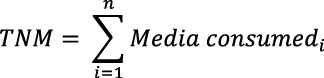
From the concept of media diet, this study operationalizes and analyzes the effects of three of its dimensions: quantity, diversity and frequency of use. To verify the quantity hypothesis (H1), the total number of media consumed is calculated (TNM) (Dubois and Blank, 2018; Padró-Solanet and Balcells, 2022) during the election campaign. The following formula is proposed for its calculation:
To verify the diversity hypothesis (H2), based on the classification of partisan tendency, three variables are created: one, to measure the accumulation of consumption of conservative media; another, to measure the accumulation of consumption of progressive media; and finally, to measure the overall degree of diversity in the media diet. The two indicators of partisan leanings in news consumption will form a scale and one point will be added every time the media consumed is considered progressive or conservative, according to the indicator at hand. Zero points will be added if the media is considered cross-cutting, in accordance with Stroud’s proposal (2010).
As an intermediate step between the construction of the indicators of accumulation of progressive or conservative media and that of the diversity indicator, the media diet indicator at the individual level is created. It is the result of subtracting the number of accumulated conservative media outlets from the number of accumulated progressive media outlets (Bogado et al., 2024), and will give rise to an indicator that ranges between negative or positive values. Subsequently, this media diet indicator is positively factored to create the media diet partisan diversity indicator (Ramírez-Dueñas and Humanes, 2023). A value of 0 indicates that a media diet with a heterogeneous tendency will have higher values, while high values on this same scale will indicate a greater degree of partisan homogeneity.
To verify the frequency hypothesis (H3), the frequency of media use is operationalized through the general frequency of media use variables (press, radio and television, whether in their traditional or digital version). This gives rise to three independent variables on a scale where the value 0 implies non-existent or almost non-existent consumption and high values imply a higher frequency of consumption.
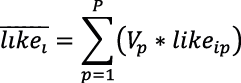
As an indicator of affective polarization at an individual level, this study relies on the weighted affective polarization index developed by Wagner (2021). It allows us to see the effects of the dimensions of individual media diets on the affective polarization of each individual, weighted by the electoral weight of each political force. The formula proposed by Wagner for its calculation is:

Here, p is the party, i refers to the surveyed individual and likeip indicates the score of liking-disliking assigned to each match p by individual i. Vp is the percentage of votes of each party, measured as a proportion with a range from 0 to 1. Furthermore, is weighted using the following formula:
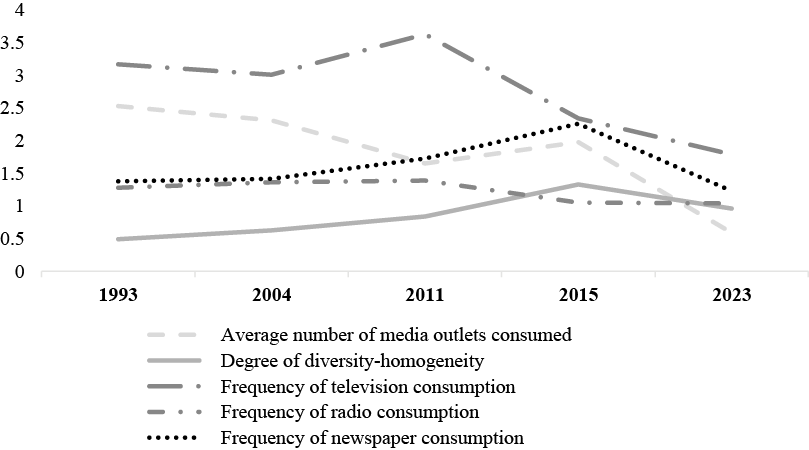
Graph 1 shows the evolution of the average of the explanatory independent variables in this study. These include the average number of media consumed, the frequency of consumption of television, radio and press, and the degree of diversity-homogeneity of the media diet during the election campaign. The average number of media consumed ranged from 2.53 in 1993 to 0.6 in 2023. Its greatest decline occurred between 2015 and 2023. This decline may be due to a progressive reduction in the use of traditional media in favor of social media, and due to certain contextual factors that were not analyzed. Continuing with consumption frequencies, the graph shows a sustained predominance of television consumption over press and radio, in line with the historical trend of our media system (Gunther, Montero and Wert, 2000; Hallin and Mancini, 2004). While it is true that press consumption increased from 2004 to 2015, this was most likely influenced by the emergence of new newspapers in digital format. Finally, the diversity of the media diets has reduced upon increasing their ideological homogeneity between 1993 (0.49) and 2023 (0.96). It reached its peak value in 2015 with a value of 1.33. This trend suggests a shift towards the consumption of media that reinforces individuals’ ideological and partisan predispositions. However, this study does not attempt to determine whether these changes are a consequence of alterations in audience behavior or modifications in the media offering.
Regarding the causal analysis, Table 2 presents four multivariate linear regression models that represent the effects of the three dimensions of the media diet analyzed and of the control variables on affective polarization at the individual level in each of the years analyzed. Unfortunately, the 2023 model is being undertaken without the use of interest in the election campaign, given its absence in the Spanish questionnaire. It should be noted that multicollinearity assessments were performed on each of the regression models, considering the tolerance indices and variance inflation factors (VIF). Overall, tolerance values were between 0.341 and 0.988, and the VIF ranged between 1.012 and 2.935. Therefore, they were situated between acceptable thresholds, ruling out significant multicollinearity problems.
The quantity hypothesis (H1) is rejected in all of the presented models, and, except in 2004, the direction of the estimation of the results on affective polarization is contrary to the hypothesized. Although the results do not allow us to accept the formulated hypothesis, the slight positive trend revealed by the beta coefficients may be interpreted in light of the findings of Padró-Solanet and Balcells (2022). According to these findings, the mere cumulative use of media, regardless of the time of attention devoted to each, may exacerbate affective polarization.
The diversity hypothesis (H2) is only accepted in the 2004 model, suggesting that a greater partisan and ideological homogeneity of the media diet would explain some of the affective polarization in that electoral context. In 2023, although the standardized beta coefficient of the diversity of the media diet has a positive direction and an intensity in line with the expected, it does not reach a sufficient level of statistical significance for its hypothesis to be accepted. However, this result points in the same direction as the findings of Melero López, Quiles Bailén and López Palazón (2024), who analyzed the data obtained during the same elections and used a larger sample size than that used in this study. In their case, they find the same direction and a similar effect size, which, in that study, is statistically significant.
The results from 2011 are striking, not only in that they are contrary to the hypothesis, but also because they are unexpected. A closer examination of the issue revealed a minimal and non-significant positive association between cumulative consumption of conservative media and affective polarization, but a highly significant negative relationship between cumulative consumption of progressive media and this polarization. This result may be attributed to the political and social context during the early years of the Great Recession, as these were elections called due to the exhaustion of the socialist party’s (PSOE) government in the face of the onslaught of the consequences of the crisis (Martín and Urquizu-Sancho, 2014; Torcal, 2015). Therefore, only in this way could one expect that the homogeneity of the media diet is negatively related to affective polarization, since it is explained by a reduction of affection, and even rejection with respect to the left-wing candidates.
The frequency hypothesis (H3) is partially confirmed in the years 1993 and 2011 for those who intensely watched television to be informed during the campaign. Furthermore, intensive newspaper consumers in 1993 and 2011 show a decrease in affective polarization at an individual level. The positive effect for those consuming television to stay informed about politics would be expected amongst the intensive newspaper consumers, given the historical tendency of major newspapers to adopt a much clearer political stance than major television channels. These results may be due to the concurrence of two factors: on the one hand, there is a historical tendency amongst Spaniards to watch television more intensely than to read the newspaper (Gunther, Montero and Wert, 2000; Hallin and Mancini, 2004). On the other hand, television formats are more likely to present politics with a greater degree of spectacularization, sentimentalization, and dramatization (Arias, 2016). This contributes to the retransmission of aggressive rhetoric in political coverage during the campaign. Interestingly, there are no significant effects of radio consumption, despite the marked political bias of the main stations, very similar to that expressed by the national press.
The control variables reveal equally interesting results. Proximity to the political party displays the anticipated results given the identity-based nature of affective polarization: positive and significant in all four models presented, with a notable prominence in 2023 (0.223, p<0.001). Although less frequent in terms of statistical significance, ideological self-placement explains some of the affective polarization in two models. Self-placement on the right wing increased affective polarization at an individual level in 2011 and 2023 (0.129, p<0.001, and 0.098, p<0.05, respectively), while that self-placing on the left wing reduced polarization in 2011 (-0.123, p<0.001). General interest in politics and interest in the election campaign played inverse roles in 1993 and 2011: in these cases, while the former was associated with less polarization, the latter increased affective polarization. The negative direction of the effects of general interest in politics on affective polarization, which were only positive in 2004, implies that those with a greater general interest reduce their level of affective polarization, unlike the case when discussing specific interest in the electoral campaign. If we consider the election campaign as a proxy for competitiveness, this result would be explained by the competitive nature of the electoral context (Rodríguez, Santamaría and Miller, 2022). However, a general interest in politics has a broader character, not being focused exclusively on the competitive aspect.
Table 3 summarizes the degree of acceptance of the formulated hypotheses; the diversity hypothesis and the frequency hypothesis are those that can be accepted or partially accepted in some of the analyzed years. An initial reading of this table suggests caution in assertions regarding the media’s ability to affectively polarize, given the role played by audiences’ prior political attitudes and orientations. This calls for an analysis based on limited effects theories (Lazarsfeld, Berelson and Gaudet, 1948) or conditioned effects (Ball-Rokeach and DeFleur, 1976; Katz, Blumler and Gurevitch, 1974) of the mass media. These statistically modest effects do not diminish the importance of the role of the media in electoral contexts within the Spanish political and media system, which is characterized by high ideological and affective polarization.
Thus, it may be suggested that, given the characteristics of the Spanish media system and the specific nature of each electoral situation, media diets characterized by a high frequency of political information consumption via television or by a marked ideological homogeneity of information sources will intensify affective polarization at an individual level.
This affirmation should be contrasted with recent literature. First, the frequency hypothesis of this study is coherent with the intensive consumer hypothesis, but not with the results obtained by Crespo-Martínez et al. (2024). In their study, it was suggested that the consumption of social networks and digital newspapers contributed to affective polarization, whereas there are no significant effects for television consumption. In this study, on at least three occasions, intensive television consumption increased affective polarization, whereas newspaper consumption2 contributed to depolarization on two occasions: 1993 and 2011. Second, despite its systematic rejection in this study, the quantity hypothesis shares the same direction with regard to the increase in polarization as seen in the study by Padró-Solanet and Balcells (2022). However, they do not agree with respect to the effective number of media consumed, a predictor of depolarization in the aforementioned study that has not been operationalized here. Finally, the diversity hypothesis, confirmed in 2004, is coherent with the theory of selective exposure and homophilic consumption of media according to social identity (Dvir-Gvirsman, 2017, 2019), despite the unexpected results obtained in the election context of 2011.
This article has certain methodological limitations. First, there is the precision with which the dimensions of media diet are operationalized, given the confidence placed in the self-reporting of the surveyed individuals. This was the case for both approaching an effective use of the media or with respect to the ideological tendency of the media (Prior, 2013). Second, there was the exclusion of the media diet of the local, provincial and some regional mass media –whose impact is not measured due to the diverse encoding of those media– to the variable sample size between years of study and to statistical practice. Third, this article excluded the use of the social networks and other social communication media in its analysis. Since at least 2011, this has been a growing space for the flow of political information, participation and activism, filled with drama and emotion (Serrano-Puche, 2021). Finally, this article focuses on affective polarization at an individual level, based on feelings of affection and rejection towards the leaders of the main national political parties, excluding leaders of peripheral nationalities, as well as affective polarization based on feelings towards the party in general and towards the voters of those parties.
Based on theoretical considerations, findings, and observed limitations, this study establishes an agenda for future research. First, this article assumes that affective polarization is caused by certain dimensions of media diet. However, it should be noted that, in research on the effects of the media on political attitudes, processes of mutual influence of the factors studied here may be expected (Dahlgren, Shehata and Strömbäck, 2019; Slater, 2007). Therefore, theoretical and empirical proposals that posit an inverse and spiral relationship are possible, and their investigation is desirable. Secondly, research is necessary to clarify the effects related to very frequent or intensive media consumption on affective polarization. Although coherent in its general thesis, this is not the case with respect to the type of media used. Third, the intermittent nature of hypothesis confirmation invites us to investigate why dietary diversity matters more in certain contexts while media usage frequency matters more in others. And fourth, it is important to improve the method of collecting media consumption information through surveys, taking care to improve the wording of the questions to reduce the cognitive effort of the respondent and opting for the closed frequency media list format (Andersen, Vreese and Albæk, 2016).
The dynamics of contemporary political communication is one of the main lines of research on the causes of affective polarization. Previous studies, a high predominance of which use the US as a case study or a single medium or platform, offer a localized and partial picture of the effects of news consumption on affective polarization. This study focuses on Spain, taking a longitudinal perspective and addressing this prolific line of research on the other side of the Atlantic. Encouraged by recent literature on the effects of frequency (Crespo-Martínez et al., 2024), quantity and diversity of the media diet (Padró-Solanet and Balcells, 2022) on affective polarization in the latest Spanish electoral processes and by the considerable evidence existing with regard to the tendency of audiences to selective exposure in Spain (Valera-Ordaz, 2023b), this work examines how these dimensions of the media diet impact some of the electoral processes of one of the most affectively polarized democracies (Reiljan, 2020; Torcal, 2021; Wagner, 2021).
The configuration of individual media consumption had a moderate influence on levels of affective polarization in Spain during the electoral contexts analyzed. Not all dimensions exert a uniform influence. Specifically, the frequency of intensive television consumption and the presence of an ideologically homogeneous media diet stand out as factors that may potentially explain affective polarization. This, in turn, is conditioned by prior individual attitudes and orientations, such as ideology or affiliation with political parties, as well as by possible contextual factors not addressed in this study.
The findings of this study invite us to pay attention to and further examine the effects of contemporary political communication on affective polarization in Spain. This is the case, not only due to the configuration of individual media consumption, but also because of the content and way that political information is conveyed by the media and partisan communication in electoral and institutional campaigns. Given the predominance of studies examining media-induced polarization (Cuéllar-Rivero, 2024; Kubin and Sikorski, 2021), from a normative point of view, it is worth considering the media’s role in these highly polarized contexts and empirically examining ways to analyze its possible contribution to depolarization.
Aelst, Peter van; Strömbäck, Jesper; Aalberg, Toril; Esser, Frank; Vreese, Claes de; Matthes, Jörg and Hopmann, David (2017). “Political Communication in a High-choice Media Environment: a Challenge for Democracy?”. Annals of the International Communication Association, 41(1): 3-27. doi: 10.1080/23808985.2017.1288551
Andersen, Kim; Vreese, Claes H. de and Albæk, Erik (2016). “Measuring Media Diet in a High-Choice Environment - Testing the List-Frequency Technique”. Communication Methods and Measures, 10(2-3): 81-98. doi: 10.1080/19312458.2016.1150973
Arabaghatta Basavaraj, Kiran; Saikia, Pahi; Varughese, Anil; Semetko, Holli A. and Kumar, Anup (2021). “The COVID-19–Social Identity–Digital Media Nexus in India: Polarization and Blame”. Political Psychology, 42(5): 827-844. doi: 10.1111/pops.12774
Arceneaux, Kevin; Johnson, Martin and Murphy, Chad (2012). “Polarized Political Communication, Oppositional Media Hostility, and Selective Exposure”. The Journal of Politics, 74(1): 174-186. doi: 10.1017/S002238161100123X
Arias Maldonado, Manuel (2016). La democracia sentimental: Política y emociones en el siglo XXI. Barcelona: Página Indómita. (1st ed.).
Balcells, Laia and Kuo, Alexander (2023). “Secessionist conflict and affective polarization: Evidence from Catalonia”. Journal of Peace Research, 60(4): 604- 618. doi: 10.1177/00223433221088112
Ball-Rokeach, Sandra J. and DeFleur, Melvin L. (1976). “A Dependency Model of Mass-Media Effects”. Communication Research, 3(1): 3-21. doi: 10.1177/009365027600300101
Beam, Michael A.; Hutchens, Myiah J. and Hmielowski, Jay D. (2018). “Facebook News and (De)polarization: Reinforcing Spirals in the 2016 US Election”. Information Communication and Society, 21(7): 940- 958. doi: 10.1080/1369118X.2018.1444783
Bennett, W. Lance and Pfetsch, Barbara (2018). “Rethinking Political Communication in a Time of Disrupted Public Spheres”. Journal of Communication, 68(2): 243-253. doi: 10.1093/joc/jqx017
Bogado, Natalia; Coninck, David de; Duque, María and Schwartz, Seth (2024). “Depolarized by the Media? The Role of Heterogeneous and Homogeneous Traditional and Digital Media Diets in Issue Polarization Around COVID-19 in the United States”. Health Communication, 39(13): 1-9. doi: 10.1080/10410236.2024.2312614
Bosco, Anna and Verney, Susannah (2020). “Polarisation in Southern Europe: Elites, Party Conflicts and Negative Partisanship”. South European Society and Politics, 25(3-4): 257-284. doi: 10.1080/13608746.2020.1971444
Brüggemann, Michael; Engesser, Sven; Büchel, Florin; Humprecht, Edda and Castro, Laia (2014). “Hallin and Mancini Revisited: Four Empirical Types of Western Media Systems”. Journal of Communication, 64(6): 1037-1065. doi: 10.1111/jcom.12127
Castro, Laia (2021). “Measuring Partisan Media Bias Cross-Nationally”. Swiss Political Science Review, 27(2): 412-433. doi: 10.1111/spsr.12459
Castro-Herrero, Laia; Hopmann, David Nicolas and Engesser, Sven (2016). “Parties, Ideology, and News Media in Central-Eastern and Western Europe”. East European Politics and Societies: and Cultures, 30(3): 571-593. doi: 10.1177/0888325415625090
Comellas, Josep M. and Torcal, Mariano (2023). “Ideological Identity, Issue-based Ideology and Bipolar Affective Polarization in Multiparty Systems: The Cases of Argentina, Chile, Italy, Portugal and Spain”. Electoral Studies, 83: 102615. doi: 10.1016/j.electstud.2023.102615
Crespo-Martínez, Ismael; Melero-López, Inmaculada; Mora-Rodríguez, Alberto and Rojo-Martínez, José-Miguel (2024). “Política, uso de medios y polarización afectiva en España”. Revista Mediterránea de Comunicación, 15(2): e26681. doi: 10.14198/MEDCOM.26681
Cuéllar-Rivero, Rubén (2024). “El papel de los medios de comunicación en contextos de polarización afectiva: una revisión sistemática de la literatura”. Revista Española de Ciencia Política, 64: 179-201. doi: 10.21308/recp.64.07
Dahlgren, Peter M. (2022). “Forced Versus Selective Exposure: Threatening Messages Lead to Anger but Not Dislike of Political Opponents”. Journal of Media Psychology, 34(3): 150-164. doi: 10.1027/1864-1105/a000302
Dahlgren, Peter M; Shehata, Adam and Strömbäck, Jesper (2019). “Reinforcing Spirals at Work? Mutual Influences between Selective News Exposure and Ideological Leaning”. European Journal of Communication, 34(2): 159-174. doi: 10.1177/0267323119830056
Díaz-Nosty, Bernardo (2017). Diez años que cambiaron los medios: 2007-2017. Madrid: Fundación Telefónica.
Díez-Nicolás, Juan and Semetko, Holli A. (1995). La televisión y las elecciones de 1993. In: Muñoz Alonso, A. and Rospir, J. I. (eds.). Comunicación política (pp. 243-304). Madrid: Editorial Universitas.
Dilliplane, Susanna (2011). “All the News You Want to Hear: The Impact of Partisan News Exposure on Political Participation”. Public Opinion Quarterly, 75(2): 287-316. doi: 10.1093/poq/nfr006
Druckman, James N. and Levendusky, Matthew S. (2019). “What Do We Measure when We Measure Affective Polarization?”. Public Opinion Quarterly, 83(1): 114-122. doi: 10.1093/poq/nfz003
Dubois, Elizabeth and Blank, Grant (2018). “The Echo Chamber is Overstated: The Moderating Effect of Political Interest and Diverse Media”. Information, Communication & Society, 21(5): 729-745. doi: 10.1080/1369118X.2018.1428656
Dvir-Gvirsman, Shira (2017). “Media Audience Homophily: Partisan Websites, Audience Identity and Polarization Processes”. New Media & Society, 19(7): 1072-1091. doi: 10.1177/1461444815625945
Dvir-Gvirsman, Shira (2019). “Political Social Identity and Selective Exposure”. Media Psychology, 22(6): 867-894. doi: 10.1080/15213269.2018.1554493
Festinger, Leon (1957). A theory of cognitive dissonance. Stanford University Press.
Fletcher, Richard; Cornia, Alessio and Nielsen, Rasmus K. (2020). “How Polarized Are Online and Offline News Audiences? A Comparative Analysis of Twelve Countries”. International Journal of Press/Politics, 25(2): 169-195. doi: 10.1177/1940161219892768
Fraile, Marta and Meilán, Xavier (2012). Los medios de comunicación y la información política en las elecciones Europeas de 2009. In: Torcal, M. and Font Fábregas, J. (eds.). Elecciones europeas 2009 (pp. 109-137). Madrid: Centro de Investigaciones Sociológicas.
Gidron, Noam; Adams, James and Horne, Will (2019). Toward A Comparative Research Agenda On Affective Polarization In Mass Publics. APSA Comparative Politics Newsletter.
González, Juan J.; Rodríguez, Raquel and Castromil, Antón R. (2010). “A Case of Polarized Pluralism in a Mediterranean country. The Media and Politics in Spain”. Global Media Journal: Mediterranean Edition, 5(1-2): 1-9.
Gunther, Richard; Montero, José R. and Wert, José I. (2000). The Media and Politics in Spain: From Dictatorship to Democracy. In: Gunther, R. and Mughan, A. (eds.). Democracy and the Media (pp. 28-84). Cambridge: Cambridge University Press. doi: 10.1017/CBO9781139175289.002
Hallin, Daniel C. and Mancini, Paolo (2004). Comparing media systems: Three models of media and politics. Cambridge: Cambridge University Press.
Heeter, Carrie (1985). “Program Selection with Abundance of Choice: A Process Model”. Human Communication Research, 12(1): 126-152. doi: 10.1111/j.1468-2958.1985.tb00070.x
Hmielowski, Jay D.; Beam, Michael A. and Hutchens, Myiah J. (2016). “Structural changes in media and attitude polarization: Examining the contributions of TV News before and after the Telecommunications Act of 1996”. International Journal of Public Opinion Research, 28(2): 153-172. doi: 10.1093/ijpor/edv012
Humanes, María L. (2014). “Exposición selectiva and partidismo de las audiencias en España. El consumo de información política durante las campañas electorales de 2008 y 2011”. Palabra Clave-Revista de Comunicación, 17(3): 773-802. doi: 10.5294/pacla.2014.17.3.9
Humanes, María L. and Mellado, Claudia (2017). Modelos explicativos de la exposición selectiva a la información política y partidismo de las audiencias en España. In: Transforming culture, politics and communication: New media, new territories, new discourses. Cartagena de Indias.
Humanes, María L. and Valera-Ordaz, Lidia (2022). “Partisanship, Ideology, and Selective Exposure: A Longitudinal Analysis of Media Consumption in Spain (2008-2019)”. Media and Communication, 11(2). doi: 10.17645/mac.v11i2.6280
Hyun, Ki Deuk and Moon, Soo Jung (2016). “Agenda Setting in the Partisan TV News Context: Attribute Agenda Setting and Polarized Evaluation of Presidential Candidates among Viewers of NBC, CNN, and Fox News”. Journalism and Mass Communication Quarterly, 93(3): 509-529. doi: 10.1177/1077699016628820.
Iyengar, Shanto and Hahn, Kyu S. (2009). “Red Media, Blue Media: Evidence of Ideological Selectivity in Media Use”. Journal of Communication, 59(1). doi: 10.1111/j.1460-2466.2008.01402.x
Iyengar, Shanto; Sood, Gaurav and Lelkes, Yphtach (2012). “Affect, not ideology: A social identity perspective on polarization”. Public Opinion Quarterly, 76(3): 405-431. doi: 10.1093/poq/nfs038
Iyengar, Shanto and Westwood, Sean J. (2015). “Fear and Loathing across Party Lines: New Evidence on Group Polarization”. American Journal of Political Science, 59(3): 690-707. doi: 10.1111/ajps.12152
Iyengar, Shanto; Lelkes, Yphtach; Levendusky, Matthew; Malhotra, Neil and Westwood, Sean J. (2019). “The Origins and Consequences of Affective Polarization in the United States”. Annual Review of Political Science, 22: 129-149. doi: 10.1146/annurev-polisci-051117
Katz, Elihu; Blumler, Jay G. and Gurevitch, Michael (1974). Utilization of mass communication by the individual. In: Blumler, J. G. and Katz, E. (eds.). The uses of mass communications: current perspectives on gratifications research (pp. 19-32). Beverly Hills: SAGE Publisher.
Kelly Garrett, R.; Dvir Gvirsman, Shira; Johnson, Benjamin K.; Tsfati, Yariv; Neo, Rachel and Dal, Aysenur (2014). “Implications of Pro- and Counterattitudinal Information Exposure for Affective Polarization”. Human Communication Research, 40(3): 309-332. doi: 10.1111/hcre.12028
Kubin, Emily and Sikorski, Christian von (2021). “The Role of (Social) Media in Political Polarization: A Systematic Review”. Annals of the International Communication Association, 45(3): 188-206. doi: 10.1080/23808985.2021.1976070
Lagares, Nieves; Máiz, Ramón and Rivera, José M. (2022). “El régimen emocional del procés tras las elecciones catalanas de 2021”. Revista Española de Ciencia Política, 58: 19-52. doi: 10.21308/recp.58.01
Lazarsfeld, Paul F.; Berelson, Bernard and Gaudet, Hazel (1948). The people’s choice: How the voter makes up his mind in a presidential campaign. New York: Duell, Sloan and Pearce. (2nd ed.).
Martín, Irene and Urquizu-Sancho, Ignacio (2014). The 2011 General Election in Spain: The Collapse of the Socialist Party. In: Bosco, A. and Verney, S. (eds.). Elections in Hard Times: Southern Europe 2010-11. London: Routledge.
Martínez Amat, Marc (2020). “One Country, Two Media Systems: The Evolution of the Media Audience in Catalonia in the Context of the Independence Debate”. Comunicació: Revista de Recerca i d’Anàlisi, 37(1): 53-73. doi: 10.2436/20.3008.01.190
Mason, Liliana (2018). Uncivil Agreement. How politics became our identity. Chicago: The Chicago University Press. (1st ed.).
Melero López, Inmaculada; Quiles Bailén, María and López Palazón, María I. (2024). “Beyond ideology; The influence of media diet on affective polarization in Spain”. Revista Internacional de Sociología, 82(4): e263. doi: 10.3989/ris.2024.82.4.1301
Miller, Luis (2020). Polarización en España: más divididos por ideología e identidad que por políticas públicas. Barcelona: Do Better.
Mutz, Diana C. (2006). Hearing the Other Side. Cambridge: Cambridge University Press. doi: 10.1017/CBO9780511617201
Nordbrandt, Maria (2022). “Affective Polarization in Crosscutting Communication Networks: Offline and Online Evidence from Spain”. Frontiers in Political Science, 4. doi: 10.3389/ fpos.2022.921188
Orriols, Lluís and León, Sandra (2020). “Looking for Affective Polarisation in Spain: PSOE and Podemos from Conflict to Coalition”. South European Society and Politics, 25(3-4): 351-379. doi: 10.1080/13608746.2021.1911440
Padró-Solanet, Albert and Balcells, Joan (2022). “Media Diet and Polarisation: Evidence from Spain”. South European Society and Politics, 27(1): 75-95. doi: 10.1080/13608746.2022.2046400
Prior, Markus (2007). Post-Broadcast Democracy. How Media Choice Increases Inequality in Political Involvement and Polarizes Elections. New York: Cambridge University Press. (1st ed.).
Prior, Markus (2013). “Media and Political Polarization”. Annual Review of Political Science, 16(1): 101-127. doi: 10.1146/annurev-polisci-100711-135242
Ramírez-Dueñas, José M. and Vinuesa-Tejero, María L. (2021). “How Does Selective Exposure Affect Partisan Polarisation? Media Consumption on Electoral Campaigns”. The Journal of International Communication, 27(2): 258-282. doi: 10.1080/13216597.2021.1899957
Ramírez-Dueñas, José M. and Humanes, María L. (2023). “Exposición selectiva y polarización de audiencias. Un análisis a través del consumo acumulado de información política en España”. Cuadernos.info, 56: 1-21. doi: 10.7764/cdi.56.59797
Reiljan, Andres (2020). “‘Fear and Loathing across Party Lines’ (also) in Europe: Affective Polarisation in European Party Systems”. European Journal of Political Research, 59(2): 376-396. doi: 10.1111/1475-6765.12351
Rodríguez, Isabel; Santamaría, Diego and Miller, Luis (2022). “Electoral Competition and Partisan Affective Polarisation in Spain”. South European Society and Politics, 27(1): 27-50. doi: 10.1080/13608746.2022.2038492
Rogowski, Jon C. and Sutherland, Joseph L. (2016). “How Ideology Fuels Affective Polarization”. Political Behavior, 38(2): 485-508. doi: 10.1007/s11109-015-9323-7
Rojo-Martínez, José M. and Crespo-Martínez, Ismael (2023). “‘Lo político como algo personal’: Una revisión de la literatura sobre la polarización afectiva”. Revista de Ciencia Política (Santiago), 43(1): 25-48. doi: 10.4067/s0718-090x2023005000102
Sears, David O. and Freedman, Jonathan L. (1967). “Selective Exposure to Information: A Critical Eeview”. The Public Opinion Quarterly, 31(2): 194-213
Serani, Danilo (2022). “In-Party Like, Out-Party Dislike and Propensity to Vote in Spain”. South European Society and Politics, 27(1): 125-146. doi: 10.1080/13608746.2022.2047541
Serrano-Puche, Javier (2021). “Digital Disinformation and Emotions: Exploring the Social Risks of Affective Polarization”. International Review of Sociology, 31(2): 231-245. doi: 10.1080/03906701.2021.1947953
Skovsgaard, Morten; Shehata, Adam and Strömbäck, Jesper (2016). “Opportunity Structures for Selective Exposure”. The International Journal of Press/Politics, 21(4). doi: 10.1177/1940161216658157
Slater, Michael D. (2007). “Reinforcing Spirals: The Mutual Influence of Media Selectivity and Media Effects and Their Impact on Individual Behavior and Social Identity”. Communication Theory, 17(3): 281-303. doi: 10.1111/j.1468-2885.2007.00296.x
Stroud, Natalie J. (2008). “Media Use and Political Predispositions: Revisiting the Concept of Selective”. Political Behavior, 30: 341-366.
Stroud, Natalie J. (2010). “Polarization and Partisan Selective Exposure”. Journal of Communication, 60(3): 556-576. doi: 10.1111/j.1460-2466.2010.01497.x
Stroud, Natalie J. (2011). Niche News: The Politics of News Choice. Oxford: Oxford University Press. doi: 10.1093/acprof:oso/9780199755509.001.0001
Tajfel, Henri and Turner, John (1979). An Integrative Theory of Intergroup Conflict. In: Austin, W. G. and Worchel, S. (eds.). The Social Psychology of Intergroup Relations. Monterey: Brooks/Cole.
Torcal, Mariano (2015). The Incumbent Electoral Defeat in the 2011 Spanish National Elections: The Effect of the Economic Crisis in an Ideological Polarized Party System. In: Magalhães, Pedro (ed.). Financial Crisis, Austerity, and Electoral Politics. European Voter Responses to the Global Economic Collapse 2009-2013. London: Routledge.
Torcal, Mariano (2023). De votantes a hooligans. La polarización política en España. Madrid: Catarata. (1st ed.).
Torcal, Mariano and Comellas, Josep M. (2022). “Affective Polarisation in Times of Political Instability and Conflict. Spain from a Comparative Perspective”. South European Society and Politics, 27(1): 1-26. doi: 10.1080/13608746.2022.2044236
Tsfati, Yariv and Nir, Lilach (2017). “Frames and Reasoning: Two Pathways From Selective Exposure to Affective Polarization”. International Journal of Communication, 11: 301-322. 1932–8036/20170005
Valera-Ordaz, Lidia (2023a). “Political Identity and News Media Choice: The Polarizing Logic of Selective Exposure During the Catalan Independence Conflict”. Mass Communication and Society, 26(2): 326-352. doi: 10.1080/15205436.2022.2127366
Valera-Ordaz, Lidia (2023b). “Research on Selective Media Exposure in Spain: A Critical Review of Its Findings, Application Phases, and Blind Spots”. El Profesional de la Información, 32(5). doi: 10.3145/epi.2023.sep.07
Valera-Ordaz, Lidia (2024). “Medios, identidad nacional y exposición selectiva predictores de preferencias mediáticas de los catalanes”. Revista Española de Investigaciones Sociológicas, 164: 135-154. doi: 10.5477/cis/reis.164.135
Valera-Ordaz, Lidia and Humanes, María L. (2022). What Drives Selective Exposure to Political Information in Spain? Comparing Political Interest and Ideology. In: Palau-Sampio, D.; López García, G. and Ianelli, L. (eds.). Contemporary Politics, Communication, and the Impact on Democracy (pp. 93-112). IGI Global.
Wagner, Markus (2021). “Affective Polarization in Multiparty Systems”. Electoral Studies, 69: 102199. doi: 10.1016/j.electstud.2020.102199
Warner, Benjamin R. (2018). “Modeling Partisan Media Effects in the 2014 U.S. Midterm Elections”. Journalism and Mass Communication Quarterly, 95(3): 647-669. doi: 10.1177/1077699017712991
Webster, Steven W. and Abramowitz, Alan I. (2017). “The Ideological Foundations of Affective Polarization in the U.S. Electorate”. American Politics Research, 45(4): 621-647. doi: 10.1177/1532673X17703132
Wojcieszak, Magdalena; Leeuw, Sjifra de; Menchen-Trevino, Ericka; Lee, Seungsu; Huang-Isherwood, Ke M. and Weeks, Brian (2021). “No Polarization from Partisan News: Over-Time Evidence from Trace Data”. International Journal of Press/Politics, 28(3). doi: 10.1177/19401612211047194
Wojcieszak, Magdalena; Clemm von Hohenberg, Bernhard; Casas, Andreu; Menchen-Trevino, Ericka; Leeuw, Sjifra de; Gonçalves, Alexandre and Boon, Miriam (2022). “Null Effects of News Exposure: A Test of the (Un)desirable Effects of a ‘News Vacation’ and ‘News Binging’”. Humanities and Social Sciences Communications, 9(1). doi: 10.1057/s41599-022-01423-x
Wolfsfeld, Gadi; Yarchi, Moran and Samuel-Azran, Tal (2016). “Political Information Repertoires and Political Participation”. New Media and Society, 18(9): 2096-2115. doi: 10.1177/1461444815580413
1 Rubén Cuéllar-Rivero received funding from the USAL 2021 predoctoral contract call, co-financed by Banco Santander.
We wish to thank José Miguel Rojo (University of Murcia) and Asbel Bohigues (University of Valencia) for their comments and suggestions on the first draft of this article.
2 In the Spain CNEP of 2023, the digital format is included in the same question regarding newspapers.