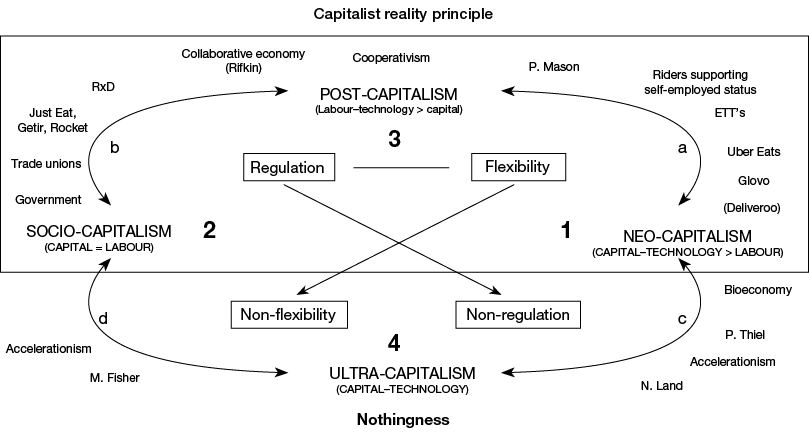
CHART 1. Ideological types
doi:10.5477/cis/reis.195.63-78
The Spanish Rider Law: Social Movements, Political Process and a Semiotic Analysis
of Ideological Differences
Ley rider española: movimientos sociales, proceso político
y análisis semiótico de las diferencias ideológicas
Miguel Montañés Grado, José Ángel Bergua Amores and Jaime Minguijón
|
Key words Capitalisms
|
Abstract The Spanish 2021 Rider Law was enacted by the left-wing government, with the support of traditional trade unions. It sought to regulate the work of delivery riders in the new platform capitalism. A description and analysis of the political process involved shows that the corporatism of the left prevailed over the other actors concerned, whereby (bogus) self-employed workers were converted into employees. The article also proposes an analysis based on Greimas’s semiotic framework, which unpicks the ideological frameworks in the informants’ opinions, namely neo-capitalism, socio-capitalism, post-capitalism and ultra-capitalism. The first three broadly outline the reality principle of capitalism, while the latter points to a fully external structure, without a society to sustain it. |
|
Palabras clave Capitalismos
|
Resumen La ley rider de 2021 impulsada por el Gobierno de izquierdas español y el sindicalismo clásico buscó regular la actividad de los riders en el nuevo capitalismo de las plataformas. La descripción y análisis del proceso político muestra que el corporativismo de izquierdas prevaleció, transformando a los (falsos) autónomos en trabajadores asalariados. Además, el artículo propone un análisis basado en lógica del cuadro semiótico de Greimas, que desentraña los marcos ideológicos presentes en las opiniones de los informantes: el neocapitalismo, el socialcapitalismo, el poscapitalismo y el ultracapitalismo. Los tres primeros dibujan el principio de realidad del capitalismo en sentido amplio, mientras que el último apunta a un exterior absoluto sin sociedad que lo sostenga. |
Citation
Montañés Grado, Miguel; Bergua Amores, José Ángel; Minguijón, Jaime (2026). “The Spanish Rider Law: Social Movements, Political Process and a Semiotic Analysis of Ideological Differences”. Revista Española de Investigaciones Sociológicas, 195: 63-78. (doi: 10.5477/cis/reis.195.63-78)
Miguel Montañés Grado: Universidad de Zaragoza | miguelmg@unizar.es
José Ángel Bergua Amores: Universidad de Zaragoza | jabergua@unizar.es
Jaime Minguijón: Universidad de Zaragoza | jmingui@unizar.es
Introduction
Transformations in the work sphere give rise to new forms of mobilisation and resistance which, in turn, prompt adjustments in corporate profit-making strategies (Johnston and Land-Kazlauskas, 2019). This dynamic is evident in platform capitalism in the food delivery sector, where rider protests across different contexts, pressure from trade unions and broad segments of the left and the enactment of the Spanish 2021 Rider Law forced the sector to restructure.
The origin of platform capitalism can generally be traced back to the 1990s, with the arrival of multinational corporations, the outsourcing of work and the offshoring and subcontracting of production processes, all of which fragmented the labour market and made it more precarious. Freeing workers who were employed on a casual, intermittent basis while remaining permanently on call therefore coalesced with a demand for services from consumers who likewise sought to optimise their time by freeing themselves from tasks associated with reproductive labour in the domestic sphere (Alonso and Fernández Rodríguez, 2021).
Home delivery was not a new phenomenon, as pizza and Chinese food restaurants had long provided this service. The emergence of the Internet and then smartphones gave rise to today’s digital food delivery platforms (Griesbach, Reich, Elliott-Negri and Milkman, 2019). Home delivery via the Internet started with thewaiter.com in California in 1995, followed by the Danish Just Eat in 2001. In Spain, this online service started with ComerComer.com (2001), SinDelantal.com (2010), Just Eat (2010) and La Nevera Roja (2014), which introduced the use of self-employed delivery drivers for the first time. Smartphones were a pivotal turning point, as they could incorporate applications that put all of the actors involved in contact with each other. The first companies to operate in this new way were Deliveroo in London in 2013 and Uber Eats in San Francisco in 2014. A year later, Deliveroo entered the Barcelona market and Glovo was founded in Spain, while Stuart began operating in Barcelona and Paris in 2016.
The main novelty was that the labour regulations so painstakingly institutionalised by trade unions and left-wing political parties began to be challenged as a consequence of offshoring and the high levels of automation involved (Woodcock and Graham, 2019). Platform labour brings with it an unprecedented, unique employment regime (Schor, 2021), since riders were considered to be self-employed rather than employees, as might be expected (Dugan et al., 2020; Vieira, 2021). This situation generated significant difficulties for the regulation of labour relations (Rahman, 2016; Rogers, 2016), leading to the appearance of numerous illegal and irregular practices.
The specialised literature has focused not only on the confusion between employee and self-employed status (Tomassetti, 2016) in the new context of corporate governance (Todolí-Signes, 2021), but also on issues related to algorithmic management through artificial intelligence (Molina et al., 2024). Unlike other digital tools with more easily identifiable and manageable effects (such as computers or tablets), these systems exert broader and more systemic forms of control over work and occupational health. This is because they shape both the working conditions in the industries concerned and their associated managerial practices and decision-making processes.
Both of these issues were addressed in the agreement reached between the Council and the European Parliament on 8 February 2024 on a platform work directive. It proposed that the relationship between a digital platform and a person performing work on it shall be presumed to be an employment relationship when facts indicating control and direction are found. It also stated that workers would have to be informed about the use of automated monitoring and decision-making systems. This Directive has yet to harmonise the highly significant legal differences between countries. Some Member States, such as Spain and Portugal, have focused their efforts on combating bogus self-employment based on the recognition and presumption that an employment relationship exists (Sanz de Miguel et al., 2023). In other countries, such as Greece, some social rights have been legally recognised for platform workers, irrespective of their legal status. Finally, countries such as Estonia have focused on extending social protection to self-employed workers (Guinea, Sisto and Roy, 2024). There are also differences between countries depending on the source of regulation chosen (Ilsøe, Jesnes and Hotvedt, 2020; Sanz de Miguel et al., 2025). While several Eastern and Southern European countries have opted for law-based regulation, the Nordic countries have preferred collective bargaining.
As far as Spain is concerned, the institutional and left-wing momentum to regularise this new form of work and classify it as standard employment was supported by some groups of riders. Others, however, preferred to accept the self-employed status offered by the new companies, for example, signing professional interest agreements (Vieira, 2021), while demanding improved working conditions. Finally, there were those who opted to leave salaried paid employment and create cooperatives, such as Mensakas, Les Mercedes and 2GoDelivery (Bergua, Montañés and Báez, 2023; Cañada, Izcarra and Zapata,2023).
Much of the conflict was related to these differing alignments among riders, who found support from a range of actors, some more institutionalised than others, depending on the context (Fernández-Trujillo Moraes and López Calle, 2024). They frequently used digital social media (Cant, 2020; Tassinari and Maccarrone, 2020) and consistently organised highly visible demonstrations.
In Spain, Deliveroo riders were the first to mobilise in 2017 in response to the compulsory implementation of hourly and per-order payment. Later, some social movements appeared that were strongly influenced by the new objectives, grammars and modes of communication and organisation that emerged from the Spanish 15M movement (Fernández-Trujillo Moares and López Calle, 2024). These were very similar to those of the Occupy movement in the English-speaking context (Khestiban, Callahan and Harris, 2021) and shared closely related characteristics with other very recent social movements (Lugon Sánchez, 2017; Laksana and Abdhu, 2023). These reactions can be traced back to mobilisations in other European cities, and were driven by groups who were aware of these issues; they initially had no links to trade unions and could barely be considered a social movement. They more closely resembled grassroot networks (Ekins, 1992; Yenerall, 2017; Cini, Maccarrone, and Tassirani, 2021) in which primary or grassroots sociability reaches elaborate or secondary levels characteristic of political action. As a result, the classic distinction between community and association has lost much of its relevance. Although similar struggles have occurred in other countries (Paret, 2015; Crocco and Atzeni, 2022; Mieruch and McFarlane, 2023), there is still no consensus on whether platform capitalism and the types of subjects employed by it (including their lifestyles) have enabled or can enable genuine social movements to emerge (Grenfell, 2023; Maffie, 2023).
Objective and Methodology
The objective of this article is to conduct both a formal and semantic analysis of the conflict involving riders in Spain, from its origins through to the enactment of the 2021 Rider Law. It draws on information obtained by one of the authors while working as a rider for Glovo in a medium-sized city in the Spanish Levante region from March 2020 until the end of December 20211. During this time, participant observation provided information on job performance and the relationship with the company in that particular city. It also gave us access to the social media platforms through which riders in other territories exchanged perspectives on the conflict and circulated news and calls for action issued by the wide range of actors involved2.
The Telegram and WhatsApp groups consisted of 381 and 280 members, respectively. Several hundred messages and other shared materials were collected, whereupon a selection process was carried out based on criteria of thematic relevance. A final corpus was compiled which consisted of thirty-two links to news items from sixteen digital newspapers, forty-two screenshots encompassing actions for mobilisation, official documents (employment contracts and court rulings), graffiti and other graphic elements, and thirty-two opinions (in text, audio and video formats) extracted and highlighted from among the hundreds of interactions in the chats3.
Drawing on this material, a formal analysis was conducted of the political process related to the protest and the alignment of actors according to the opportunity structure generated. The thread that connected the materials was the chronological sequence of events that began in 2017 and culminated with the passing of the 2021 Rider Law. From a semantic perspective, attention was paid to the links between the various ideological types at play and the axes along which the different groups of riders and other actors were positioned.
Timeline of the political process
The Rider Law, enacted in August 2021, was the culmination of a long conflict and public debate which can be traced back to 2 July 2017. That was the date when the first major strike of Deliveroo riders was called in Madrid and Barcelona as a response to the removal of a minimum guaranteed amount. This mobilisation was similar to the one previously held in London for the same reason (Cant, 2019). The initiative was led by Riders x Derechos (RxD), a grassroots social movement that brings together loosely connected local initiatives grounded in intersectional values. It maintains close ties with other movements that are similarly diffuse and horizontal, yet highly responsive to local conditions (Alberti and Joyce, 2023). In Spain, the alliances forged by riders included a group known as las kellys, who campaign against precarious work in the hotel cleaning sector, and Elite Taxi, which opposes platform-based companies such as Cabify and Uber.
Two years later, on 25 May 2019, 22-year-old Nepali rider Pujan Koraila was killed by a cleaning truck. After the accident, it was revealed that he was renting someone else’s account and that he was working in an irregular situation4. This incident publicly highlighted the problems of the sector, mainly disseminated through the left-wing media. A few days later, on 2 June 2019, Yolanda Díaz, the Spanish Employment Minister and a member of the Unidas Podemos coalition (situated to the left of the PSOE), had a meeting with RxD to discuss a future law that would regulate the work of the food delivery sector. Neither the companies involved nor trade unions were invited to this meeting.
As a result of the complaints that trade unions had been filing against food delivery companies for some time, the employment status of riders became clearer. On 25 September 2020, following several earlier and contradictory rulings, the Supreme Court established that a rider cannot be considered to be self-employed, thereby confirming the position long held by trade unions and by the political left as a whole. This was significant because it brought the trade unions’ struggle against the sector to the public’s attention. Until then, the conflict had been confined to the legal arena, as the unions had lacked sufficient representation among riders to engage in mobilising actions. The presence and influence of trade unions had been hindered by the absence of common shared workplaces, competition among workers, algorithmic management and the individualised relationship between work and remuneration (Fernández-Trujillo Moares and López Calle, 2024). No less problematic for trade unions was the spread among riders of a new vocabulary introduced by the companies, which resonated with neoliberal values alien to trade unionism and was close to being incorporated into the everyday culture of work (Fernández Rodríguez, 2022). Some examples include the use of expressions such as “service provider” instead of worker; “income” instead of salary; “separation” instead of dismissal; and talking about “fishing” for hours or orders.
However, despite these difficulties, trade unions succeeded in capitalising on the conflict and leading a growing mobilisation. Their objective was to secure institutional recognition of these workers as employees rather than being regarded as self-employed, thus countering the entrepreneurial ideology derived from neoliberalism that had already taken hold among some riders (Maury, 2023; Vieira, 2023). From a legal perspective, this struggle led to a sophisticated hermeneutic that resulted in very different and even contradictory judgments. The Supreme Court ruling of September 2020 put an end to all this. After it was issued, the companies defended themselves by arguing that the ruling referred to a specific case and that they had already implemented changes to regularise the situation of “their” self-employed people. One month later, on 21 October 2020, it became known that a total of 11 013 riders had been granted regular status by the Labour Inspectorate since 2019, both as a result of complaints from the trade unions and ex officio actions.
On 11 November 2020, a group of self-
employed riders –Repartidores Unidos (RU)– organised protests in thirty-five Spanish cities. They sought to meet with the Employment Minister, take part in the debate on the Rider Law and submit proposals for the improvement of working conditions, while remaining self-employed. They therefore resisted being classified as employees, as advocated by RxD, the trade unions and the Ministry itself, a position which had already been supported by a ruling from the Supreme Court. RU was a type of social movement, just as fragmented and diffuse as RxD, and related to other groups, such as undocumented migrants and those fighting against the taxi drivers’ efforts to prevent the normalisation of Uber and Cabify. In a public debate between business models held on 19 November 2020, the working conditions at Just Eat, the only company that directly employed riders, were leaked to the press. They worked fifteen hours a week for 6.56 euros gross pro rata per hour and could work up to 7.5 hours of overtime per week, resulting in a maximum income of 560 euros gross per month. These data seriously called into question the idea that changing the status of the self-employed into employees would end precarity, as suggested by the proponents of self-employed status for riders (Altenried, 2021).
On 21 January 2020, there was a rally outside Glovo’s headquarters in Barcelona to demand an increase in the base rate per order and to recover the 2.80 euros per order (considerably more than the 1.30 euros that prevailed at the time). This demonstration was supported by both the movement in favour of self-employed status for riders and the those who advocated for standard employment conditions. It was therefore reminiscent of the first demonstration in 2017 against Deliveroo. The latest draft of the Rider Law was leaked a few days later, on 24 January 2020. The text was fairly constrained compared to the initial demands, as it was limited to the delivery platforms without addressing the issue of the “bogus self-employed”. It was not yet known whether employers would accept it. On 4 February 2020, the riders who supported self-employed status reacted to the leaks. The movement gained momentum through coordinated demonstrations held simultaneously in thirteen cities, where the hashtag “SiSoyAutonomo” (“YesIamSelfemployed”), created in June 2020, became increasingly prominent, in line with communication practices adopted by other social movements (Sylvana, Agustia and Irwansyah, 2023). In this case, it was used to highlight that they had not had a voice in the legislative negotiation process, that businesses had been closed in some cities and that the chosen flexibility arrangements had been terminated (as these excluded people with family responsibilities).
The leaks regarding the future law continued, and on 17 February it was disclosed that the companies in the sector would be granted a three-month period to adapt to the new state of affairs. Further leaks followed on 21 February, accompanied by press statements from all the actors involved, while reports also emerged of the companies’ hopes that the CEOE (main employer organisation in Spain) might be able to renegotiate the final stages of the Rider Law. Otherwise, they envisaged the creation of delivery cooperatives. For their part, riders in support of self-employed status organised a march in Madrid on 3 March 2021. On 10 March 2021, all actors, including the CEOE, approved the text of the preliminary agreement, which was subsequently adopted as a matter of urgency by means of a Royal Decree-Law.
In the first week of April 2021, Glovo reacted by announcing that it had decided to leave the CEOE. On 26 April 2021, UGT (a major trade union) made an official complaint against Glovo and Deliveroo for an illegal transfer of workers. Faced with the new legal scenario and the trade union offensive, the delivery companies started to test some solutions. One of these was outsourcing through temporary employment agencies (known by their initials in Spanish as ETTs), which would hire riders as employees and then transfer them to the delivery companies. In response, there was criticism about the collective bargaining agreement that regulated the working conditions of these courier delivery companies, with complaints that it established some of the lowest wage levels in the sector. In addition, riders who supported self-employment status objected to the working conditions of ETTs and claimed that their worst predictions about the Rider Law and their gaining employee status were coming true.
In the midst of this realignment of actors, Royal Decree-Law 9/2021 was passed on 11 May 2021 and the Rider Law was expected to enter into force on 12 August 2021. There was an immediate response from business organisations. On 11 May, the Asociación de Plataformas de Servicios Bajo Demanda (Association of Platforms for On-demand Services), which had been created as an alternative to the CEOE, criticised the approval of the Royal Decree. Riders who advocated for self-employed status continued to organise sporadic protests under the slogan “SiSoyAutónomo”. They also considered the option of creating cooperatives of self-employed workers and became involved in pilot projects with ETTs.
On 28 July 2021, it was leaked to the press that Glovo intended to introduce a series of operational changes in order to continue to treat approximately 80 % of its workforce (around 10 000 riders) as self-employed. The most significant change involved the introduction of a multiplier system through which riders themselves would effectively enter into an “auction” to determine delivery prices. This measure eliminated time slots and made it easier for all riders to remain active at any time. This changed some aspects of the operational process that facilitated the presumption of employee status for riders. On 30 July 2021, Deliveroo declared that it was considering abandoning its operations in Spain due to the changes brought about by the Rider Law. The Law entered into force on 12 August 2021 after a five-month wait. In September and October of the same year, two new delivery companies entered the Spanish market: Getir and Rocket. They claimed that they would comply with the Rider Law. However, Glovo did not do so and on 2 November CC. OO. (a major trade union in Spain) claimed that the company had “failed to comply with the Rider Law for three months”. Deliveroo had also been unable to implement the changes and, finally, on 29 November 2021 it ceased its operations in Spain for good. On 17 December 2021, Just Eat and the unions signed a Working Conditions Agreement, which they tried to sell as confirmation that an employment agreement was possible by hiring riders.
In short, the heterogeneous, dynamic and diffuse riders’ movements contributed to the construction of a “multi-organisational” field (Klandermans, 1994) that benefited from a specific “political opportunity structure” (Tarrow, 1997). They aligned themselves with businesses, trade unions and the Employment Ministry at different points in time and they also experimented with cooperativism. All of this took place in defiance of Spain’s own neo-corporatist tendency, similar to that observed in other southern European countries (Wilson, 1994; Landman, 2011). Those rider movements that allied with businesses contributed to reaffirming the model of capital–labour relations that had been in place throughout the twentieth century and had put an end to the violent relations between the two agents, which characterised the early stages of capitalism (Sanz et al., 2023). This strategy not only generated new forms of engagement with businesses, but also drew on workers’ autonomy, enabling practices such as account rental that provided a livelihood for institutionally marginalised groups, including undocumented migrants (Bergua, Montañés and Báez, 2023). Finally, those rider movements that experimented with cooperativism seemingly sought to depart from a conflict-ridden relationship with capital towards greater self-reliance, as had occurred previously in other sectors. However, this experiment took place in a context where market forces set the rules of the game, a condition that ultimately tended to undermine it.
Ideological types
Aside from the formal dimension of the political process and the range of opportunities and alliances tested by the actors involved in the conflict, it is also possible to focus on its semantic or symbolic dimension (Della Porta and Diani, 2011). In general terms, culture provides the cognitive framework through which individuals orient themselves in the world, beyond the specific contents it conveys and the values it articulates (McAdam, 1994). In this article, however, the emphasis is placed on the political dimension of culture; more specifically, on the ideological types within which actors are situated and through which they operate, as well as on the logics that structure the relationships between these ideologies. For this purpose, we decided to use the “semiotic square” (Greimas and Courtes, 1982; Greimas, 1989). It has been constructed here on the basis of a “semantic axis” (Chart 1) formed by “regulation” and “flexibility”, two notions that are constantly referred to but are not used to qualify exactly the same issue. “Regulation” refers primarily to the need to eliminate precarity and also to the opacity of the algorithm (Puglianu, 2019), issues that were addressed by the 2021 Rider Law. “Flexibility” essentially alludes to riders’ freedom to manage their working time and their income.
From these “object terms”, two diagonals can be drawn that connect to their negative counterparts (“non-regulation” and “non-flexibility”), thereby constructing a semiotic square composed of four “meta-terms” in which the information obtained can be situated. These meta-terms are logically related to one another. This is very useful when conducting an in-depth analysis, as it makes it possible to discover what is left unsaid or unexpressed. Horizontal meta-terms 1 and 2 (in this case, “neo-capitalism” and “social-capitalism”) are opposites or complementary; therefore, the explicit affirmation of one using the corresponding information entails the reciprocal assumption of the other, which requires the analysis to be pointed in that direction.
Vertical meta-terms 3 and 4 (“post-capitalism” and “ultra-capitalism”) are contradictory or incompatible. The explicit affirmation of one entails the implicit negation of the other, and it is therefore necessary to clarify the underlying contradiction. In addition, the information and the fieldwork itself have led to the understanding that there is a certain fluidity and relationship between neighbouring ideological poles, as it is possible to pass from one to the other through their respective vertices. These movements required that we drew on authors and agents who embody and support them.
The origin of the conflict lies in “neo-
capitalism” as represented by the platform economy. Within it, capital is aided by technology to establish a new way of dealing with work that is characterised by a combination of “flexibility” and “non-regulation”. Non-regulation is related to the fact that riders are considered to be “self-employed” workers, and as such, have a great deal of freedom to decide on their work. The counterpart of this autonomy is obligation, as individuals are required to provide virtually all of their own equipment, including smartphones and means of transport. The following views were expressed when the Rider Law first came into force. They referred to the arrival of temporary work agencies and exposed the modus operandi of the delivery business.
Hello! A leading construction company is looking for construction workers. An employment contract is offered at 7.35 euros per hour. We pay you 0.07 per kilometre. It is essential that you provide bricks, concrete, doors, tiles, windows, toilets, etc. Sign up, there are still 28 places left (Rider comment on Telegram).
You provide the materials and we’ll provide you with some breadcrumbs and rights (Rider comment on Telegram).
Being employed is no panacea. Just eat is used as an example and these dismissals are used as an example of replacing the precarity involved in being self-employed for the precarity of being an employee (Rider comment on WhatsApp).
However, neo-capitalism goes beyond merely requiring riders to provide the tools necessary to perform their work, which in conventional business settings where standard employment prevails are supplied by companies. More fundamentally, beyond the provision of work tools, the ultimate objective of this business model is to exploit the totality of workers’ lives, to the extent that it can be described in terms of a “bioeconomy” (Fumagalli, 2020). Indeed, in addition to the pace of work and volume of deliveries, which can be required to be made at any time on any day, information related to traffic flow, distance to destinations and customer and supplier ratings are added to build rankings and ratios that are handled by algorithms to optimise business effectiveness and efficiency (Sadin, 2018; Grabher and König, 2020; Giandini, 2021). If we consider that the factory was not only a place of production but also a disciplinary device in industrial capitalism, it turns out that working on the streets today is a “fourth degree prison sentence” (Gómez Villar, 2020). But since all the information is obtained and managed through the app that workers are required to have installed on their smartphone, the factory is in fact an all-encompassing device where production and consumption, together with discipline and enjoyment, are intermingled.
“Socio-capitalism” (“regulation” and “non-flexibility”) emerged as a reaction to neo-capitalism. This position was embodied by the social-democratic State and supported by traditional trade unions, which sought to reinstate riders’ work to standard paid employment. To this end, they made substantial legal efforts aimed at ensuring that the three core characteristics of employment under the Workers’ Statute (“salary”, “dependence”, and “employee status”) would be applied to riders. This form of socio-capitalism seeks to establish equality between capital and labour. To this end, it attempts to correct the production of inequality that capital tends to spontaneously generate (Milanovic, 2024). One key reason is that returns on capital grow faster than overall economic growth (Piketty, 2014). As Piketty has shown, inequality was contained (and in some cases reduced) only between the end of the Second World War and the mid-1970s, when Keynesian policies were implemented. It is precisely these policies that trade unions continued to advocate for in the face of the hesitant positions of social democratic parties. This helps to explain why the Employment Ministry, which sought to secure the passage of the Rider Law, was an exception in the history of Spanish democracy. References to technology were less important on this ideological pole than on its opposite. However, ample views were expressed concerning the inability of the classic trade unions to negotiate that self-employed workers would become employees, as required by the Rider Law. Trade unions, a fundamental part of socio-capitalism, were also criticised for having substituted one type of precarity for another. Finally, it was argued that the new law did not bring about a substantial transformation, as it applied only to the delivery sector and excluded 96 % of the self-employed working in platform capitalism, both in Spain and across Europe.
We have been receiving a lot of questions from you and we would like to say this. You have chosen us to represent you in the termination negotiations, and you can rest assured that we will do so to the best of our ability. However, you cannot expect us to be your advisors on legal issues, tax issues, etc. on all the individual matters that may arise (Comment by a trade union member on Telegram).
You know what happens, Paco? That before there was no need for these campaigns for putting the multiplier and so on. Why? Because we had more options, you could choose between the best paid orders, because you could connect to several platforms or take advantage of the promotions of Uber, or Deliveroo, or Glovo at certain times and in the morning people would get their Amazon block... Do you see what I mean? You see, it’s what I always tell you, that it was you guys that created the problem????? (Comment by a rider on Telegram).
First, the offer of 12-hour contracts was established; second, it was stipulated that the vehicle was to be provided by the Rider; third, temporary contracts became a structural component of the fleet; fourth, there was a reduction in wages compared with what UGT itself had told us we would earn as employees, since this was stipulated by the collective bargaining agreement (and they also assured us that the company would provide the vehicle); fifth, mandatory additional hours were introduced, meaning that it was impossible to make plans more than five days in advance and making work–life balance unfeasible; sixth, no bonus whatsoever was established for rainy or hazardous conditions. In short, workers were expected to get wet for free and to continue to be obliged to work when it was raining (Comment by a member of the Asociación Interés Profesional on Telegram).
The draft presented by the Ministry only restricted delivery platforms, leaving open the gap regarding tens of thousands of unregulated bogus self-employed (Comment by a member of the Asociación Interés Profesional on Telegram).
Neo-capitalism and socio-capitalism have thus developed a dialectical relationship that is rooted in the origins of capitalism itself. This system has been characterised by the continual redefinition of the relationship between capital, labour and sustained efforts by trade unions. Unions have only been intermittently supported by the institutional framework, in order to prevent this relationship from moving beyond the codified framework that had been in force for almost a century (although in Spain it dates back only to 1980).
In response to this dialogue between the two ideological positions, riders split into two groups: those who were under the sway of trade unions and adopted their perspective (as was the case with RxD) and emphasised the need for “regulation”; and those who paid greater attention to “flexibility” (as was the case with the “genuinely self-employed” (RU)). The latter appeared to maintain a less conflictual relationship with the neo-capitalist pole, as they were able to capitalise on it, in some cases by becoming small entrepreneurs who rented out their accounts to other “workers”. This arrangement provided a means of subsistence for groups such as undocumented migrants, whom the institutional framework was neither willing nor able to incorporate. Nevertheless, the various co-operative experiences undertaken were the most representative of this post-capitalist pole (which sought to achieve a degree of work autonomy through the use of technology). While the views listed below do not fully reflect this wide range of post-capitalist options, the idea behind them all was to use the options provided by technology to obtain as much freedom and autonomy as possible in order to deal with capital on equal terms.
Hello Deliverers! Given the extremely serious situation surrounding the Rider Law, which seeks to sacrifice us only to preserve the use of self-employed workers in other sectors and companies, thereby claiming credit for acting as the “saviours” of our collective through measures that merely ensure our unemployment, exclusion and precaritisation, we consider it appropriate to organise a demonstration ahead of the social dialogue meeting and state our position at a press conference. This is the position that has already been adopted in other countries and includes guaranteed hourly pay, effective regulation of the oversupply of riders, bonuses for adverse weather, night work and public holidays, expanded insurance coverage… (Comment by a member of the Asociación de Interés Profesional on Telegram).
There are faults in all the apps. That is why we work with the ones we like the most. In my case, during the week I combine Shargo, Amazon and Glovo. On weekends Glovo and Deliveroo. And I’m doing well... I like to be able to work anywhere. Wearing any clothes (Comment by a rider on WhatsApp).
I have already said that I am never in favour of a company. And clearly if they said anything, I would give them a miss. And if they want more [of us to go] with them, they should improve the pay, ha ha, because at weekends I prefer Deliveroo (Comment by a rider on WhatsApp).
Let me explain something. I’m not Spanish, I’m Venezuelan and we love to work and work blooooody hard. Without expecting anything from anyone. If I don’t work, I don’t eat. I am not like you people who are expecting a pension or rather, unemployment benefit, because that is what you do, you last 2 months in a job and ask to be fired to go on the dole and enjoy 6 months of laziness. That’s how the years go by and at the end, they come to realise they have nothing. They live in their parents’ homes. Because they never have anything (Comment by a rider on Telegram).
This criticism about new accounts being created or new riders joining comes across rather badly. There are new people everywhere, even in large companies, at least I became [officially] self-employed in October. I think the issue of rented accounts is far more damaging than the arrival of new workers. Anyone who spends time on the street and talks to other colleagues can see that 50 or 60 % of those working do so with rented accounts. If you stop somewhere where there are ten riders and ask who has a rented account, seven will tell you they do. I know someone who has a hairdresser’s who can’t even drive a motorbike and has rented out her account; there is a restaurant chef I know who has his Glovo account rented out; there are people who have companies who opened their accounts to rent them out because it doesn’t cross their mind to work them, only to get 30 % (Comment by a rider on Telegram).
More generally, this post-capitalist pole could also be taken to include: those discourses that highlight the benefits of the collaborative economy (Rifkin, 2014); those that regard its shortcomings as surmountable (Allen, 2016); and those who see techno-economic logic itself as transcending capitalism. There is therefore a heterogeneous range of positions on this ideological pole. They all share an affirmation of workers’ autonomy and flexibility (something that neo-capitalism does not see as being entirely wrong), while at the same time calling for regulation to prevent precarity (which aligns with the aims of socio-capitalism). Thus, the A and B vertices that separate post-capitalism from its neighbouring ideological poles are permeable and allow for some transfer or communication to take place. It could be argued that the three of them together constitute capitalism’s “reality principle”, meaning that it is not only difficult for thought but even for imagination to escape its confines (Fisher, 2022).
In contrast to post-capitalism, and at the outer limits of what it makes it possible to conceive, lies “ultra-capitalism”, characterised by the simultaneous absence of regulation and flexibility. Although it appeared neither in the accounts of our informants nor in socio- or neo-capitalist discourses, its existence can be inferred from the internal logic of the semiotic square. The very affirmation of post-capitalism (and even of the meta-level category it forms together with socio-capitalism and neo-capitalism) implicitly negates ultra-capitalism. Whereas in post-capitalism the tension between capital and labour tends to dissolve because labour prevails, supported by technology, in ultra-capitalism capital deploys technology to eliminate any antithesis, move beyond the modern political order and rule over an absolute void.
A representative of this ideological position can be found in N. Land’s “neoreactionary re-accelerationism”. This proposed to eliminate the elements imposed by progressivism, modernity and the Enlightenment itself to hinder technology in its alliance with capital, which prevent “an uncompensated cybernetic runaway” (Land, 2022: 254). More specifically, Land proposed some positive feedback between the decoding produced by commercialisation and the de-territorialisation driven by industrialisation, all of which must lead to “Zero”, emptiness or nothingness. Albeit from the opposite end of the ideological spectrum, Mark Fisher (2022) pointed to the same scenario. Fisher understood that the vampire-like emptying of subjectivity carried out by capitalism must not be compensated for either by restoring what is presumably lost, or by accepting the simulacra of authenticity offered by the “society of the spectacle” (Debord, 2000). Rather, it is a matter of maintaining the “flatline” of the death of subjectivity and using that position to overcome any subjective category.
Nick Land and Mark Fisher met in 1995 at the CCRU (2021) of the Department of Philosophy at the University of Warwick (United Kingdom). While Fisher (2022) represented a leftist viewpoint that did not garner much success in the political establishment, Land (2022) was closer to liberalism. This shows that ultra-capitalism communicates better with neo-capitalism (vertex C) than with social-capitalism (vertex D). Both movements are facilitated by “accelerationism”, a loose collective of cyberpunks, apocalyptics and many other groups. For those on the left edge, the (capitalist) world has already ended. By leveraging technology, other social adventures that are outside of capitalism and even environmentalism need to be allowed to emerge (Danowsky and Viveros, 2019). On the opposite edge, there are some (like Peter Thiel, founder of PayPal) who claim that freedom is no longer compatible with democracy, as only technology is up to that level (Hui, 2020).
Beyond the edges and the political axis itself, the nothingness referred to by our authors of reference (Fisher and Land) is what matters, as it goes beyond their respective ideological affiliations. This “nothingness” seems to be the unnamed place that absolutely contradicts not only post-capitalism, but also the reality principle that it outlines together with neo-capitalism and social-capitalism, all of them encompassing the limits of the thinkable.
Conclusions
The political process that culminated in the Spanish Rider Law emerged from various grassroots movements. Although trade unions later played a leading role, with the support of left-wing media and a favourable response from the State through the Employment Ministry, this narrative alone does not capture the full complexity of the conflict. Traditional business organisations, for their part, played only a marginal role in the public debate, which forced the new platform-based firms to represent their own interests. At the same time, trade unions ultimately succeeded in imposing their perspective on those classified as employees, even though the heterogeneity of riders hindered the articulation of a coherent and fully inclusive discourse.
For all these reasons, an analysis of these mobilisations along the terms of the political process paradigm had to be complemented by a structural analysis of the ideological positions that were genuinely concerned. As not all viewpoints were included and some of them articulated internally inconsistent discourses, it was necessary to use an approach that could reveal not only what was explicitly articulated, but also what remained latent.
The results of this alternative approach indicate that the conflict ultimately set the neo-capitalism of the new platform companies in opposition to the classic socio-capitalism of social democracies. Both, however, converge at a common vertex in post-capitalism, an ideological pole that nonetheless accommodates a range of heterogeneous positions. At the same time, the form of capitalism articulated across these three poles possesses a logical—albeit unexpressed—antithesis in ultra-capitalism, which points towards a process of de-territorialisation and de-codification driven by capital and leading to an indeterminate scenario, devoid of any antithesis. What is particularly striking is that some strands of left-wing thought, represented by segments of accelerationism, also gesture towards the same scenario, despite having failed to establish a meaningful relationship with the classical political left.
The rider’s conflict therefore functions as a sort of “analyser” (Lourau, 1980: 62) that reveals a boundary located precisely at the point where the reality principle of capitalism (constituted by neo-capitalism, social-capitalism and post-capitalism) dissolves. We have named this point where the flight begins “ultra-capitalism”, as the liberal-inspired position seems more capable of connecting with it than the social-democratic position. Nevertheless, if we move beyond the sphere of political influence, we could well be speaking of nothingness.
Bibliography
Alberti, Gabriell and Joyce, Simon (2023). “Mutualism, Class Composition, and the Reshaping of Worker Organisation in Platform Work and the Gig Economy”. Global Labour Journal, 14(3): 220-235. doi: 10.15173/glj.v14i3.5332
Allen, Jonathan P. (2016). “The Sharing Economy: Studying Technology-Mediated Social Movements”. SIGMIS-CPR ‘16. Conference on Computers and People Research: 65-67. doi: 10.1145/2890602.2890609
Alonso, Luis Enrique and Fernández Rodríguez, Carlos J. (2021). “El papel del consumo en la economía de plataformas: el vínculo oculto”. Revista Española de Sociología, 30(3): 1-12. doi: 10.22325/fes/res.2021.69
Altenried, Moritz (2021). “Mobile Workers, Contingent Labour: Migration, the Gig Economy and the Multiplication of Labour”. Environment and Planning A: Economy and Space, 54(5): 1069-1087. doi: 10.1177/0308518X211054846
Bergua, José Á.; Montañés, Miguel and Báez, Juan M. (2023). “Riders, algoritmos y la negociación de la realidad”. EMPIRIA. Revista de Metodología de Ciencias Sociales, 59: 81102. doi: 10.5944/empiria.59.2023.37939
Cant, Callum (2019). Riding for Deliveroo: resistance in the new economy. Cambridge: Polity Press.
Cañada, Ernest; Izcarra, Carla and Zapata Campos, María J.(2023). “Putting Fairness into the Gig Economy: Delivery Cooperatives as Alternatives to Corporate Platforms”. Societies, 13(3): 68. doi: 10.3390/soc13030068
CCRU, Unidad de Investigación de Cultura Cibernética (2021). Hiperstición. Madrid: Materia Oscura.
Cini, Lorenzo; Maccarrone, Vicenzo and Tassirani, Arianna (2021). “With or Without U(nions)? Understanding the Diversity of Gig Workers’ Organising Practices in Italy and the UK”. European Journal of Industrial Relations, 28(3): 341-362. doi: 10.1177/09596801211052531
Crocco, Francisca and Atzeni, Maurizio (2022). “The Effects on the Pandemic on Gig Economy Couriers in Argentina and Chile: Precarity, Algorithmic Control and Mobilisation”. International Labour Review, 161(3): 441-461. doi: 10.1111/ilr.1237
Danowsky, Déborah and Viveiros de Castro, Eduardo (2019). ¿Hay mundo por venir? Buenos Aires: Caja Negra.
Debord, Guy (2000). La Sociedad del espectáculo. Valencia: Pre-Textos.
Della Porta, Donatella and Diani, Mario (2011). Los movimientos sociales. Madrid: Centro de Investigaciones Sociológicas.
Díez Prat, Felipe and Ranz Martín, Ruben (2020). «Mi experiencia como repartidor de Deliveroo riders y el intento por articular nuestra lucha desde la estructura sindical de UGT». Teknokultura. Revista de Cultura Digital y Movimientos Sociales, 17(2): 187-193. doi: 10.5209/TEKN.69532
Ekins, Paul (1992). A New Order. Grassroots Movements for Global Change. London: Routledge.
Fernández Rodríguez, Carlos (2022). Cadenas, redes y algoritmos: una mirada sociológica al management. Madrid: Los Libros de la Catarata.
Fernández-Trujillo Moares, Francisco and López Calle, Pablo (2024). Riders, la movilización de un nuevo sujeto laboral al final de la cadena logística. In: Romero-Delgado, M.; Castillo Patón, A. E. and Betancor Nuez, G. (dirs.). Movimientos sociales en transformación. Protesta y movilización social en España (2000-2022) (pp. 241-262). Madrid-Barcelona: Marcial Pons y Federación Española de Sociología.
Fisher, Mark (2022). Constructos flatline. Buenos Aires: Caja Negra.
Fumagalli, Andrea (2020). Veinte tesis sobre el capitalismo contemporáneo (Capitalismo biocognitivo). In: Reis, M. (comp.). Neooperaísmo (pp. 49-72). Buenos Aires: Caja Negra.
Giandini, Alessandro (2021). “Labour Process Theory and the Gig economy”. Humans Relations, 72(6). doi: 10.1177/0018726718790002
Gómez Villar, Antonio (2020). Transformaciones de la agencia política contemporánea. In: Reis, M. (comp.). Neo-operaísmo (pp. 297-313). Buenos Aires: Caja Negra.
Grabher, Gernot and König, Jonas (2020). “Disruption, Embedded. A Polanyy Framing of the Platform Economy”. Sociologica, 14(1): 95-118. doi: 10.6092/issn.1971-8853/10443
Greimas, Algirdas J. (1989). Del sentido II. Madrid: Gredos.
Greimas, Algirdas J. and Courtes, Joseph (1982). Semiótica. Diccionario razonado de la teoría del lenguaje. Madrid: Gredos.
Grenfell, Raymond (2023). “Platform Capitalism and Place Relations in Social Movements: Environmentalism and Extinction Rebellion in Western Australia”. Media International Australia, 0(0). doi: 10.1177/1329878X231202273
Griesbach, Kathleen; Reich, Adam; Elliott-Negri, Luke and Milkman, Ruth (2019). “Algorithmic Control in Platform Food Delivery Work”. Socius: Sociological Research for a Dynamic World, 5: 115. doi: 10.1177/2378023119870041
Guinea, Oscar; Sisto, Elena and Roy, Oscar du (2024). Regulating the Working Conditions of Platform Work: What Can We Learn from EU Member States? Brussels: European Centre for International Political Economy.
Hui, Yak (2019). Fragmentar el futuro. Ensayos sobre la tecnodiversidad. Buenos Aires: Caja Negra.
Ilsøe, Anna; Jesnes, Kristin and Hotvedt, Mari (2020). Social partner responses in the Nordic platform economy. In: Jesnes, K. and Oppegaard, J. (eds.). Platform work in the Nordic models: 68-78. Nordic Council of Ministers.
Johnston, Hannah and Land-Kazlauskas, Chris (2019). Organizing On-Demand: Representation, Voice, and Collective Bargaining in the Gig Economy. Conditions of Work and Employment Series, 94. Geneva: International Labour Office.
Khestiban, Amir; Callahan, Jamie and Harris, Martin (2021). “Leaderlessness in Social Movements: Advancing Space, Symbols, and Spectacle as Modes of ‘Leadership’”. Human Resource Development Quaterly, 34(1). doi: 10.1002/hrdq.21460
Klandermans, Bert (1994). La construcción social de la protesta y los campos pluriorganizativos. In: Laraña, E. and Gushfield, J. (eds.). Los nuevos movimientos sociales, de la ideología a la identidad (pp. 93-118). Madrid: Centro de Investigaciones Sociológicas.
Laksana, Muhibudin W. and Abdhu, Muhammad (2023). “The Power of Social Movements: Activism in the Age of Connectivity”. Journal of Current Social and Political Issues, 1(1): 18-23. doi: 10.15575/jcspi.v1i1.441
Land, Nick (2022). La Ilustración Oscura. Madrid: Materia Oscura.
Landman, Todd (2011). Política comparada. Madrid: Alianza.
Lourau, René (1980). El estado y el inconsciente. Barcelona: Kairos.
Lugo Sánchez, Luis J. (2017). “Participación y acción conectiva en novísimos movimientos sociales”. Revista International de pensamiento político, 12: 35-49. doi: 10.46661/revintpensampolit.3223
Maffie, Michael D. (2023). “Politicized Shopping in the Gig Economy: Retaliation and Solidarity on the ‘Other Side’”. Industrial Relations, 63(3): 347-367. doi: 10.1111/irel.12346
Mason, Paul (2016). Postcapitalismo. Barcelona: Paidós.
Maury, Olivia (2023). “The Fragmented Labor Power Composition of Gig Workers: Entrepreneurial Tendency and the Heterogeneous Production of Difference”. Critical Sociology, 50(7-8): 1167-1182. doi: 10.1177/08969205231216418
McAdam, Doug (1994). Cultura y movimientos sociales. In: Laraña, E. and Gushfield, J. (eds.). Los nuevos movimientos sociales, de la ideología a la identidad (pp. 43-68). Madrid: CIS.
Mendonca, Pedro; Clark, Ian and Kougiannou, Nadia (2023). “Informalization in Gig Food Delivery in the UK: The Case of Hyper-flexible and Precarious Work”. Industrial Relations, 62(1): 60-77. doi: 10.1111/irel.12320
Menéndez, Nicolás D.; Haidar, Julieta and Arias, Cora (2023). “Prácticas organizativas de trabajadores de plataformas de reparto en Argentina. Un análisis desde la teoría de los recursos de poder”. Papers, 108(1): 125. doi: 10.5565/rev/papers.3044
Mieruch, Yannik and McFarlane, Daniel (2023). “Gig Economy Riders on Social Media in Thailand: Contested Identities and Emergent Civil Society Organisations”. Voluntas, 34: 1232-1242. doi: 10.1007/s11266-022-00547-7
Milanovic, Branko (2024). Miradas sobre la desigualdad. Madrid: Taurus.
Molina, Óscar; Caprile, Maria; Arasanz, Juan; Sanz de Miguel, Pablo and Moral-Martín, David (2024). Worker participation and representation: the impact on risk prevention of AI worker management systems. Luxembourg European Agency for Safety and Health at Work.
Morales, Karol and Abal, Paula (2020). “Precarización de plataformas: El caso de los repartidores a domicilio en España”. Psicoperspectivas Individuo y Sociedad, 19(1): 112. doi: 10.5027/psicoperspectivas-vol19-issue1-fulltext-1680
Paret, Marcel (2015). “Precarious Labor Politics: Unions and the Struggles of the Insecure Working Class in the United States and South Africa”. Critical Sociology, 41(45): 757-784. doi: 10.1177/0896920513483149
Piketty, Thomas (2014). El capital en el siglo XXI. México, D. F.: Fondo de Cultura Económica.
Puglianu, Valeria (2019). “Work and Emplyment under the Gig Economy”. The Open Journal of Sociopolitical Studies, 12(2): 629-639. doi: 10.1285/i20356609v12i3p629
Rahman, Khaled S. (2016). “The Shape of Things to Come: The On-Demand Economy and the Normative Stakes of Regulating 21st-century Capitalism”. European Journal of Risk Regulation, 7(4): 652-663. doi: 10.1017/S1867299X00010096
Rifkin, Jeremy (2014). La sociedad de coste marginal cero. El Internet de las cosas, el procomún colaborativo y el eclipse del capitalismo. Barcelona: Paidós.
Rogers, Brishen (2016). “Employment Rights in the Platform Economy: Getting Back to Basics”. Policy Review, 10: 479-520.
Sadin, Éric (2018). La silicolonización del mundo. La irresistible expansion del liberalism digital. Buenos Aires: Caja Negra.
Sanz de Miguel, Pablo; Casas-Cortés, Maribel I.; Prieto Arratibel, Amaia and Arasanz Díaz, Juan (2023). «El empleo irregular tras la Ley Rider: ¿nueva regulación, idénticas estrategias empresariales?”. Revista Española de Sociología, 32(3), a177. doi: 10.22325/fes/res.2023.177
Sanz de Miguel, Pablo; Martinaitis, Zilvinas; Bazzani, Tania; Potrony, Jordi and Caprile, Maria (2025). “Varieties of Telework Regimes across European Regions: A Tale of Four Different Worlds”. Journal of Industrial Relations, 0(0): 1-25. doi: 10.1177/00221856251350496
Sanz, Juan P.; Arasanz, Juan; Moniz, Antonio B. and Boavida, Nuno (2023). “Revitalización sindical y nuevo sindicalismo en el capitalismo de plataformas: una comparación de los casos de España y Portugal en el sector del reparto”. EMPIRIA. Revista de Metodología de las Ciencias Sociales, 59: 53-79. doi: 10.5944/empiria.59.2023.37935
Schor, Juliet (2021). After the gig: how the sharing economy got hijacked and how to win it back. Oakland: University of California Press.
Srniceck, Nick (2017). Platform Capitalism. Cambridge: Polity.
Sylvana, Virginia A.; Kharisma, Natalia and Irwansyah (2023). “Communication Through Hashtags in Social Movements: A Systematic Literature Review”. Journal La Sociale, 4(5): 319-228. doi: 10.37899/journal-la-sociale.v4i5.908
Tarrow, Sidney (1997). El poder en movimiento. Los movimientos sociales, la acción colectiva y la política. Madrid: Alianza.
Tassinari, Arianna and Maccarrone, Vicenzo (2020). “Riders on the Storm: Workplace Solidarity among Gig Economy Couriers in Italy and the UK”. Work, Employment and Society, 34(1): 35-54. doi: 10.1177/0950017019862954
Todolí-Signes, Adrian (2021). “Making Algorithms Safe for Workers: Occupational Risks Associated with Work Managed by Artificial Intelligence”. Transfer: European Review of Labour and Research, 27(4): 433-452.
Tomassetti, Julia (2016). “Does Uber Redefine the Firm? The Postindustrial Corporation and Advanced Information Technology”. Hofstra Labor and Employment Law Journal, 34: 1.
Vieira, Tiago (2021). “The Unbearable Precarity of Pursuing Freedom: A Critical Overview of the Spanish Sí-soy-autónomo Movement”. Sociological Research Online, 28: 244-260. doi: 10.1177/13607804211040090
Vieira, Tiago (2023). “Platform Couriers’ Self-exploitation: The Case Study of Glovo”. New Technology, Work and Employment, 38: 493-512. doi: 10.1111/ntwe.12272
Wilson, Frank (1994). Neocorporativismo y auge de los nuevos movimientos sociales. In: R. Dallton and M. Kuechler (eds.). Los nuevos movimientos sociales (pp. 101-122). Valencia: Alfons El Magnanim.
Woodcock, Jamie and Graham, Mark (2019). The Gig Economy: A Critical Introduction. Cambridge: Polity Press.
Yenerall, Kevan (2017). Grassroots Politics. In: Genovese, M. A. and Han, L. C. (eds.). Encyclopedia of American Government and Civics. New York: Facts on File.
1 This study is part of the research project Culturas emergentes de precariedad en la Gig Economy digital: un estudio de caso sobre el sector de la comida a domicilio en España (Emerging cultures of precarity in the digital gig economy: a case study on the home delivery sector in Spain) (Ref. PID2020-115170RB-I00 SOC).
2 For more on participant observation applied to research on the rider phenomenon, see also Díez Prat and Ranz Martín (2020). Other similar studies on this kind of work include Menéndez and Haidar (2023) and Morales and Abad (2020), among others.
3 For full details, visit https://doi.org/10.6084/m9.figs
hare.27187467
4 On the issue of accounts sublet by non-account holders, see Altenried (2021) and Mendonca et al. (2023).
CHART 1. Ideological types
Source: Author's own creation.
RECEPTION: December 16, 2024
REVIEW: June 12, 2025
ACCEPTANCE: September 10, 2025