doi:10.5477/cis/reis.195.135-152
Learning from Academic Obituaries
(and Other Tributes): Narrative-discursive Practices about the Life and Death of Colleagues
Aprendiendo de los obituarios académicos (y otros homenajes):
prácticas narrativo-discursivas ante la vida y muerte de colegas
Miguel S. Valles Martínez
|
Key words Symbolic Capital
|
Abstract This article theoretically situates the study of academic obituaries within the sociology of death. It then analyses the In Memoriam notices published by the Revista Española de Investigaciones Sociológicas (REIS) from 1978 to 2024. Their characterisation yields a wide range of narrative forms and discursive practices used in the face of the death of colleagues. It also provides typological insights into these academic obituaries, intellectual networks and biographies, as well as their associated visibility and consecration processes. While this case study is centred on the REIS, it is further contextualised within the changing landscape of sociological journals over the period considered and incorporates other forms of tribute. The significant number of obituaries published contrasts with the scant attention given to the sociological analysis of this material in these types of journals. |
|
Palabras clave Capital simbólico
|
Resumen En este artículo encuadramos teóricamente el estudio de los obituarios académicos dentro de la sociología de la muerte, antes de abordar el análisis de los in memoriam publicados por la Revista Española de Investigaciones Sociológicas (REIS) desde 1978 hasta 2024. La caracterización de estos ofrece una variedad de formas narrativas y prácticas discursivas ante la muerte de colegas que aporta conocimiento tipológico sobre tales necrológicas, las redes y biografías intelectuales y sus procesos asociados de visibilización y consagración. El estudio de caso alrededor de la REIS ha precisado su contextualización en el panorama cambiante de revistas sociológicas en el lapso temporal abarcado, así como la consideración de otros homenajes. El importante número de obituarios contrasta con la escasa atención al análisis sociológico de este material en dichas revistas. |
Citation
Valles Martínez, Miguel S. (2026). «Learning from Academic Obituaries (and Other Tributes): Narrative-Discursive Practices about the Life and Death of Colleagues». Revista Española de Investigaciones Sociológicas, 195: 135-152. (doi: 10.5477/cis/reis.195.135-152)
Miguel S. Valles Martínez: Universidad Complutense de Madrid | msvalles@ucm.es
Introduction
The learning process—indicated through the use of the gerund—constitutes the contextual foundation for a research undertaking initiated several years ago. This study was motivated by the passing of numerous colleagues belonging to the most recent generation. There is, undoubtedly, a desire for sociological knowledge, but what is especially motivating is the intention to pay tribute to people who have been part of the human landscape, both personal and professional, not only of the writer, but also of those who have made this and other journals possible.
A decision was made to refer to other tributes (both during life and posthumously) alongside obituaries. This broader framing was intended to keep the scope open to a wider range of ways of expressing remembrance and recognition. It also encompasses modes of forgetting or oblivion that arise when faced with the lives and deaths of colleagues who have been connected to one’s own field of knowledge or specialisation in varying degrees. Neither of the expressions in italics above correspond to standardised or universal modes, but rather have taken different forms over time (Starck, 2004) and in each production and dissemination medium (Williams, 2003). Starck has contributed to the evolution of an art that he considers more focused on capturing life than death, drawing from his professional practice as a journalist and university educator. This requires both research and narrative skills. From a sociological perspective, Williams has noted that, although the (local and national) press has traditionally played a prominent role in the authorship and dissemination of obituaries, these texts have also been produced and published by other business and professional organisations. She mentioned some websites which are, in turn, promoted either by business or professional organisations, and are linked to the media or other bodies. In some cases, these facilitate or accept contributions from the public.
Whilst this article does not disregard certain contributions from the information sciences, its main focus is on sociology and other related social sciences, as will be seen in the following section on the theoretical framework.
A theoretical framework for academic obituaries (and post-mortem tributes). Looking at death with sociological eyes and from the viewpoint of other social sciences
Michael Kearl (2009: 291) is the author of the most frequently cited book on the sociology of death, which was first published in 1989 under the striking title Endings: A Sociology of Death and Dying. In a later work he provided a list of disciplines within the social sciences and the humanities, in which history was mentioned first. The other disciplines he identified were “social psychology, philosophy, anthropology, religion, political science, and sociology”. He noted the difficulty in setting clear boundaries for a sociology of death, given the significant overlap between the various fields concerned. This also serves to recall Philippe Ariès (who described himself as a “Sunday historian”) and his work on death in the Western world. His biography bears the mark of his relationship with the French historian Michel Foucault, who was also a philosopher, sociologist and psychologist. Ariès was instrumental in Foucault’s doctoral thesis being published, and Foucault wrote an obituary when Ariès died, only four months before Foucault’s own death. This helps to understand the difficulty in defining the contours of a sociology of death and disciplinary overlaps noted by Kearl.
In Spain, sociology of death scholars such as Marí-Klose and De Miguel (2000) have also drawn on some aspects of Ariès’s work. De Miguel has a long track record of research in this field, although this is beyond the scope of this article. It suffices to note here that he edited the first special issue on Sociología y Medicina (Sociology and Medicine) published by the journal Papers in 1976; and that in a recent article (De Miguel, 2020) he analysed how learning about death, both present and absent, was addressed in the medical textbooks used to train new cohorts of students.
The international literature on the sociology of death, particularly the most cited and widely recommended (Faunce and Fulton, 1958; Riley, 1983; Walter, 2008), has concluded that there has been evolution of the field. Additionally, international scholars have established that this research area warrants greater attention both within the social sciences in general, and within sociology in particular. Tony Walter’s extensive research career, which culminated in his appointment as Emeritus Professor of Death Studies at the University of Bath (United Kingdom), is worthy of note. He has studied a variety of aspects regarding the nexus between death and society, including not only end-of-life care but also funerary practices, among other themes (Walter, 1993, 2017; Walter and Bailey, 2020). The most recent of these works highlights funerals as strategic contexts for sociological inquiry (“a significant arena”1). The author argues for a thanatological concept, namely “disenfranchised grief”2, which draws attention to the particular significance of some relationships, even if there are no blood ties involved. In the words of Walter and Bailey (2020: 177): “intense grief can be felt for anyone to whom one felt a close connection, irrespective of formal family relationship”.
While Jacobsen was part of the Danish sociological academia at Aalborg University, he edited a collective volume that was published in 2017. Its striking title described society as postmortal and advocated for a sociology of immortality. These new conceptual ideas or codes have also proved useful for analysing the materials on academic obituaries examined in this article. Relevant keywords include symbolic immortality, digital immortality and celebrity immortalisation. The book was initially conceived to be co-edited with Kearl, but he passed away in 2015. Jacobsen was left as the sole editor and dedicated the volume to the deceased. He also included a text written by Kearl in 2010 on the proliferation of postselves in American culture as the final chapter of the book. Chapter 1 was authored by Walter, the other leading specialist in the sociology of death, whose work has already been discussed. In this chapter he examined the relationship between immortality and memory.
Shortly before the abovementioned compilation volume was released, its editor had published an article (Jacobsen, 2016), followed by a book with a similar title (Jacobsen, 2021). In these works, he proposed adding a fifth phase, termed “spectacular death”, to the four stages identified by Ariès in his history of death: “tamed death”, “death of one’s own”, “death of the other” and “forbidden death”. Proposals for naming and conceptualisation followed under the label “digital death” (Sumiala and Jacobsen, 2024).
Holmberg, Jonsson and Palm (2019), researchers from the Department of Sociology at Uppsala University, brought together a dozen contributions in the volume Death Matters. Cultural Sociology of Mortal Life, as part of a collective research project under the umbrella of cultural sociology. The plurality of cases studied also covered locations outside Sweden and included processes of memorialisation and mourning, such as at the death of celebrities (Kania-Lundholm, 2019). This author studied “Digital Mourning Labor” in terms of the use by commercial brands and other organisations of the images of deceased celebrities for profit. This also helps in the analysis of obituaries and academic tributes (the focus of this article) and seems to relate to the concepts of digital and spectacular death referred to above.
Another noteworthy, particularly critical and self-critical contribution on sociological approaches to death is the writing of Jyoti Puri (2021). It calls for the decolonisation of theoretical perspectives adopted from a Eurocentric sociology that pays little attention to gender, class or ethnic disparities. It seeks to provide an alternative genealogy of the sociology of death by revisiting key figures in social thought, such as Harriet Martineau3, Ida B. Wells and W. E. B. Du Bois. More recently, Cachón-Rodríguez (2024) highlighted the limited engagement with Du Bois’s work in Spanish sociological scholarship. He had also addressed the racist and recurrent deaths of African Americans in the United States in a 2021 publication.
As noted above, the sociology of death provides a wide-ranging theoretical framework. This could be further extended by examining its relationship with approaches to ageing, as well as with care and quality of life discourses in the final stages of life (Powell, 2022). However, it is worth mentioning some more specific contributions on academic obituaries from sociology, especially Bourdieu’s contribution to the understanding of scientific life.
Bridget Fowler (2004: 148) has devoted part of her research career to the study of obituaries as collective memory. In one of her early writings, she noted that “obituaries reveal and actively shape how societies remember”, an expression placed in quotation marks by the author (italicised here) alluding to the work of Connerton (1989). Following this author and others, such as Halbwachs (1992), Fowler invited us to approach obituaries not only as mere individual tributes, but as part of a representation or symbolic power play in the social macro-context. She added that obituaries, under the guise of individual portraits, compose a kind of legitimacy of the social order of commemoration. In this first contribution, which focuses on obituaries published in the British press between 1900 and 2000-2001, Fowler seeks to develop an empirical approach applicable to obituary narratives, particularly drawing on Bourdieu’s work. She considers the work La noblesse d’état: grandes écoles et esprit de corps, used in its English edition of 1996, as a key work for a critical analysis of obituaries in general. I share the assessment made by Fowler (2004: 150) and her identification in Bourdieu’s work (which I have also corroborated), of the world that is negotiated by editors, newspapers and academic journals in which the publication of obituaries is filtered according to the profile of the obituary subjects. I also endorse her call for this (desirable), albeit slow, evolution from meritocratic criteria to more democratic ones.
A few years later, Fowler (2005, 2007) expanded her sociological enquiries into collective memory and obituaries, first in an article and later in a book. These continued to focus on journalistic obituaries in the British press. The book combined a quantitative analysis of “the lives we choose to remember” with an analysis of the discourse of these obituaries. It also differentiated the categories of politicians, writers, artists, sportspeople and trade unionists for the period 1999-2006. A typology of obituaries is put forward, ranging from the most common, called “traditional positive”, to the “negative”, “tragic”, “ironic” and, finally, the “ untraditional positive”. These types are matched with some categories of collective memory, namely “dominant”, “popular” and “counter-memory”. Her research was guided by a question which she answered by providing a conceptual reflection4. This has since been partly taken up in studies conducted by other scholars (Tight, 2008; Macfarlane and Chan, 2014; Hamann, 2016; Piumbato, Masson and Massao, 2021).
Ten years later, Fowler (2015) tackled the study of the academic obituaries published in newspapers in a book chapter that was a tribute to a deceased teacher of hers. She returned to the theoretical contributions made by Halbwachs, in particular, his concept of social memory); and by Bourdieu, specifically, the notions of distinction and of canon formation in university structures, among other conceptual contributions (but with little reference to the key concept of symbolic capital). In addition to Bourdieu’s work, previously recommended for its analysis of corporatism inside campus5, Fowler also pointed to the need to revisit Homo Academicus6 and issued a critical warning about some undesirable side effects seen in certain academic obituaries (managerialism, commodification and rationalisation derived from such classifications or rolls of honour).
Williams has also made some contributions to the social scientific knowledge of necrologies, which have been useful to us for this analysis of academic obituaries. In the 1990s she published a pioneering article on the obituaries of people who died of AIDS (Williams, 1997). Her theoretical use of Goffman’s work (on stigmatised identity) was taken up and expanded (using the concept of frame analysis) in the chapter on obituaries that she authored years later (Williams, 2003). This chapter highlighted the issue of institutional recognition in obituaries, reserved for those who have held prestigious occupations during their lifetime. This issue reappeared in a later contribution (Williams, 2009), now under a separate, renamed heading: “Democratization of Obituaries”. Democratisation, an aspect of the sociology of obituaries, has been identified in other disciplinary approaches (Starck, 2004), taken up here in the analysis of collected academic obituaries and considered alongside Bourdieu’s (2007, 2015) contributions on symbolic capital. This concept helps to uncover the social construction and reproduction of power relations and hierarchies by examining how prestige is recognised and attributed within academic contexts. In Bourdieusian terms, obituaries can be analysed as discursive practices for the consecration of academic trajectories, determine social and cultural reproduction, shape class habitus and generate symbolic capital. As a form of posthumous acknowledgement articulated through academic publications, obituaries condition the legacy and reception of the deceased’s work, while also constituting a form of capital for the academic community to which that work belongs.
Methodology
The summary of how the study was conducted (methodological backstage) in this document requires mentioning the methodological strategy of case studies and their unique characteristics in qualitative social research. The account of the investigative activity carried out must invoke, albeit concisely, the dual approach (biographical and ethnographic) with which this strategy has usually been addressed from anthropology, social psychology, sociology and related social sciences. The relationship of the researcher to the materials collected, analysed and interpreted must also be considered. Documentary fieldwork and participatory observation were central to this process, as they documented and contextualised the experiences that informed the study up to the time of writing. Fowler’s (2015: 131) words on academic obituaries as ethnographic documents are worth recalling here: “If we approach these obituaries of academics as ethnographic documents, they open up certain rather surprising aspects”.
From the preliminary record to the systematic archive of in memoriam cases of colleagues
In keeping with a custom that has become part of my archiving routines in recent years, I have become accustomed to creating a new digital folder inside the one entitled In Memoriam each time I heard of a colleague’s or a student’s death7 from my university environment, whether through institutional channels or more personal means. Depending on the circumstances and my personal relationship with the individual, my initial reaction of filing and preparing some preliminary documentation has given way to different forms of participation in funerary tributes.
From May 2022 onwards, I began to work on In Memoriam cases on a systematic basis, with the intention of writing an article on discursive practices surrounding the death of colleagues. The process involved searching and surveying articles for relevant obituary content, taking Spanish sociology journals as the main focus of attention (from the founding of the journal to the present day). The sociological and methodological interest in obituaries extended beyond the strictly academic domain of disciplinary journals and quickly turned to tracing how deaths were reflected in the press and in other media of social communication and interaction. In some cases, posthumous commemorative events were held, including some direct participation in them, with varying degrees of involvement.
Preliminary case documentation and writing was sometimes done with colleagues from my working environment, regardless of whether or not their area of expertise was strictly sociology. This made it possible to benefit from a degree of distant comparison8. It also served as a reminder of some discursive practices observed in university academia and even put into practice; namely the dedication of an article or one of its sections to the memory of colleagues. I recall having done so on two occasions, by including an In Memoriam reference in a text published in 2015, dedicated to two colleagues, Ángel de Lucas and Juan José Linz (who died in 2012 and 2013, respectively).
Moving from an initial open sampling approach to a more focused one
The literature reviewed on academic obituaries following the aforementioned work by Bourdieu (1988) yielded, at one end of the spectrum, research focused on a single journal (Fernández, 2015); and at the other end, approaches that encompassed several disciplines, several countries and a large number of obituaries over time (Hamann, 2016). Julian Hamann undertook a qualitative analysis of 266 obituaries published in academic journals in physics, history and sociology in the United States, the United Kingdom and Germany from the 1960s to the 2000s.
Other contributions that have focused only or especially on newspaper obituaries should also be noted (Bytheway and Johnson, 1996; Williams, 1997; Starck, 2004; Tight, 2008; Fowler, 2015; Fuente, 2017). Here, the literature also shows clear polarities, ranging from studies limited to a single country, newspaper and year (Bytheway and Johnson, 1996; Fuente, 2017) to a doctoral thesis comparing newspaper obituaries in leading national outlets in Australia with those in the United States and the United Kingdom (Starck, 2004). These polarities notably include the work of Francescutti (2019), a comparative study of the obituaries published in three leading newspapers in Spain, namely El País and ABC (Madrid), and La Vanguardia (Barcelona). As the author noted when he explained the reasoning behind the sample, each of these newspapers represents an ideological position along the progressive–conservative spectrum and in relation to Catalan nationalist orientations. Separate mention should be made of the article by Tight (2008), in which the author constructed a striking sample consisting of the first one hundred obituaries published in the “quality press” in the United Kingdom in 2007. The analysis was restricted to academic obituaries, that is, for individuals whose lives were spent primarily within universities.
This should be supplemented by contributions focusing on online obituaries (Mosquera, 2014; Heynderickx, Dieltjens and Oosterhof, 2019; McGlashan, 2021). These are new virtual spaces (including social media) to which traditional newspaper obituaries—now largely dominated by obituaries of celebrities—have increasingly moved (Boyce and Dove, 2022).
The sample delimitations in the preceding paragraphs offered insights that informed the learning process underpinning this study. Sampling decisions evolved from a more open approach to a more focused approach. It was decided at an early stage not to limit the analysis solely to material published in sociological journals. It was deemed important to see the impact of each death as reported in the press and other media. Tributes that came from both within and outside academia were also considered. Finally, the analysis focused on the Revista Española de Investigaciones Sociológicas (REIS), a leading journal in Spanish sociology, and the Centro de Investigaciones Sociológicas (CIS), its host institution, given the distinctive role they play in academic recognition practices. Both exploratory research avenues were deemed to be complementary (as part of a single case), and of particular interest because of their strategic character. In this way, consideration was given not only to texts published in the journal (from its launch in 1978 to 2024), but also to posthumous commemorative initiatives promoted by the presidency of the CIS in response to the loss of colleagues (besides tributes paid during their lifetimes).
Analytical openness: a commitment to combined modes of analysis
The preceding sections on theoretical frameworks and empirical research on posthumous tributes and obituaries have covered a good part of the modes of analysis used in this field. Although emphasis has sometimes been placed on more quantitative or qualitative modes of analysis, combined approaches have been recurrently employed and tended to be more convincing and promising (Bourdieu, 1988; Fowler, 2007; Tight, 2008; Williams, 1997, 2003, 2009; Hamann, 2016; Heynderickx et al., 2019). This study has been guided by the consideration that analysis is omnipresent throughout the research process: from the formulation of the problem through a sociological or social science lens, to the selection of approaches, materials and other design decisions, and even during the phases of partial and final writing.
The study has been driven by the aim to test and apply some of the concepts identified in the reviewed literature (which have informed several of the results presented below) to the Spanish case examined here. From a methodological perspective, the Análisis Sociológico del Sistema de Discursos (Sociological Analysis of Discourse Systems) approach, known by its Spanish acronym ASSD and developed by Fernando Conde (2009), played a central role in complementing the typological proposals presented in the results.
Results
The main results of the analysis of the obituaries published in the REIS are presented below. They are organised into three sections: 1) the characterisation and contextualisation of these obituaries within the landscape of other Spanish journals in the same field; 2) the relational plurality between the deceased individuals and the obituarists, together with the academic networks and biographies made visible through discursive practices of recognition and mutual consecration, analysed using a typology of academic obituaries; and 3) other forms of tribute that contextualise the obituaries published in the REIS.
Characterisation of obituaries published in the REIS from 1978 to 2024
The REIS has published twenty-two In Memoriams between the first issue in 1978 and issue 187 in 2024. However, there were only nineteen obituary subjects (all of them male), as more than one necrology was produced for two people: Luis Rodríguez-Zúñiga (President of the CIS, 1988-1991) and Manuel Justel (CIS researcher). Table 1 details the specific cases and provides the data considered to be essential for an initial characterisation, including journal issue, date of death, deceased’s age at death, obituarist and obituary word count.
Ten of the nineteen obituary subjects died before the age of seventy, the compulsory retirement age at university; nine of them died under the age of sixty. Premature death, unexpectedness, accident circumstances or illness often affected the type and number of obituaries. Fowler (2005) called these “tragic obituaries”. Aside from the cases published in the REIS, there were numerous premature deaths in the Spanish sociological community: Eduardo Terrén (46), Carmen Gavira (52), Andrés Bilbao (53), María Ros (55), Javier Garrido (57), Julio Alguacil (58), Ángela López (62), Julio Cabrera (63), Jesús Ibáñez (64), Jaime Martín Moreno (64), Enrique Laraña (65), Helena Béjar (67).
The general word count (last column of Table 1) is taken as a first indicator or empirical basis for the variety of narrative forms which obituaries published in the REIS have taken ever since its foundation. The number of words published in this paper pantheon (Francescutti, 2019) has ranged from 197 words9 (shortest obituary) to 6446, 9432 and 11 310 words, respectively (longest obituaries), which shows that the editorial space given over to obituaries by the REIS has been evolving and flexible. Moreover, it reflects a heterogeneity that allows (and invites) a variety of analyses, including typological proposals. For example, the three longest obituaries (cases 10, 17 and 19) exemplify a form of academic obituary that resembles a monographic research article on the academic figure and work of the deceased colleague10. Two shorter obituaries, which included a more (case 18) or less (case 15) extensive bibliography, could be included in this modality. This corresponds to the bio-bibliographical obituary type—or subgenre—11.
As noted above, word count has been used as an initial indicator to help distinguish between different types of academic obituaries. Nevertheless, this initial measure needs to be complemented in order to progress with the typological analysis. In this respect, Obituary 8 for Esteban Pinilla had the third least number of words (246 words). However, its author, Jesús De Miguel, fulfilled Pinilla’s final wish by having the manuscript of his deceased colleague and friend published in the REIS. This is a form of obituary reminiscent of (but not on a par with) the Classic Text section of the REIS. In 1991, Beltrán authored Spreafico’s In Memoriam. He used the same modality, combining the obituary with a text written by his deceased colleague12, in this case in an extended version of 1403 words and commemorating a colleague whose nationality was other than Spanish. There were other cases of obituaries for colleagues whose nationality was other than Spanish, a total of seven (of the twenty-two obituaries); in addition to the one referred to above, the subjects of these obituaries were: Kish, Melucci, Laslett, Bourdieu, Merton and Galtung.
The REIS in the changing foundational context of other sociological journals in Spain
Table 1 shows the dates of publication of each obituary in the REIS. It should be noted that there were years where no In Memoriams were published (1980, 1982 to 1990, 1992 and 1993, 1997 and, especially, the long period 2005-2023). For this latter period, it is necessary to acknowledge that other academic journals in Spain existed or emerged in fields of shared knowledge similar to that of REIS. In addition to the information provided in the methodology section, some basic details on other journals are outlined below, paying attention to the period when no obituaries were published in the REIS after the beginning of the twenty-first century.
The RIS (Revista Internacional de Sociología), published by the Instituto de Estudios Sociales Avanzados (IESA-CSIC), has published the In Memoriams of five colleagues in this first quarter of a century: Mendras, López, Tilly, Ayala and Giner13 (published in 2003, 2007, 2009, 2010 and 2020, respectively).
PAPERS, with more than fifty years of history, linked to the Department of Sociology of the Autonomous University of Barcelona, has published eighteen obituaries. They are available online: five before 2000 (for Pinilla, Marcos Alonso, García Nieto, Popper, Boix), five from 2000 to 2004 (for Bernstein, Bourdieu, Rawls, Merton, Sweezy) and the remaining eight in the period 2010-2014 (Dahrendorf, Cohen, Terrén, Bell, Malek, de Lucas, Ostrom and Linz).
Sociología del Trabajo (ST) is a journal based at the Complutense University. It has published eight In Memoriam originals, as well as one reprinted text, during the initial period (1979-1983) and the second period (from 1987 onwards). The first obituary was written for Santos in 1999 and was authored by the directors of ST. The second was for Brusco (in 2003), and the third for Wisner. Dombois was commemorated in 2018, and de la Garza in 2021. Three obituaries were published in 2023, one in issue no. 102 (for Miguélez) and two in issue no. 103 (for Ortí and de Miguel). ST also opted to republish in this issue the extensive obituary that Alfonso Ortí dedicated to his colleague and friend Ángel de Lucas, which had previously been published by the journal Sociología Histórica in 2012.
Política y Sociedad, published by the Faculty of Political Science and Sociology of the Complutense University of Madrid, appeared in 1988. It only published four In Memoriams: one in 1999 (for Luhmann); two in 2003 (for González Encinar and Bilbao), and in 2004 for Murillo, for whom Beltrán had also written an obituary that was published in the REIS. Política y Sociedad did not cover the absence of obituaries in REIS during the period 2005-2023.
In 2001, the FES (Federación Española de Sociología) recreated14 and published the Revista Española de Sociología (RES). In its twenty-four years of continuous existence it published fourteen In Memoriams: the first three in 2007, 2008 and 2009 (for López, Bouzada and Jiménez Blanco) and the last three in 2020, 2021 and 2024 (for Castillo, Giner and Carabaña). In between, the remaining eight obituaries were concentrated in 2010 (Centelles, Vidal-Beneyto), 2013 (Alabart, Boudon) and 2014 (Linz, Laraña). Therefore, unlike the journal Política y Sociedad, the RES provided an outlet for academic obituaries that were not published in the REIS during the period 2005-2023.
Encrucijadas (with the complementary title of Revista Crítica de Ciencias Sociales) was born in 2011. Over its fourteen years of existence, it published seven In Memoriam pieces, although this total could almost be doubled if each of the five individually authored obituaries presented as a single document were counted separately. These were coordinated by the editor, who added a highly developed bio-bibliographical appendix on the figure and work of Mario Gaviria in the 2018 monographic issue. The journal had previously published its first obituary in 2013. The piece was dedicated to Santiuste and was authored institutionally by the Editorial Team and the Editorial Board. The remaining four obituaries are dated 2016, 2017, 2019 and 2020, and were dedicated respectively to Bauman, Atkinson, Millett and Porqueres. These four obituaries show the multidisciplinary approach of the journal (as in ST and REIS), as obituary subjects and obituarists came from various disciplines, ranging from sociology to economics, philosophy (and other fields) through to anthropology. All four obituaries have abundant bibliographical references.
While other journals in the sociological field open to other social sciences and humanities have been published obituaries, they would be beyond the editorial scope of this article, as the main focus of attention revolves around the case of the REIS.
Relational and authorial plurality, networks and academic biographies made visible through discursive practices of mutual consecration
It is worth asking to what extent friendship, as a recurring feature in obituarist/obituary subject pairings, has both advantages and drawbacks for obituaries. When the obituarist was a friend, this afforded both the ability and the willingness to portray the deceased, as well as forms of recognition grounded in admiration; however, it also entailed the risk of providing an idealised, biased or constrained account. Tight (2008) warned about the close relationship between obituarists and obituarised, particularly the discipleship relationship, although only in some cases. In the case of the REIS, only two obituarists acknowledged this kind of relationship. Case 11 spoke of “maestro sui géneris” (“master of his own kind”) and differentiated official from “unofficial” disciples, among whom they included themselves; and case 20 highlighted the “undisputed teacher” (now atypical) as well as the wide network of disciples in various fields. Other relational forms have appeared in the obituaries of the REIS, such as: the one that combines the academic and friendly relationship, the most abundant (cases 1, 2, 5, 6, 8, 9, 12, 13, 21 and 22); the international academic (cases 7, 14, 15, 16, 17 and 19); the national academic (cases 10 and 18) and the institutional (cases 3 and 4). The latter can be qualified as endogenous, as they are obituaries dedicated to staff working for the CIS (president or researcher), the journal’s publishing body. It is foreseeable (and desirable) to imagine an exogenous institutional type that gives way to editorial practices where any death belonging to the scientific community covered by the journal or publishing entity is at least minimally reflected in an institutional In Memoriam. Some organisations currently engage in the practice of “collecting and disseminating the names and perhaps a brief biography of people who died over the past year” (Williams, 2009: 786), a way of addressing the issue of the democratisation of obituaries, which has been highlighted by Williams.
Beyond the metrics and forms found within this relational plurality, other conceptual outcomes should be highlighted, such as academic intergenerationality, “which materialises in networks of scientific collaboration” (Piumbato, Masson and Massao, 2021: 391). The extent to which academic obituaries are characterised by their reference to master-disciple networks, collaboration, etc. has been a driving concern, as in other studies (Fernandez, 2015). The discipleship relationship noted in the previous paragraph has been partly confirmed and exemplified. However, these generational chains and networks also appear in many cases of academic relationships with or without friendship, which are the most prevalent.
We must also add the learning that academic obituaries provide regarding the
biographical-curricular tripod (teaching-
research-management)15. These are biographies situated in academic and intellectual networks that help to explain the composition of schools, groups and invisible colleges which mobilise to honour someone in the network or community to which they belong16. Other authors have referred to this as an ideal community (Mosquera, 2014), a community of reference and audience (Hamann, 2016) or an academic community (Piumbato, Masson and Massao, 2021). Hamann (2016: 4) highlighted the particular nature of obituaries compared to biographies, peer reviews and recommendation letters, as he considered that obituaries, by more regularly addressing an imagined audience, manage to involve it more in the “(e)valuative discourse”. He added that the author of each obituary suggests to these communities of reference and audience how academic life ended by death should be remembered, as these are “positioning practices” that encompass all kinds of academic merits, including the positions held, to classify this life, ascribe it to a network or school, or compare it with other figures in the community of reference. Hence, this author defined obituaries as “acts of consecration” that are “aimed at the scientific community as much as at the decedent” (Hamann, 2016: 11). Bourdieu (2007: 222) referred to institutionalised consecration through titles of nobility and academic honours as a means of expressing not only social position but also collective recognition, a feature observed in a large proportion of the obituaries published in the REIS (and in other journals).
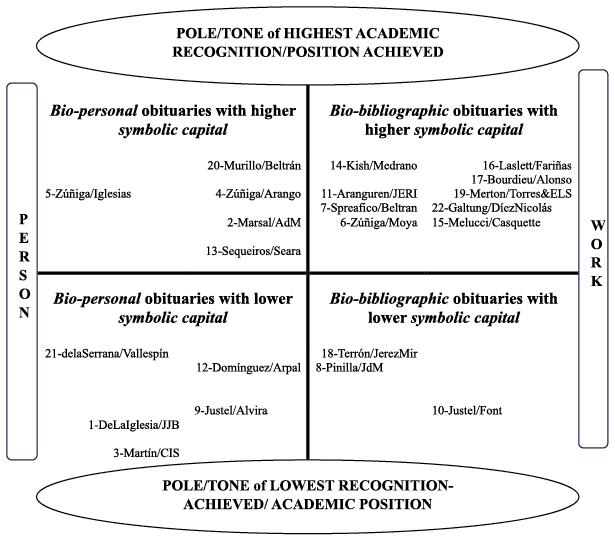
The obituary accounts analysed here have shown a double narrative configuration (Conde, 2009) resulting from the interweaving of a horizontal biographical axis (private pole of personal life versus the public pole of academic life) and a vertical hierarchical-classist axis (according to the greater or lesser recognition of the academic position achieved). This polarisation was finally chosen, replacing the aristocratic vs. democratic pole, to integrate Bourdieu’s (1988, 2007, 2015) contribution on the struggles for symbolic capital in the scientific field. Figure 1 shows the results of this analysis. The location of each obituary on this typological-discursive map represents the correspondence of its positioning on the axes referred to above; that is, its proximity to, or distance from, the corresponding poles. In the upper-right quadrant, the most numerous are what have been called bio-bibliographical obituaries with greater symbolic capital, devoted to highly renowned colleague-mentors, particularly in recognition of their published work and their national or international honours. While in the upper-left quadrant are what have been labelled bio-personal obituaries, also with similar capital, of colleagues-teachers or friends valued more for their personal attributes, their teaching or their management work than for their published or research work. Both types have a complementary necrological form with less symbolic capital, applied to colleagues who were less well known or who had fewer disciples.
Other tributes
This section summarises the issues mentioned in brackets in the title of the paper, given the editorial constraints. As with the years in which no obituaries appeared in the REIS, which required reference to other Spanish sociological journals, it is also necessary to consider tributes published elsewhere, whether during scholars’ lifetimes or after their death, and not necessarily associated with the REIS. This applies not only to the journal’s host institution (CIS), although it has played an important role as a promoter and editor of such tributes. While these materials cannot be examined in detail here, they inform the more comprehensive contextual analysis of academic obituaries. Moreover, some of these refer to lifetime tributes, in their various forms (academic events, books or other media, and awards), as a curricular distinction for the deceased.
Again, the premature deaths of colleagues (very numerous, as noted in the REIS obituary period) made a notable difference. Their sudden and early nature explains why lifetime tributes for them were not held, as these commemorative events are typically held around the age of retirement. By contrast, some of the obituaries for colleagues who died at an advanced age concern international peers (cases 14, 16, 19 and 22), for whom such lifetime and posthumous tributes tend to be organised primarily by their home institutions. An exceptional case of a double posthumous tribute promoted by the CIS (among others, see Valles, 2023) was that for Alain Touraine. It consisted in a commemorative event held in December 2023 and a book published in June 2024 in the Classics of Social Thought series.
Case 17, on the life and work of Bourdieu, deserves individual consideration here. He died at the age of seventy-one and was the subject of both strong affinities and marked aversions before and after his death, as his Spanish obituarist and promoter of other tributes pointed out (Alonso, 2021). Outside Spain, Swartz, who promoted the special issue on Bourdieu in Theory and Society (vol. 32, 2003) and authored the 2013 book Symbolic Power, Politics, and Intellectuals: The Political Sociology of Pierre Bourdieu, also argued for middle-ground discursive and academic practices for assessing the work of this exceptional scholar. Such practices are intended to avoid the extremes that may arise from discipleship passion and the profanation of colleagues or works regarded as sacred.
Discussion and conclusions
The review of the literature on the sociology of death, as a theoretical and empirical framework for the study of academic obituaries, has led us to discover a field of specialisation with a variety of contributions mainly made by colleagues outside Spain. This literature has focused particularly on obituaries published in the media, rather than in the journals of the various social science disciplines. A significant number of academic obituaries have been published in the main Spanish sociological journals, but little attention has been paid to the sociological analysis of this material.
The main focus of this article has been on the obituaries published in the REIS from its inception in 1978 until 2024. In order to analyse and understand the REIS case, it has been necessary to contextualise it in two ways. On the one hand, within the panorama composed of other journals that share their field of knowledge, some of which have been founded in the 21st century. On the other hand, the REIS, like other journals, is located in organisations that also offer living and posthumous tributes other than the journal format, which should be considered and included in the case study. It is precisely this dual context that is lacking in some of the typological proposals on obituaries in the literature.
Another feature that characterises the analysis of academic obituaries based on the case of the REIS has been the emphasis placed on the relational plurality between the obituarised colleagues and their obituarists, while taking into account the dual context referred to above. This in turn has been linked to two processes addressed in the literature: the process of making academic networks and biographies visible, and what has come to be called mutual consecration. In both processes, obituaries are instructive and a source of learning about discursive practices in which a redundant narrative structure emerges, as identified through the narrative and discursive analysis undertaken. This structure involves the biographical polarity between the private and personal history, on the one hand, and the public and academic trajectory, on the other. The latter intersects with a further polarity of greater or lesser recognition according to the academic position attained, understood in terms of symbolic capital. Each type of academic obituary results from the dosage and combination of these polarities, as well as being profiled according to the characterisation set out in the results section. The obituary genre observed in the REIS offers a wide range of ways of honouring the lives and legacies of those who preceded us in the profession, which will need to continue to be compared with academic obituaries published by other journals and by editorial bodies or institutions that promote this and other types of tributes. The case of the REIS and the CIS were selected as an initial step in the sociological study of obituaries within Spanish academic sociology due to its strategic character, openness to related disciplines, and the broad time span encompassed by the obituaries published between 1978 and 2024. This temporal breadth has facilitated the observation and analysis of their typological evolution as a key narrative and discursive genre in the development of the sociology of death and of scientific communities.
Bibliography
Alburquerque, Francisco (2024). Cambiar la sociedad. Recuerdos de la universidad franquista and de una transición inacabada. Madrid: Catarata.
Alonso, Luis E. (ed.) (2021). Siempre nos quedará Bourdieu. Madrid: Círculo de Bellas Artes.
Bourdieu, Pierre (1988). Homo academicus. Cambridge: Polity Press.
Bourdieu, Pierre (2007) [1980]. El sentido práctico. Buenos Aires: Siglo XXI.
Bourdieu, Pierre (2015). Sociologie générale, volume 1. Cours au Collège de France (1981-1983). Paris: Raisons d’agir.
Boyce, Charlotte and Dove, Danielle M. (2022). “Obituary, Gender, and Posthumous Fame: The New York Times Overlooked Project”. Celebrity Studies, 13(4): 507-523.
Bytheway, Bill and Johnson, Julia (1996). “Valuing Lives? Obituaries and the Life Course”. Mortality, 1(2): 219-234.
Cachón-Rodríguez, Lorenzo (2024). “Las almas del pueblo negro de Du Bois 120 años después: una filosofía política emancipadora”. Revista Española de Investigaciones Sociológicas, 188: 39-54.
Conde, Fernando (2009). Análisis sociológico del sistema de discursos. Madrid: CIS.
Connerton, Paul (1989). How Societies Remember. Cambridge: Cambridge University Press.
De Miguel, Amando (1973). Homo Sociologicus Hispanicus. Para entender a los sociólogos españoles. Barcelona: Barral Editores.
De Miguel, Jesús M. (2020). “What Medical Students Learn about Death and Dying”. Sociology International Journal, 4(1): 7-20.
Díaz Martínez, Capitolina (2022). Presentación. In: H. Martineau. Cómo observar la moral and las costumbres. Madrid: CIS.
Faunce, William A. and Fulton, Robert L. (1958). “The Sociology of Death: A Neglected Area of Research”. Social Forces, 36(3): 205-209.
Fernández, Cristina B. (2015). “La construcción de la imagen del intelectual en las notas necrológicas de la Revista de Filosofía”. Latinoamérica. Revista de Estudios Latinoamericanos, 1: 187-206.
Fowler, Bridget (2004). “Mapping the Obituary: Notes Towards a Bourdieusian Interpretation”. The Editorial Board of the Sociological Review, 52(2): 148-171.
Fowler, Bridget (2005). “Collective Memory and Forgetting: Components for a Study of Obituaries”. Theory Culture & Society, 22: 53-72.
Fowler, Bridget (2007). The Obituary as Collective Memory. London: Routledge.
Fowler, Bridget (2015). The Media and Collective Memory: The Obituaries of Academics. In: Dawson, M.; Fowler, B.; Millerand, D. and Smith A. (eds.). Stretching the Sociological Imagination. Palgrave Macmillan.
Francescutti, Luis P. (2019). “El panteón de papel: élites tradicionales and cultura de masas en las necrológicas españolas”. Estudios sobre el Mensaje Periodístico, 25(3): 1403-1419.
Fuente Escribano, Alejandro de la (2017). “Hacia una definición del obituario en la prensa española. El caso de ‘El País’”. Index comunicación, 7(1): 45-70.
Halbwachs, Maurice (ed.) (1992). On Collective Memory. Chicago: The University of Chicago Press.
Hamann, Julian (2016). “‘Let Us Salute One of Our kind’: How Academic Obituaries Consecrate Research Biographies”. Poetics, 56: 1-14.
Heynderickx, Priscilla C.; Dieltjens, Sylvain M. and Oosterhof, Albert (2019). “The Final Fight: An Analysis of Metaphors in Online Obituaries of Professional Athletes”. OMEGA—Journal of Death and Dying, 79(4): 364–376.
Jacobsen, Michael H. (2016). “‘Spectacular Death’—Proposing a New Fifth Phase to Philippe Ariès’s Admirable History of Death”. Humanities, 5(2): 1-20.
Jacobsen, Michael H. (ed.) (2021). The Age of Spectacular Death. London: Routledge.
Kania-Lundholm, Magdalena (2019). Digital Mourning Labor: Corporate Use of Dead Celebrities on Social Media. In: Holmberg, T.; Jonsson, A. and Palm, F. (eds.). Death Matters. Cultural Sociology of Mortal Life. Switzerland: Springer & Palgrave.
Kearl, Michael (2009). Death, Sociological Perspectives. In: Bryant, C. D. and Peck, D. L. (eds.). Encyclopedia of death and the human experience. Thousand Oaks, California: SAGE.
Macfarlane, Bruce and Chan, Roy Y. (2014). “The Last Judgement: Exploring Leadership in Higher Education through Academic Obituaries”. Studies in High Education, 39(2): 294-306.
Maestre, Juan (2021). University Transfer. Sevilla: Red de Impresión.
Marí-Klose, Marga and De Miguel, Jesús M. (2000). “El canon de la muerte”. Política and Sociedad, 35: 115-143.
McGlashan, Mark (2021). “Networked Discourses of Bereavement in Online COVID-19 Memorials”. International Journal of Corpus Linguistics, 26(4): 557-582.
Mosquera, Alexander (2014). “Los obituarios en internet como rito de paso virtual de la actualidad”. TELOS. Revista de Estudios Interdisciplinarios en Ciencias Sociales, 16(1): 95-110.
Parra Luna, Francisco (2001). Campus Adentro. Madrid: Huerga and Fierro Editores.
Piumbato, María C.; Masson, Alexandre and Massao, Carlos R. (2021). “Obituarios académicos and homenajes póstumos: legados científicos para el campo de la Cienciometría”. Rev. General de Información y Documentación, 31(1): 369-394.
Powell, Jason (2022). Sociology of Aging and Death. Switzerland: Springer.
Puri, Jyoti (2021). “The Forgotten Lives of Sociology of Death: Remembering Du Bois, Martineau and Wells”. The American Sociologist, 52: 638-655.
Riley, John W. (1983). “Dying and the Meanings of Death: Sociological Inquiries”. Annual Review of Sociology, 9: 191-216.
Starck, Nigel (2004). Writes of passage: a comparative study of newspaper obituary practice in Australia, Britain, and the United States. Flinders University of South Australia. [Doctoral thesis].
Sumiala, Johanna and Jacobsen, Michael H. (2024). “Digital Death and Spectacular Death”. Social Sciences, 13(2): 1-11.
Tight, Malcolm (2008). “Dead Academics: What Can We Learn About Academic Work and Life From Obituaries?”. London Review of Education, 6(2): 125-135.
Valles, Miguel S. (2022). “Remirando la investigación social cualitativa made in Spain de los últimos lustros, en clave metodológica de trastienda, archivo and calidad”. Papers, 107(4): 1-28.
Valles, Miguel S. (2023). “Amando de Miguel in memoriam (1937-2023). Recuerdos de un maestro abierto a la sociología and la metodología cualitativista”. Sociología del trabajo, 103: 101-106.
Walter, Tony (1993). Sociologists never die: British sociology and death. In: Clark, David (ed.). The Sociology of Death. Basingstoke: Macmillan.
Walter, Tony (2008). “The Sociology of Death”. Sociology Compass, 2(1): 317-336.
Walter, Tony (2017). How the dead survive: ancestor, immortality, memory. In: Jacobsen, M. H. (ed.). Postmortal Society. Farnham: Ashgate.
Walter, Tony and Bailey, Tara (2020). “How Funerals Accomplish Family: Findings from a Mass Observation Study”. Omega—Journal of Death and Dying, 82(2): 175-195.
Williams, Joyce E. (1997). “Discourses on Death: Obituaries and the Management of Spoiled Identity”. Omega—Journal of Death and Dying, 34(4): 301-331.
Williams, Joyce E. (2003). Obituaries. In: Bryant, C. D. (ed.). Handbook of death and dying. Thousand Oaks, CA: Sage.
Williams, Joyce E. (2009). Obituaries, Death Notices, and Necrology. In: Bryant, C. D. and Peck, D. L. (eds.). Encyclopedia of Death and the Human Experience. Thousand Oaks, CA: Sage.
1 This article focuses on academic obituaries and other tributes. Beyond funerals themselves, disciplinary journals constitute a significant arena and a strategic context for sociological observation, alongside the press and other commemorative practices. Unlike in-person funerals, this is a virtual form of encounter pertaining to communities whose shared reference point for knowledge and recognition lies in published text.
2 A concept, coined by Kenneth J. Doka in 1989, referring to forms of grief that are less recognised from a socio-cultural viewpoint: the death of pets or of loved ones with whom we are not related by blood.
3 The first Spanish edition of Martineau's work was published in November 2022. Capitolina Díaz (2022: 7 and 13) was the author of an introductory piece that helped to contextualise and assess the contributions of “our methodologist”, a pioneering sociologist who was a precursor of Durkheim’s work on suicide and examined moral values through epitaphs, among other empirical materials.
4 "What, then, is the obituary, sociologically speaking?" (Fowler, 2005: 61). She answered the question on the same page: "a semi-ritualised nexus of ethical, political and professional worlds", "a verdict, derived from professional peers, about the worth of the dead person’s contribution".
5 The expression campus adentro (inside campus) has been taken from the homonymous book (Parra, 2001). Another critical personal testimony of lived experience of Spanish university structures can be found in the autobiographical work by Juan Maestre (2021). These are two made in Spain versions of Homo Academicus and other works by Bourdieu, to be complemented by the early work of Amando de Miguel (1973), with echoes of Ralf Darendorf's Homo Sociologicus of 1968. All three Spanish authors mentioned have achieved the status of emeritus professors in sociology. The critical view contained in their writings on academia, scholarship practice and the practitioners of their university speciality has been further pursued in Alburquerque's most recent work (2024).
6 Years earlier, Tight (2008: 127) described this work as follows: "The only academic study which touches on academic obituaries in particular of which I am aware, is by Bourdieu (1988)". It was further specified that Bourdieu analysed thirty-four obituaries, examining the relationship between social origin and academic success on the basis of an alumni yearbook from a French elite institution for the period 1962–1965.
7 In 2023 and 2024, particular attention was given to the study of academic obituaries. There were sudden deaths of students whose academic lives I had been involved in as a lecturer (Sandra González Clavería), which included participation in a posthumous commemorative event (Daniela Rojas Salas). This sociological piece of research is also dedicated to them.
8 A practice of constant and distant comparison learned from Barney Glaser and Anselm Strauss, and further developed by those who have taken up their legacy by innovating and extending the classical methodological proposal and its variants, including colleagues such as Kathy Charmaz and Adele Clarke.
9 This is the only anonymous obituary, as it is not personally signed but only bears the CIS seal. The obituary subject was a member of the CIS’s technical or administrative staff, rather than of the academic teaching and research staff within the social sciences.
10 Case 10 is particularly distinctive, as only the first three paragraphs of the article were devoted to the individual and then focused exclusively on the work, specifically on electoral abstention, the area of specialisation of the deceased, with whom the author of the obituary had had a cordial intellectual disagreement.
11 This is the designation proposed here, as specified in Figure 1. The expression "bio-bibliography" was also used by the author of Obituary 17 in one of the headings.
12 This modality, inaugurated in case 1, reappears in case 12, where the death occurred while the deceased colleague’s article was already in press. It was a contribution to a monographic issue of the journal.
13 The tribute to Salvador Giner took two forms. The first was an introduction to the Personalia section written by the editor of the RIS. The second, by Manuel Pérez Yruela, was a republished article on Giner’s work that included the response Giner had written to that text.
14 It was founded in 1963, but only published Issue no. 0 (illegally, as it was censored by Franco’s regime) and Issue no. 1 (legally) before it was closed.
15 This is something I expected to find, given the observation-participation in the university field and the results of authors such as Macfarlane and Chan (2014).
16 The case of Alfonso Ortí has been dealt with elsewhere to develop and connect these and other concepts, starting from the so-called bibliographic tribute in life (Valles, 2022).
TABLe 1. Obituaries published in the REIS (1978-2024)
|
CASE NO. |
Obituarised colleague |
Journal year (and issue no.) |
Year of death |
Age at death (years) |
Author of the obituary |
Text word count |
|
1 |
Ángel de la Iglesia |
1978 (REIS 2) |
1978 |
58 |
José Jiménez Blanco |
390 |
|
2 |
Juan Francisco Marsal |
1979 (REIS 5) |
1979 |
51 |
Amando de Miguel |
412 |
|
3 |
J. L. Martín Martínez |
1981 (REIS 16) |
1981 |
51 |
CIS |
197 |
|
4 |
Luis Rodríguez-Zúñiga |
1991 (REIS 54) |
1991 |
49 |
Joaquín Arango |
472 |
|
5 |
Luis Rodríguez-Zúñiga |
1991 (REIS 54) |
1991 |
49 |
Carmen Iglesias |
1279 |
|
6 |
Luis Rodríguez-Zúñiga |
1991 (REIS 54) |
1991 |
49 |
Carlos Moya |
1885 |
|
7 |
Alberto Spreafico |
1991 (REIS 56) |
1991 |
63 |
Miguel Beltran |
1403 |
|
8 |
E. Pinilla de las Heras |
1994 (REIS 67) |
1994 |
71 |
Jesús M. De Miguel |
246 |
|
9 |
Manuel Justel |
1995 (REIS 71) |
1995 |
50 |
Francisco Alvira |
681 |
|
10 |
Manuel Justel |
1995 (REIS 71) |
1995 |
50 |
Joan Font Fábregas |
11310 |
|
11 |
J. L. Lopez Aranguren |
1996 (REIS 74) |
1996 |
86 |
J. E. Rodríguez Ibáñez |
1329 |
|
12 |
Iñaki Domínguez |
1998 (REIS 84) |
1998 |
48 |
Jesus Arpal |
217 |
|
13 |
José Luis Sequeiros |
1999 (REIS 87) |
1999 |
47 |
Luis González Seara |
680 |
|
14 |
Leslie Kish |
2000 (REIS 92) |
2000 |
90 |
Juan Díez Medrano |
437 |
|
15 |
Alberto Melucci |
2001 (REIS 96) |
2001 |
58 |
Jesus Casquette |
2042 |
|
16 |
Peter Laslett |
2001 (REIS 96) |
2001 |
85 |
Diego Ramiro Fariñas |
2022 |
|
17 |
Pierre Bourdieu |
2002 (REIS 97) |
2002 |
72 |
Luis Enrique Alonso |
9432 |
|
18 |
Eloy Terrón |
2002 (REIS 98) |
2002 |
83 |
Rafael Jerez Mir |
4456 |
|
19 |
Robert K. Merton |
2002 (REIS 100) |
2003 |
92 |
C. Torres and E. Lamo |
6446 |
|
20 |
Francisco Murillo |
2004 (REIS 107) |
2004 |
86 |
Miguel Beltran |
2846 |
|
21 |
J. L. García de la Serrana |
2004 (REIS 107) |
2004 |
58 |
Fernando Vallespin |
1426 |
|
22 |
Johan Galtung |
2024 (REIS 187) |
2024 |
93 |
Juan Díez Nicolás |
1458 |
Source: Prepared by the author.
FIGURE 1. Types of academic obituaries (REIS, 1978-2024)17
17 Except in exceptional circumstances, higher or lower recognition corresponds to a higher or lower academic position attained. It is this higher or lower recognition that generates higher or lower symbolic capital. Therefore, both dimensions can be grouped along the horizontal axis under a single label, namely highest recognition and academic position attained, and this label can then be operationalised by reference to highest or lowest symbolic capital.
Source: Prepared by the author.
RECEPTION: January 03, 2025
REVIEW: March 14, 2025
ACCEPTANCE: September 10, 2025