The Income Gap between Natives and Immigrants in Spain According to their Education Level
La brecha de rentas entre nativos e inmigrantes en España según
su nivel educativo
Rubén Baeza-Cabrera and Mauro Mediavilla
|
Key words Income Gap
|
Abstract Since 2016, Spain has consistently ranked as the European Union Member State with the second highest annual inflow of immigrants. Almost 40 % of them are aged between twenty and thirty-five years old. Spanish society therefore faces the challenge of helping immigrants enter the labour market. This study analyses how the income gap between natives and first-generation immigrants varies according to their education level, differentiating between EU and non-EU nationals. The data were obtained from the Encuesta de Condiciones de Vida (Living Conditions Survey) conducted by the Instituto Nacional de Estadística (INE) (Spanish National Statistics Institute) for the years 2019 and 2023. After applying the Oaxaca–Blinder methodology to the data, it was found that an increase in educational attainment was associated with a wider income gap. These are new findings, as no similar research has been conducted in Spain. |
|
Palabras clave Brecha de ingresos
|
Resumen Desde 2016, España es el segundo país de la Unión Europea que más inmigración recibe anualmente y casi el 40 % de los inmigrantes son personas de entre veinte y treinta y cinco años. Dada esta situación, la sociedad española enfrenta el reto de ayudar a los inmigrantes en su inserción laboral. Este estudio analiza cómo varía la brecha de rentas entre nativos e inmigrantes de primera generación según su nivel educativo, diferenciando entre comunitarios y no comunitarios. Utilizando datos de la Encuesta de Condiciones de Vida del INE de los años 2019 y 2023, así como la metodología de Oaxaca y Blinder, se encontró que, cuanto mayor sea el nivel educativo, mayor es la brecha de rentas. Los hallazgos obtenidos en este trabajo son novedosos, pues no existe un estudio similar para el caso español. |
Citation
Baeza-Cabrera, Rubén; Mediavilla, Mauro (2026). “The Income Gap between Natives and Immigrants in Spain According to their Education Level”. Revista Española de Investigaciones Sociológicas, 194: 5-24. (doi: 10.5477/cis/reis.194.5-24)
Rubén Baeza-Cabrera: Universitat de València / IVIE/EVALPUB | ruben.baeza@ivie.es
Mauro Mediavilla: Universitat de València / EVALPUB | Mauro.Mediavilla@uv.es
Following the economic recovery from the Great Recession, Spain has once again become a net recipient of immigrants, as it was in the years prior to the crisis, when migrant inflows reached record levels. According to the Instituto Nacional de Estadística (INE), in 2007, the year preceding the Great Recession, Spain received more than nine hundred thousand foreign-born immigrants (INE, 2021), the highest figure in a calendar year until 2022 (INE, 2022a). This trend reversed with the onset of the crisis, and between 2010 and 2014 the net migration balance among foreign-born individuals was negative, which amounted to nearly four hundred thousand people in total. Half of these departures occurred in 2013, when two hundred thousand foreign-born immigrants left Spain (INE, 2022b). When the economy started to recover, Spain recorded a positive net migration balance of foreign-born individuals in each year from 2015 to 2022, the most recent year for which data were available when this research began (February 2024). It has now become one of the countries with the highest levels of migration inflows worldwide (INE, 2022a; INE, 2022c). In 2022, more than 1.1 million foreign-born immigrants arrived in Spain (INE, 2022a), which meant that it was the country in both the OECD (2024) and the European Union (Eurostat, 2024) to receive the highest number of immigrants from other countries, second only to Germany.
The most current statistical data available at the start of this study were those from the INE’s Estadística del Padrón Continuo de 2022 (2022 Continuous Register Statistics). According to these data, the foreign-born immigrant population amounted to 7.5 million citizens registered in Spanish municipalities’ registers. Given that Spain’s total registered population was approximately 47.5 million, these 7.5 million citizens accounted for 15.9 % of the total. These data represent the highest number of foreign-born immigrants in Spain in its entire history, both in absolute terms and as a percentage of the total population (INE, 2022d). Of the total number of foreign immigrants, 1.5 million were EU foreign nationals, that is, born in an EU member state other than Spain. This group represented 3.3 % of the resident population registered. The number of non-EU foreign immigrants (born in a country outside the European Union) was close to six million, which accounted for 12.6 % of the total registered population (INE, 2022d).
The majority of this immigrant population was of working age or in the process of completing their education. About 40 % were between twenty and thirty-five years old (INE, 2022c). Therefore, apart from their socio-cultural integration, the main challenge faced by these immigrants was entering the labour market and identifying employment opportunities that were available to them. The OECD report entitled International Migration Outlook 2007 (2007) concluded that:
In all of the countries considered, at least 25 %, and on average nearly 50 %, of skilled immigrants between 15 and 64 years of age are inactive, unemployed or relegated to jobs for which they are over-qualified.
Moreover, as the literature indicates, immigrants face greater difficulties in securing employment (Auer, Bonoli and Fossati, 2017; Carlassare, Mendieta and Jacinto, 2021; Bayona-i-Carrasco and Domingo, 2024); and even when they find work, a wage gap persists between them and native workers (Huang and Anderson, 2019; Amo-Agyei, 2020). Thus, the barriers they encounter upon attempting to join and entering into the Spanish labour market are twofold.
Education is a key factor when analysing the determinants that most influence individuals’ earnings (Card, 1999; Blundell, Dearden and Sianesi, 2005). This paper seeks to provide new evidence on whether the education level of immigrants (defined in this paper as foreign-born nationals) enhances their entry into the labour market. To examine immigrants’ entry into the labour market and the extent to which their educational attainment influences this process, the study analyses the evolution of the income gap between native and immigrant workers in Spain across different education levels. The analysis is grounded in signalling theory or the use of education as a filter (Arrow, 1973; Spence, 1973). This analysis of the gap between native-born and immigrant population and its evolution according to the educational attainment of individuals in each of these groups provides a novel insight into this area, given that no similar research has been conducted on the Spanish labour market.
In order to calculate the gap between the earnings of native-born and foreign-born individuals, a distinction will be made between EU immigrants and non-EU immigrants, according to their country of birth. This classification of immigrants into two groups is used because studies have shown that the income gap between immigrants and natives in Spain differs according to their country of origin: the gap between Spanish-born and European Union workers is smaller, as the latter are more likely to have access to better jobs than non-EU immigrants (Ruiz and Gómez, 2010; Amuedo-Dorantes and Rica, 2008). The data to be used are taken from the Encuesta de Condiciones de Vida (ECV) (Living Conditions Survey) carried out by the INE for 2019 and 2023, merged into a single database. The database resulting from merging these two ECV Surveys contains 36 630 observations, of which 31 827 correspond to individuals born in Spain, 3719 to non-EU immigrants and 1084 to EU immigrants.
In this paper, we will use one of the most widely used methodologies in the literature that studies earnings or income gaps between different groups, as initially used by Oaxaca (1973) and Blinder (1973) and subsequently applied in a large number of studies (Antón, Bustillo and Carrera, 2010; Machado and Mata, 2005; Albrecht, Björklund and Vroman, 2003; Rica, Dolado and Llorens, 2008; Díaz and Ojeda, 2020). The methodology used is based on the calculation and subsequent decomposition of the gross income gap between native and immigrant workers. The estimates of the expected wages for each group of individuals will be made on the basis of a modified Mincer equation, which will be explained in the methodology section.
The results obtained in this paper show that, for the three education levels studied in this paper, there is a positive income gap for native workers. A large part of this income gap can be is explained by the difference in the remuneration of their human capital, a difference that is positive for the native-born population. These results are largely consistent with much of the existing literature on this issue and show how, even if immigrants attain the same level of education as natives, they are not equally remunerated in the Spanish labour market.
Section two provides a literature review and section three contains a discussion of the databases and methodology used. The fourth section shows the results obtained in the research and, the final section presents the conclusions drawn from the study.
There is a large body of research in the economic literature concerned with immigrant populations and their performance in the labour market. Most of the studies on this topic investigate the income gaps that often exist between natives and immigrants, as well as their causes.
A large number of theories and models have been put forward to explain these wage differentials, including human capital theory (Becker, 1964), segmented labour market theory (Piore, 1969) and discrimination theory (Becker, 1957). Both the signalling theory or theory based on the use of education as a filter are also widely used in labour and education economics. Early precursors of this theory were Michael Spence (1973), Kenneth J. Arrow (1973) and Joseph E. Stiglitz (1975). The basic idea of this theory is that there is asymmetric information in the labour market: while workers know their level of productivity, their productive capabilities are not known to employers prior to hiring them; it is not until workers have started to perform their duties in the new job that the employer knows their real productivity in that job. Michael Spence, in Job Market Signaling, illustrated the behaviour of individuals in the following way.
In the labour market there are two parties: employers (who do not know the real productivity of the workers being employed) and employable individuals (who know their productivity). Individuals who are employed (hereafter referred to as “workers”) can be classified according to their productivity; for the sake of simplicity, the author divides them into two groups, Group I, high-productivity workers, and Group II, low-productivity workers. Given the asymmetric information problem faced by the employer, the wage offered to workers is equivalent to a “lottery”. This means that the wage proposed will be equal to the proportion of workers of Type I (which is represented by qI) multiplied by their marginal productivity (MgPI) plus the proportion of workers of Type ii (1-qI) multiplied by their marginal productivity (MgPII), as seen in the following equation:

In this situation, workers in Group II will have incentives to send signals to the market to show what kind of workers they are, as the wage they are currently paid is lower than their productivity. Employers will also have an incentive to encourage workers to send out signals, as Type I workers are being paid a wage above their productivity level. The authors of this theory argue that one of the signals that workers can send out is their highest educational attainment achieved, since they assume that the capabilities that make individuals more productive in the workplace are also useful for them to be successful in terms of achievement in the education process. By moving up the education levels, workers show employers that they have capabilities (which they are “signalling”) that Type I workers (the less productive workers) do not have, as they do not have the capacity to achieve the same education levels as Type II workers.
In this theory, the term “capabilities” refers to the inherent productive potential of workers, i.e. those characteristics that determine their efficiency or value in the labour market, but which are not directly observable by employers. These skills are not strictly interpreted as “competences”, as this concept refers to a combination of knowledge, skills and attitudes applied in specific contexts. In contrast, “capabilities” in signalling theory relate to those qualities that enable an individual to perform more productively (Weiss, 1995).
This theory contrasts with human capital theory (Becker, 1964), which considers education to be a process by which individuals acquire the skills that will subsequently make them more productive, while education-as-a-filter theory understands education as a way of signalling innate skills in individuals that make them more productive workers.
Characterised by structural rigidity and segmentation (Álvarez de Toledo, Núñez and Usabiaga, 2020), the Spanish labour market also exhibits persistently high unemployment (García-Cintado, Romero-Ávila and Usabiaga, 2014) and a significant overeducation issue (Turmo-Garuz, Bartual-Figueras and Sierra-Martínez, 2019), as the literature has shown. Overeducation is a recurrent problem in the Spanish labour market, which has long been studied in the economic literature (Alba-Ramírez, 1993; Nieto and Ramos, 2017) and also affects the immigrant population (Simón, Sanromà and Ramos, 2008).
The prevalence of overeducated workers in the Spanish labour market may suggest that education has diminished its effectiveness as a signal of productivity in the labour market. Despite this, the use of the Oaxaca (1973) and Blinder (1973) decomposition technique in this paper, as detailed in the methodology section, allows us to obtain the part of the income gap that can be explained by the difference in workers’ skills and the part that can be explained by the difference in the coefficients.
The estimated coefficients measure how the dependent variable of the econometric model (the natural or Napierian logarithm of the hourly wage, as will be explained later) changes as workers’ skills (explanatory variables in the model) vary. Thus, the part of the gap explained by the difference in the coefficients shows the differences in the remuneration of the skills paid to the groups of workers being compared.
Thus, if the remuneration of individuals’ skills is interpreted as the way in which employers interpret the signal that workers are emitting with their skills (that is, their productivity), when the focus is on education, this gap can be interpreted as the difference in employers’ perception of the signal that native-born and foreign-born workers send out to the labour market through their educational attainment.
Apart from this purely economic approach to the income gap between the native and the foreign-born population, it is also interesting to study it from a sociological perspective. Inequalities between Spanish-born and immigrant workers in the labour market should be understood as a manifestation of broader structural processes of social stratification. Far from being differences solely attributable to human capital, these inequalities result from labour market segmentation mechanisms which, as Doeringer and Piore (1971) argued, shape differentiated employment spaces, in which immigrants are systematically relegated to low-skilled sectors, with high turnover and low social protection coverage. Recent empirical evidence confirmed the persistence of these processes, such as the so-called “African gap”, documented by Gastón-Guiu, Treviño and Domingo (2021), or in more recent studies such as that by Aldaz Odriozola and Eguía Peña (2024).
Despite the extensive body of literature addressing immigration and income gaps between the native and the immigrant population, this study offers a new perspective by focusing on how the income gap between native-born and foreign-born workers evolves as the latter attain higher levels of education, drawing on a well-established and widely used theoretical framework.
The data used in this study were obtained from the INE’s ECV. To create the database used in this paper, we merged the 2023 ECV (the most recent ECV at the start of this paper) and the 2019 ECV. The 2019 ECV was selected instead of the 2022 ECV (which might initially appear the more logical choice), due to the structure of this survey. As the INE’s methodological section related to the 2024 ECV explained, the survey sampling strategy used a rotating panel design:
[...] the sampling design follows a rotating panel structure in which the sample consists of four annual panels. Individuals in each panel remain in the sample for four consecutive years [...] resulting in a three-quarter overlap between the sample in any given year and that of the previous year (INE, 2024).
Thus, if the new database had been created by merging the ECV for 2023 and 2022, three quarters of the individuals would have been counted twice, as they would appear in both databases. Therefore, in order to ensure that there were no duplicate observations in the sample, it was necessary to go back four years to ensure that the individuals included in the database would be unique, that is, they would not be counted twice.
All individuals who were not active in the labour force, as well as those for whom information was unavailable for any of the variables employed in calculating the income gap, were excluded from the database. We also removed those observations in which the real gross hourly wage was less than one, which we considered outliers and generated significance problems in the estimated variables. Subsequently, the two databases resulting from this screening were merged into a single new database, which contained 36 630 observations, of which 31 827 corresponded to Spanish-born individuals, 3719 to non-EU immigrants and 1084 to EU immigrants. This new database provided a highly representative sample of the composition of Spanish society today. Compared with the INE’s Estadística del Padrón Continuo de 2022, non-EU immigrant workers represented 10.2 % of our database, whereas this population group made up 12.6 % of Spanish society. A closer resemblance could be seen for EU immigrants, who represented 3.0 % of this sample and 3.3 % in the country as a whole.
Subsequently, individuals were classified according to their education level and placed into three groups: compulsory education, post-compulsory secondary education and higher education. Individuals with compulsory education were deemed to be those individuals who had completed at most their compulsory secondary education. Individuals with post-compulsory secondary education were classified as those who had obtained an upper secondary (or similar) education qualification or a post-secondary non-tertiary education qualification. The third group of workers, those with higher education, were those who had completed their studies in upper vocational training, plastic arts and design and sports (or equivalent qualification), and those who held university degrees or postgraduate degrees (Master’s degrees, university’s own expert degrees, etc.) or who had obtained a doctorate. This classification was made according to the structure set out in Organic Law 2/2006 on Education (LOE), as amended by Organic Law 3/2020 (LOMLOE).
The objective of the analysis carried out in this paper was to study whether higher educational attainment among immigrants enables them to reduce the income gap with respect to the Spanish-born population with the same level of education.
The methodology originally developed by Oaxaca (1973) and Blinder (1973) was used to calculate the income gap between native and foreign-born workers and its subsequent decomposition. This approach has been used in numerous studies examining wage or income differentials between various groups, such as those by Antón, Bustillo and Carrera (2010), Machado and Mata (2005), Albrecht, Björklund and Vroman (2003), and Rica, Dolado and Llorens (2008), albeit with some variations.
The methodology proposed by Oaxaca and Blinder has been used to such an extent because it can be used to decompose the wage gap between the groups under study by differentiating between the gross gap, the gap attributed to the characteristics of individuals, the difference due to coefficients, the difference that cannot be explained (which is the gap between constant coefficients), and a fifth gap attributed to discrimination.
To calculate the gap, the following function was first estimated:
 [1]
[1]
In this function, the dependent variable is the natural logarithm of the real wage of individuals. On the other side of the equation,  is a vector that captures the observable characteristics of individuals;
  , the constant coefficient; and μ, the estimated error.
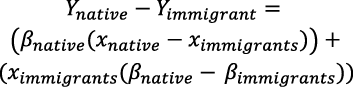
Once this function had been estimated for both groups, the authors decomposed the gross gap into the gaps explained above. In this paper, only the gap attributable to characteristics and the gap caused by differences in coefficients was decomposed. To calculate these two gaps, Blinder (1973) decomposed the gross gap as follows:
 [2]
[2]
In the formula,  is the gross gap,
  is the gap attributable to characteristics and
  is the gap caused by differences in coefficients.
In this study, the gap was calculated by estimating the equation below for each group (natives, EU immigrants and non-EU immigrants) and, within each group, for each of the three education levels:
 [3]
[3]
It should be noted that the constant estimator is not included in equation [3], unlike in equation [1]. The reason is that this approach would encounter a perfect collinearity problem, as the three education variables included in the observable characteristics matrix  cannot simultaneously have a value equal to zero, since all individuals are classified in one of the three education levels set out in the study.
Once equation [3] was estimated, the gap for each group was calculated as follows:
[4]
In the equation i may take the EU or the non-EU value, either in Yi or in xi.
In the model used to estimate the dependent variable, , is the natural logarithm of the real gross hourly wage. As the hourly wage variable was not captured in the ECV, it was a dummy variable that was created as follows:
Firstly, the database used in this paper is the result of merging the ECV for 2023 and 2019. In order to compare the gross wage for these two years, both variables had to be converted into real variables so that they could be homogeneous and comparable. The real income for both years was calculated by taking 2019 as the base year. Inflation for the period from December 2019 to December 2023 was obtained from the INE’s, Cálculo de variaciones del Índice de Precios de Consumo (Calculation of Variations in the Consumer Price Index). According to INE data, inflation for this period was 15.5 %. The real gross wage of individuals in the 2023 ECV was calculated by using the following formula:
[5]
Once the actual gross wage had been obtained, the number of hours per year worked by each individual works was calculated. For this purpose, the variable indicating the number of hours worked per week on average was selected for each employee and multiplied by four to calculate the total number of hours per month.
After the number of monthly hours had been obtained, it was multiplied by the number of months worked during the year. The total of this coefficient was interpreted as the total annual hours worked by each individual in the sample in the reference year. The formulas used were as follows:
[6]
[7]
To calculate the total number of monthly hours, the number of weekly hours was multiplied by four. Although each month has, on average, slightly more than four weeks (30.4 days), the additional days were interpreted as statutory holidays to which every worker is entitled—2.5 days per month worked (Ley del Estatuto de los Trabajadores, 2015).
Once the annual hours worked by each individual in the sample had been calculated, they were divided by the real gross wage, which was obtained using formula [5]. Thus, the formula for calculating the real gross hourly wage was:
[8]
As discussed above, the estimated model took the form of a Mincer equation, where the dependent variable was the natural logarithm of the gross hourly wage. It was decided to use the natural logarithm of gross hourly wage as the dependent variable because it allows the coefficients to be interpreted as percentage changes in wage and helps to reduce heteroskedasticity, which improves the efficiency of the estimates (Mincer, 1974; Wooldridge, 2010).
The observable characteristics matrix consisted of the variables, experience, experience2 and education level. In this case, the highest educational attainment was included, but not the years that the individual had spent in education, following the modification of the Mincer equation made by Barceinas et al. (2000). These authors argued that performance for an additional year of education is not linear, but varies when moving from one level of education to another. Following this line of reasoning, the dummy variables compulsory_education, post-secondary_education and higher_education were created, in accordance with the classification of education levels explained in the previous section. The dummy variable “female” was also included in addition to the variables mentioned above. Including this variable was a departure from some of the aforementioned articles—such as Blinder (1973) and Antón, Bustillo and Carrera (2010)—which used only native men as a reference group, and therefore omitted the gender variable from the model. In contrast, this paper followed a different group of studies which included gender as one of the observable characteristics affecting the real hourly wage received by the individual, such as those by Sanromá, Ramos and Simón (2009) and Fortin, Lemieux and Torres (2016).
Table 1 shows the mean values of the variables included in the estimated model and the gross hourly wage for the database used.
As shown in the table, on average, Spanish-born individuals were paid an hourly wage approximately €2.5 higher than workers from EU countries and about €4 higher than non-EU workers—equivalent to 24.8 % and 44.8 % more, respectively.
For the female, tertiary education, post-compulsory secondary education and compulsory education dichotomous variables, the average reflects the percentage of individuals in the sample who were part of the group that the variable represents; for example, the mean value of the variable “female” for native workers meant that 48 % of the workers were female. Based on this explanation, it is worth noting the differences in the percentage of workers with higher education qualifications. Whereas 49 % of native workers had achieved this level of education, the corresponding figures were 39 % for EU workers and 31 % for those from non-EU countries. However, the situation was reversed when looking at the percentage of workers who had attained at most compulsory education. The number of workers with only compulsory education among non-EU workers was 8 percentage points higher than among natives and 14 percentage points higher than among non-EU workers. Differences between the three groups of workers were also found in the years of experience. In this case, native workers had, on average, 21.73 years of experience compared to 19.90 years of experience for EU immigrants and 17.40 years for non-EU immigrants.
The estimation of the model explained in the previous section is presented first. The results of the estimations for each group of workers can be found in Annex 1.
The raw gap, the gap attributed to characteristics and the gap due to the coefficients (see equation [2]) are shown in Table 2.
The raw gap in the estimated equations was 0.20 between the natural logarithm of the real gross hourly wage of native workers and EU immigrants; and 0.36 with respect to non-EU workers. Thus, the gap was greater for non-EU immigrants. The difference between the two immigrant groups was 0.15, which was statistically significant at the 1 % level. This is consistent with the findings of previous studies which served as a reference for differentiating between the two immigrant population groups in this paper (Jiménez-García and Levatino, 2023; Amuedo-Dorantes and Rica, 2008; Ruiz and Gómez, 2010). On the other hand, when the gaps are decomposed, it can be seen that almost three quarters of the gap between Spanish-born and EU immigrants can be explained by differences in the coefficients. In contrast, the second gap that can be seen in Table 2, that is, the gap between the earnings of natives and non-EU immigrants, can be explained almost to the same extent by the gap attributable to the coefficients and characteristics.
This section presents an analysis of the income gap between native and immigrant workers according to their education level, which is the main objective of this study.
Table 3 shows the income gaps by education level: those between natives and EU immigrants appear in the first column, and those between natives and non-EU immigrants are shown in the second column.
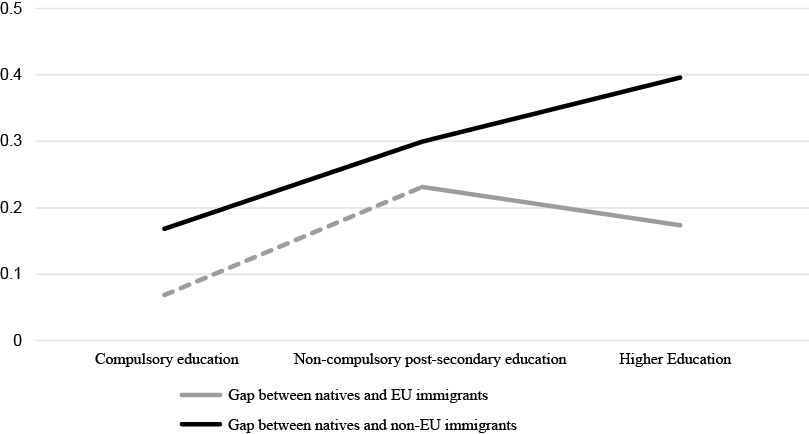
It can be observed that there was a significant gap between the native and the EU immigrant population among those whose highest level of education was non-compulsory post-secondary education, as well as among those who had completed higher education qualifications. By contrast, the gap between natives and non-EU immigrants was significant across all education levels. Moreover, the gap between natives and non-EU immigrants was also found to be larger than the gap between Spanish-born and EU immigrant workers, in line with the results shown in Table 2 and with the findings of the previous research cited above. However, the gap between natives and EU immigrants was found to have decreased when moving from post-secondary non-compulsory education to higher education; it went from 0.23 to 0.17. Conversely, the gap between natives and non-EU immigrants behaved differently, increasing progressively with higher levels of educational attainment. When moving from compulsory to post-secondary non-compulsory education, it increased from 0.17 to 0.30, and when moving from post-secondary non-compulsory education to higher education, it increased from 0.30 to 0.39; this development is shown in Figure 1. In this figure, the solid line represents the education levels for which the income gap was significant, while the dashed line represents the income gap that was not significant (only the gap between natives and EU immigrants with compulsory education was found to be significant).
Given these results, and following the approach used to analyse the raw gap shown in Table 2, the gaps between natives and the two immigrant groups were decomposed into the gap explained by characteristics and the gap explained by coefficients across all education levels where the gap was significant. The results of this decomposition are presented in Table 4.
Table 4 illustrates that the coefficients explain most of the gap with respect to the two groups and for all levels of education. When differentiating between different levels of education, it can be seen how the part of the gap explained by the differences in the coefficients also increased as the level of education increased. For example, the gap between natives and non-EU immigrants among individuals with, at the most, compulsory education was almost equally distributed between the part of the gap explained by the characteristics and the part of the gap explained by the coefficients. In contrast, when individuals had attained higher education, the gap that can be explained by characteristics only accounts for 9 % of the gap, while the remaining 91 % is explained by differences in the coefficients. A similar pattern was observed in the gap between natives and EU immigrants. However, from the level of post-secondary non-compulsory education onwards, more than 80 % of the gap is explained by differences in the coefficients, and for individuals with higher education, the coefficient-related component accounts for over 99 %.
In light of these results, it can be concluded that the different remuneration paid to native and immigrant workers, respectively, can be largely explained by the coefficients. This means that skills or abilities were not equally remunerated; wages varied depending on whether the worker was born in Spain or foreign-born. These results are aligned with the existing literature on the different remuneration of human capital between native and immigrant populations (Sanromá, Ramos and Simón, 2015; Simón, Sanromà and Ramos, 2008; Fortin, Lemieux and Torres, 2016; Aldashev, Gernandt and Thomsen, 2012; Basilio, Bauer and Kramer, 2017).
The results indicate that most of the income gap can be attributed to differences in the remuneration of human capital between native and immigrant workers. This finding accounts for the variation in the contribution of coefficient differences across education levels: the higher the level of education, the greater the remuneration individuals receive for their qualifications. When moving from one level of education to the next, the remuneration of natives was found to increase to a greater extent than the remuneration obtained by immigrants, thus widening the gap.
This paper has sought to provide new evidence on whether the education level of immigrants helps them to enhance their entry into the labour market. To examine immigrants’ entry into the labour market and the influence of their education level, the evolution of the income gap between native and immigrant workers (disaggregated by education level) has been used as an indicator.
The results obtained firstly confirm that there is a difference between the wage obtained by native workers and immigrant workers in the period under study, a difference that is favourable to the native population. Another finding that underpins the separation of immigrants into two groups is that there is also a gap between the wages earned by EU and non-EU immigrants. Based on these initial results, the income gap between native-born and foreign-born workers was decomposed following the methodology by Oaxaca (1973) and Blinder (1973), as explained above. This decomposition of the gap shows that most of the raw gap between Spanish-born and foreign-born workers is caused by differences in the remuneration of their skills, that is, by the gap due to coefficients. However, there are differences depending on whether the focus is on the gap between natives and EU immigrants or between natives and non-EU immigrants.
In the case of the raw gap between native and non-EU immigrant workers, 55 % can be explained by differences in the coefficients and 45 % by differences in workers’ human capital. By contrast, in the case of the gap between natives and EU immigrants, the proportion of the raw gap explained by differences in the coefficients was 73 %, which means that the difference in skills accounts for only 27 % of the gap.
Subsequently, when the sample was divided according to individuals’ education level and the evolution of the income gap was calculated based on the highest level of education attained by the workers, the results showed that the gap widened as the level of education increased. When the Oaxaca–Blinder decomposition was applied to the raw gaps by education level, it was found that the importance of differences in the coefficients also increased with the highest level of education attained by individuals, which amounted to 99 % of the raw gap in the case of the difference between natives and EU immigrants with higher education.
As discussed above, quantifying the difference in the remuneration for human capital received by these groups of workers makes it possible to interpret this gap as the difference in employers’ perception of the “signal” that natives and immigrants send to the market. Consequently, the results lead to the argument that the income gap between natives and immigrants does not close as the highest level of educational attainment obtained by individuals increases, since, as the level of education rises, the remuneration received by workers for their human capital increases. The increase in remuneration experienced by natives associated with educational attainment is greater than the increase obtained by immigrants, as employers perceive the same skills differently depending on whether they are possessed by natives or immigrants.
These findings are in line with the results obtained in a large body of previous research, which has concluded that migrant workers are paid less for their skills than native workers, in various countries and for various time periods (Chiswick and Miller, 2009; Fortin, Lemieux and Torres, 2016; Sanromà, Ramos and Simón, 2008).
In short, the results indicate that education does not enable immigrants to reach the income levels of native workers. On the contrary, the higher the immigrants’ level of education, the greater the gap between their income and that of natives with the same education level. This is because the Spanish labour market does not remunerate the human capital of natives and immigrants equally; in other words, the market’s signalling of educational credentials differs depending on whether the individual is native-born or foreign-born.
Although the results are significant, this study has a major limitation in that it is not known whether immigrants received their education in their country of origin or in the host country—in this case, Spain. Several studies have identified this as a differentiating factor (OECD, 2007; Sanromá, Ramos and Simón, 2015; Aldashev, Gernandt and Thomsen, 2012; Basilio, Bauer and Kramer, 2017), suggesting that the income gaps analysed might vary if immigrants were classified according to where their education was obtained.
The limitation identified in this study could serve as a starting point for future research addressing the same issue that addresses the income gap between natives and immigrants, while at the same time taking into account the place where immigrants receive their education.
Alba-Ramírez, Alfonso (1993). “Mismatch in the Spanish Labor Market: Overeducation?”. The Journal of Human Resources, 28(2): 259-278. doi: 10.2307/146203
Albrecht, James; Björklund, Anders and Vroman, Susan (2003). “Is There a Glass Ceiling in Sweden?”. Journal of Labor Economics, 21: 145-177. doi: 10.1086/344126
Aldashev, Alisher; Gernandt, Johannes and Thomsen, Stephan L. (2012). “The Immigrant-Native Wage Gap in Germany”. Jahrbücher für Nationalökonomie und Statistik, 232(5): 490-517. doi: 10.1515/jbnst-2012-0502
Aldaz Odriozola, Leire and Eguía Peña, Begoña (2024). “Segregación ocupacional por género y nacionalidad en el mercado laboral español”. Revista Española de Investigaciones Sociológicas, 156: 3-20. doi:10.5477/cis/reis.156.3
Álvarez de Toledo, Pablo; Núñez, Fernando and Usabiaga, Carlos (2020). “Matching in Segmented Labor Markets: An Analytical Proposal Based on High-dimensional Contingency Tables”. Econ. Modell, 93(C): 175-186. doi: 10.1016/j.econmod.2020.07.019
Amo-Agyei, Silas (2020). The migrant pay gap: Understanding wage differences between migrants and nationals. Geneva: International Labour Office. Available at: https://www.ilo.org/sites/default/files/wcmsp5/groups/public/@ed_protect/@protrav/@migrant/documents/publication/wcms_763803.pdf, access October 6, 2024.
Amuedo-Dorantes, Catalina and Rica, Sara de la (2008). “Labour Market Assimilation of Recent Immigrants in Spain”. British Journal of Industrial Relations, 45: 257-284. doi: 10.1111/j.1467-8543.2007.00614.x
Antón, José I.; Bustillo, Rafael M. and Carrera, Miguel (2010). “Labor Market Performance of Latin American and Caribbean Immigrants in Spain”. Journal of Applied Economics, 13(2): 233-261. doi: 10.1016/S1514-0326(10)60011-6
Arrow, Kenneth J. (1973). “HIGHER EDUCATION AS A FILTER”. Journal of Public Economics, 2(3): 193-216. doi: 10.1016/0047-2727(73)90013-3
Auer, Daniel; Bonoli, Giuliano and Fossati, Flavia (2017). “Why Do Immigrants Have Longer Periods of Unemployment? Swiss Evidence”. International Migration, 55: 157-174. doi: 10.1111/imig.12309
Barceinas, Fernando; Oliver, Josep; Raymond, José Luis and Roig, José Luis (2000). Private Rates of Return to Human Capital in Spain: New Evidence. Fundación de las Cajas de Ahorros. Available at: https://www.funcas.es/wp-content/uploads/Migracion/Publicaciones/PDF/1003.pdf, access October 12, 2024.
Basilio, Leilanie; Bauer, Thomas K. and Kramer, Anica (2017). “Transferability of Human Capital and Immigrant Assimilation: An Analysis for Germany”. Labour, 31: 245-264. doi: 10.1111/labr.12096
Bayona-i-Carrasco, Jordi and Domingo, Andreu (2024). “Descendientes de inmigrantes nacidos en España: ¿hacia una integración segmentada?”. Revista Española de Investigaciones Sociológicas, 187: 25-44. doi: 10.5477/cis/reis.187.25-44
Becker, Gary S. (1957). The economics of discrimination. Chicago: University of Chicago Press.
Becker, Gary S. (1964). Human Capital: A Theoretical and Empirical Analysis with Special Reference to Education. National Bureau of Economic Research.
Blinder, Alan S. (1973). “Wage Discrimination: Reduced Form and Structural Estimates”. The Journal of Human Resources, 8(4): 436-455. doi: 10.2307/144855
Blundell, Richard; Dearden, Lorraine and Sianesi, Barbara (2005). “Evaluating the Effect of Education on Earnings: Models, Methods and Results from the National Child Development Survey”. Journal of the Royal Statistical Society: Series A (Statistics in Society), 168: 473-512. doi: 10.1111/j.1467-985X.2004.00360.x
Card, David (1999). The Causal Effect of Education on Earnings. In: Ashenfelter, O. C. and Card, D. (eds.). Handbook of Labor Economics (Vol. 3, Part A, pp.1801-1863). Amsterdam: Elsevier. doi: 10.1016/S1573-4463(99)03011-4
Carlassare, Ana L.; Mendieta, María Isabel and Jacinto, Luis G. (2021). “Análisis y descripción de las dificultades percibidas por las personas inmigrantes en Málaga”. Documentos de trabajo social: Revista de trabajo y acción social, 64: 120-146. Available at: https://www.trabajosocialmalaga.org/wp-content/uploads/2022/03/DTS_64_6.pdf, access October 6, 2024.
Chiswick, Barry R. and Miller, Paul W. (2009). “The International Transferability of Immigrants’ Human Capital”. Economics of Education Review, 28(2): 162-169. doi: 10.1016/j.econedurev.2008.07.002
Díaz, Darío E. and Ojeda, Mirta N. (2020). “Estimación de la brecha de ingresos entre la mujer y el hombre”. REIB: Revista Electrónica Iberoamericana, 14(1): 77-117. Available at: https://dialnet.unirioja.es/servlet/articulo?codigo=7556555, access October 12, 2024.
Doeringer, Peter B. and Piore, Michel J. (1971). Internal Labour Markets and Manpower Analysis. New York: Routledge.
Eurostat (2024). Population and social conditions. Immigration. Available at: https://ec.europa.eu/eurostat/databrowser/view/tps00176/default/table?lang=en&category=t_migr.t_migr_cit.t_migr_immi, access April 18, 2024.
Fortin, Nicole; Lemieux, Thomas and Torres, Javier (2016). “Foreign Human Capital and the Earnings Gap between Immigrants and Canadian-born Workers”. Labour Economics, 41: 104-119. doi: 10.1016/j.labeco.2016.05.021
García-Cintado, Alejandro; Romero-Ávila, Diego and Usabiaga, Carlos (2014). Spanish regional unemployment: disentangling the sources of hysteresis. Berlin: Springer. doi:10.1007/978-3-319-03686-1_1
García Martínez, Jesús and Garcés Navarro, Ana (2021). “La racialización-etnica en el mercado laboral español desde un enfoque de género. (la doble desigualdad sistémica: mujer e inmigrante)”. Interacción Y Perspectiva, 11(1): 3-19. Available at: https://produccioncientificaluz.org/index.php/interaccion/article/view/36225/38699, access November 9, 2024.
Gastón-Guiu, Silvia; Treviño, Rocío and Domingo, Andreu (2021). “La brecha africana: desigualdad laboral de la inmigración marroquí y subsahariana en España, 2000-2018”. Migraciones. Publicación del Instituto Universitario de Estudios Sobre Migraciones, 52: 177-220. doi: 10.14422/mig.i52.y2021.007
Huang, Zhen and Anderson, Kathryn H. (2019). “Can Immigrants ever Earn as much as Native Workers?”. IZA World of Labor, 159. doi: 10.15185/izawol.159.v2
INE (2021). Estadística de variaciones residenciales. Madrid: Instituto Nacional de Estadística. Available at: https://ine.es/jaxi/Datos.htm?tpx=31453, access April 18, 2024.
INE (2022a). Estadística de Migraciones y Cambios de Residencia (EMCR). Madrid: Instituto Nacional de Estadística. Available at: https://ine.es/prensa/emcr_2022.pdf, access April 18, 2024.
INE (2022b). Estadística de migraciones. Madrid: Instituto Nacional de Estadística. Available at: https://www.ine.es/jaxiT3/Tabla.htm?t=24309&L=0, access April 18, 2024.
INE (2022c). Estadística de Migraciones y Cambios de Residencia 2022. Madrid: Instituto Nacional de Estadística. Available at: https://ine.es/dyngs/INEbase/operacion.htm?c=Estadistica_C&cid=1254736177098&menu=resultados&idp=1254735573002#_tabs-1254736195819, access April 18, 2024.
INE (2022d). Instituto Nacional de Estadística (España). INEbase [en línea]. Madrid: Estadística de Padrón Continuo. Available at: https://www.ine.es/jaxi/Tabla.htm?path=/t20/e245/p08/l0/&file=01006.px&L=0, access April 18, 2024.
INE (2024a). Cálculo de variaciones del Índice de Precios de Consumo. Madrid: Instituto Nacional de Estadística. Available at: https://www.ine.es/varipc/verVariaciones.do;jsessionid=CA08FB41171166B2F84AB836D6322C9A.varipc03?idmesini=12&anyoini=2019&idmesfin=12&anyofin=2023&ntipo=1&enviar=Calcular, access April 18, 2024.
INE (2024b). Metodología Encuesta de Condiciones de Vida 2024. Madrid: Instituto Nacional de Estadística. Available at: https://www.ine.es/daco/daco42/condivi/ecv_metodo.pdf, access April 11, 2024.
Jiménez-García, Juan Ramón and Levatino, Antonina (2023). “Stuck in a Time Warp? The Great Recession and the Socio-occupational Integration of Migrants in Spain”. Journal of International Migration and Integration, 24(1):1-47. doi: 10.1007/s12134-021-00914-1
Machado, José A. and Mata, José (2005). “Counterfactual Decomposition of Changes in Wage Distributions Using Quantile Regression”. Journal of Applied Econometrics, 20: 445-465. doi: 10.1002/jae.788
Mincer, Jacob A. (1974). Schooling, experience and earnings. Cambridge: National Bureau of Economic Research.
Nieto, Sandra and Ramos, Raul (2017). “Overeducation, Skills and Wage Penalty: Evidence for Spain Using PIAAC Data”. Social Indicators Research, 134: 219-236. doi: 10.1007/s11205-016-1423-1
Oaxaca, Ronald (1973). “Male-Female Wage Differentials in Urban Labor Markets”. International Economic Review, 14(3): 693-709. doi: 10.2307/2525981
OECD (2007). International Migration Outlook 2007. Paris: OECD Publishing. doi: 10.1787/migr_outlook-2007-en
OECD (2024). International migration database.
Available at: https://data-explorer.oecd.org/?fs[0]
=Topic%2C1%7CSociety%23SOC%23%7CMigration%23SOC_MIG%23&pg=0&fc=Topic&bp=true&snb=6, access April 18, 2024.
Piore, Michel J. (1969). On-the-Job Training in the Dual Labor Market: Public and Private Responsibilities in on The-Job Training of Disadvantaged Workers. In: Weber, A. R.; Cassell, F. H. and Ginsburg, W. L. (eds.). Public-Private Manpower Policies. Madison, WI: Industrial Relations Research Association.
Real Decreto Legislativo 2/2015, de 23 de octubre, por el que se aprueba el texto refundido de la Ley del Estatuto de los Trabajadores. Boletín Oficial del Estado, 24 de octubre de 2015, núm. 255. Available at: https://www.boe.es/eli/es/rdlg/2015/10/23/2/con, access October 17, 2024.
Rica, Sara de la; Dolado, Juan J. and Llorens, Vanesa (2008). “Ceilings or Floors? Gender Wage Gaps by Education in Spain”. Journal of Population Economics, 21: 751-776. doi: 10.1007/s00148-006-0128-1
Ruiz, Antonio C. and Gómez, M.ª Lucía (2010). “Capital humano y primera ocupación de los inmigrantes en Andalucía”. Documentos de trabajo (Centro de Estudios Andaluces), 1(9): 1-14. Available at: https://portaldelainvestigacion.uma.es/documentos/6622bd0d443d7a1d966c6b53?lang=gl, access October 17, 2024.
Sanromá i Meléndez, Esteve; Ramos Lobos, Raul and Simón Pérez, Hipólito (2008). “Portabilidad del capital humano y asimilación de los inmigrantes: evidencia para España”. Working papers ٢٠٠٨/٧, Institut d’Economia de Barcelona (IEB). Available at: https://ieb.ub.edu/wp-content/uploads/2018/04/2008-IEB-WorkingPaper-07.pdf, access October 17, 2024.
Sanromá, Esteve; Ramos, Raul and Simón, Hipólito (2009). Immigrant Wages in the Spanish Labour Market: Does the Origin of Human Capital Matter? IZA Discussion Paper. doi: 10.2139/ssrn.1825116
Sanromá, Esteve; Ramos, Raul and Simón, Hipólito (2015). “How Relevant Is the Origin of Human Capital for Immigrant Wages? Evidence from Spain”. Journal of Applied Economics, 18(1): 149-172. doi: 10.1016/S1514-0326(15)30007-6
Simón, Hipólito; Sanromá, Esteve and Ramos, Raul (2008). “Labour Segregation and Immigrant and Native-born Wage Distributions in Spain: An Analysis Using Matched Employer–employee Data”. Spanish Economic Review, 10: 135-168. doi: 10.1007/s10108-007-9035-1
Spence, Michel (1973). “Job Market Signaling”. The Quarterly Journal of Economics, 87(3): 355-374. doi: 10.2307/1882010
Stiglitz, Joseph E. (1975). “The Theory of ‘Screening’ Education, and the Distribution of Income”. The American Economic Review, 65(3): 283-300. Available at: https://www.jstor.org/stable/1804834, access October 6, 2024.
Turmo-Garuz, Joaquín; Bartual-Figueras, M.ª Teresa and Sierra-Martínez, Francisco Javier (2019). “Factors Associated with Overeducation Among Recent Graduates During Labour Market Integration: The Case of Catalonia (Spain)”. Social Indicators Research, 144(3): 1273-1301. Available at: https://www.jstor.org/stable/48704773, access October 17, 2024.
Weiss, Andrew (1995). “Human Capital vs. Signalling Explanations of Wages”. Journal of Economic Perspectives, 9(4): 133-154. doi: 10.1257/jep.9.4.133
Wooldridge, Jeffrey M. (2010). Econometric analysis of cross section and panel data. MIT Press. (2nd ed.).