FIGURE 1. Probability of occupying a given position by educational level, Spain (2011-2024)
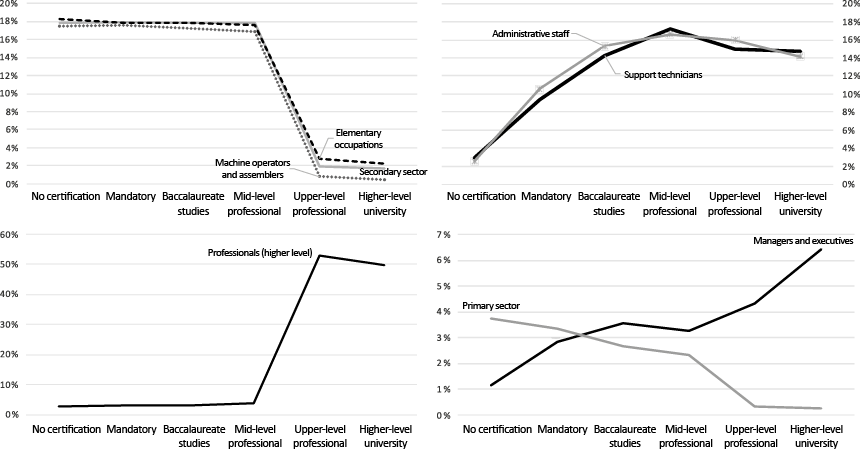
Source: Author’s own creation based on the EPA.
doi:10.5477/cis/reis.195.5-26
Is It Worthwhile to Study? Education and the Labor Market in Spain, 2011-2024
¿Vale la pena estudiar? Educación y mercado laboral en España, 2011-2024
Otávio-Junio Faria-Neves, Pau Miret-Gamundi and Joice Melo-Vieira
|
Key words Education
|
Abstract What is the relationship between educational level and occupational attainment? This study analyzes the connection between educational level and occupational positions in the Spanish labor market, using panel data from the Labor Force Survey for individuals aged 35-42 between 2011 and 2024. Applying binary logistic regression, the analysis shows that workers with higher educational levels are more likely to hold more prestigious positions. Nevertheless, inequalities persist, especially by gender and immigration status. Women, even those having higher educational levels, are concentrated in administrative positions, while men dominate leadership positions. Immigrants, especially those from Africa and Asia, face structural barriers, occupying lower-prestige occupations, regardless of their education. |
|
Palabras clave Educación
|
Resumen ¿Cuál es la relación entre el nivel educativo y la inserción ocupacional? Esta investigación analiza la relación entre el nivel educativo y la ocupación en el mercado de trabajo español a partir de datos de la Encuesta de Población Activa (EPA) para individuos de treinta y cinco a cuarenta y dos años entre 2011 y 2024. El análisis, mediante regresión logística binaria para panel, revela que los trabajadores con mayores niveles de educación tienen más probabilidades de ocupar puestos de alto prestigio. Sin embargo, persisten las desigualdades según sexo y situación migratoria: ellas, incluso aquellas con educación superior, se concentran en puestos administrativos, mientras que los hombres dominan las posiciones de liderazgo. La inmigración, especialmente de África y Asia, enfrenta barreras estructurales y ocupan empleos de menor nivel independientemente de su educación. |
Citation
Faria-Neves, Otávio-Junio; Miret-Gamundi, Pau; Melo-Vieira, Joice (2026). «Is It Worthwhile to Study? Education and the Labor Market in Spain, 2011-2024». Revista Española de Investigaciones Sociológicas, 195: 5-26. (doi: 10.5477/cis/reis.195.5-26)
Otávio-Junio Faria-Neves: Universidade Estadual de Campinas (Brasil) | otavionevescg@hotmail.com
Pau Miret-Gamundi: Centre d’Estudis Demogràfics (CED-CERCA) | pmiret@ced.uab.cat
Joice Melo-Vieira: Universidade Estadual de Campinas (Brasil) | joicemv@unicamp.br
Introduction1
The relationship between education and the labor market is central to debates on economic and social development and is continually reevaluated with the evolving global economic context. Historically, increasing educational attainment, particularly access to higher education, was considered a reliable path to improving living standards and increasing employment opportunities. However, structural changes in economies, technological advances, and the growing complexity of the labor market have revealed a persistent mismatch between educational qualifications and labor market demands.
In Spain, the education sector has experienced significant progress over recent decades. A decline in the lowest educational levels has been accompanied by a significant increase in the proportion of individuals having technical, professional, and higher qualifications. However, the country’s labor market, heavily impacted by successive economic crises, has struggled to adequately absorb skilled workers. As a result, highly educated workers often hold jobs requiring lower skill levels.
González and Miles (2021) found that, although Spain is one of the European countries with the highest percentage of university graduates in the working population, it also has one of the highest rates of overqualification. This phenomenon highlights a structural mismatch between the increase in educational qualifications and the demands of the labor market, suggesting an underutilization of available human capital.
This scenario of increasing overqualification is part of a broader debate about the future of higher education in Spain. Although public universities constitute the majority of the system, they face chronic underfunding with expenditure at 0.76 % of GDP, compared to the target of 1 %. They have experienced a 14 % decline in revenue since 2009. This has heightened their dependence on tuition fees (Hernández and Pérez, 2023; Fundación CYD, 2024). At the same time, there has been a rapid expansion of private universities, increasing from fourteen in 1998 to forty-one in 2023-2024. Their recent overtaking of public universities in master’s degree enrollments, along with a demand for public university spots which almost doubles the available supply, raise serious concerns about equity in access to quality education and the sustainability of the system. This situation is exacerbated by the high cost of private education, which may be up to twenty-three times higher than public tuition (Fundación CYD, 2024; Epdata, 2025).
The processes of occupational mobility and growth are strongly influenced by economic shocks. These shocks are defined as abrupt and unexpected changes affecting the overall economic system. They can generate varied effects, from the restructuring of sectors to transformations in occupational dynamics, specifically impacting certain groups of workers (Bennetti, 2015; Kramer and Kramer, 2020). Over recent decades, Spain has faced several crises that have left deep scars on the labor market. According to Torres (2018), the level of a country’s employment closely follows economic cycles. Periods of economic growth tend to reduce unemployment, while recessions cause unemployment rates to skyrocket.
Despite the observed educational advances, the majority of unemployed individuals continue to have low educational levels, reinforcing inequality in employment opportunities. Moreover, in Spain, the working-age population has, on average, lower educational levels than their counterparts in other European countries. This represents a structural challenge to national competitiveness and economic development (Torres, 2018).
Taking the above into account, this study aims to analyze the relationship between educational level and employment in the Spanish labor market between 2011 and 2024, considering the sex and region of birth of the individuals. In this context, crucial questions arise for understanding the dynamics of the Spanish labor market: What is the role of education in determining an individual’s current occupations? Is there a direct correlation between educational level and the quality or type of employment?
Furthermore, it is important to examine whether significant inequalities persist between men and women with equivalent educational levels, both in terms of labor market access and occupational position. This analysis is essential to assess the persistence of gender barriers, despite recent gains in female educational attainment. Another key aspect concerns the integration of immigrants into the Spanish labor market. How do individuals with distinct educational levels navigate the country’s employment dynamics? Comparing the labor market outcomes of immigrants and native-born workers may provide insight into the challenges faced by immigrants, and the effects of Spain’s employment and integration policies.
By addressing these issues, this study aims to contribute to the debate on educational, gender, and origin inequalities in the Spanish labor market. It also serves to promote the creation of public policies aimed at fostering a more equitable and efficient integration into this labor market.
Theoretical framework
Since the end of World War II, economic and social development has been intrinsically linked to the concept of social mobility, understood as the movement of individuals or groups between positions within a society’s class structure. Analyzing upward and downward mobility reveals how opportunities are distributed across society (Silva, 1999). The pursuit of better living standards has become a global goal, a symbol of economic and social progress. Within this context, investment in education is widely recognized as the primary mechanism for promoting social mobility (Fachelli and Planas, 2021).
Over recent decades, the rise of mass schooling has generated a phenomenon that challenges this expectation of mobility: the mismatch between educational credentials and the demands of the labor market. In several countries, especially members of the Organisation for Economic Co-operation and Development (OECD), overqualification has become a greater concern than underqualification (Quintini, 2011). Recent literature has highlighted that overqualification in Spain is due to a combination of educational, skills-related, and structural determinants. Martín-González, Ortiz, and Jano (2025) suggest that the area of education influences the risk of overqualification, although this may be mitigated through postgraduate studies. Nieto and Ramos (2017) demonstrated that skills gaps explain only 18 % of the wage penalty, confirming the persistent nature of the educational mismatch beyond human capital. Furthermore, Rey et al. (2024) documented a reduction in overqualification and a stabilization of working conditions for highly qualified professionals between 2005 and 2016. They suggest that improvements have resulted from EU enlargement and free movement within the EU.
Currently, having a university degree no longer guarantees, in itself, a competitive advantage in accessing employment (Fragoso, Valadas and Paulos, 2019). Given this situation, European countries and the European Union have been debating policies to combat unemployment among young graduates, emphasizing the importance of aligning education, social mobility, and employability in an increasingly globalized economy (Ribeiro et al., 2006; Vieira and Coimbra, 2006).
Recently, research has highlighted the difficulties in predicting the future of labor markets in different countries. Economic globalization and technological transformations (especially those associated with the revolution created by artificial intelligence) have profoundly changed the role of education (Peters and Jandrić, 2019; Qin et al., 2024; Salari et al., 2025). In the 21st century, these discussions have been strongly affected by the confrontation between education systems, professional qualifications, and skills development (Ribeiro et al., 2006). Despite these uncertainties, in the European context, Blossfeld et al. (2019) emphasized that education remains a crucial strategy for expanding social and economic opportunities. International development organizations stress that expanding educational attainment contributes to positive transformations in countries, such as improved economic well-being and health, strengthened democracy, and reduced inequalities (Hannum and Buchmann, 2005).
Once individuals are integrated into the labor market, occupational mobility (the movement of individuals between different occupations throughout their lives) becomes the primary means of continued social advancement. This movement is measured by occupational prestige scales, which rank occupations. Therefore, studying occupational mobility implies investigating how individuals change position within this labor hierarchy, revealing patterns of access, retention, or status change within the social structure (Valle, 1999). Occupational position is a central factor in determining income and, therefore, it is one of the main sources of inequality in living conditions (Erikson and Goldthorpe, 1992). Furthermore, it is often used as an indicator of social status, defining an individual’s place within the broader socioeconomic structure (Davis, 1942; Davis and Moore, 2019).
In the pursuit of improved living conditions, education has become the primary driver for accessing better opportunities within society, especially in the workplace. Therefore, education is often considered essential for both national development and the reduction of social inequalities (Madeira, 2006). Expanding access to education is considered a crucial driver of social mobility. It helps mitigate structural inequalities, allowing people from diverse backgrounds to compete for opportunities on a more equitable basis (Solís and Dalle, 2019). However, despite rising demand for qualifications and efforts to expand education systems to enhance equality of opportunity (Goldthorpe, 2014), classic international comparative studies, such as that of Shavit and Blossfeld (1993) have shown that educational inequalities persists and remains stable, even in contexts of broad access.
Erikson and Goldthorpe (1992) emphasized that structural transformations in the labor market should be viewed in light of generational dynamics, since major changes in mobility opportunities mainly occur through cohort replacement. While education is a fundamental instrument of mobility that directly impacts occupational position, its capacity to modify patterns of inequality depends on broader structural and intergenerational transformations.
Although they believe that access to university can transform the lives of young people from disadvantaged backgrounds, Attewell and Lavin (2007) suggested that the success of general education, especially higher education, should be measured not only by income and employment, but also by its ability to promote social transformations (especially within the family). Furthermore, recent research has indicated that the educational level of parents, especially mothers, significantly influences their children’s gender attitudes and career aspirations. Education not only qualifies individuals, but it also transmits family values and expectations that shape the trajectories of new generations (Chesters, 2023).
In the field of sociology, studies on social mobility tend to focus on occupations, assuming that the labor market is the main organizing mechanism for access to social resources and benefits (Grusky, 1994; Solís, 2018). Kalleberg and Mouw (2018) reinforced the importance of education for accessing first jobs and, consequently, for future employment opportunities. In contrast, economic studies tend to associate well-being primarily with the accumulation of income and wealth (Grusky, 1994; Solís, 2018).
It is important to view the labor market not merely as a resource allocation mechanism, but as a more complex space. In this context, occupation, income, and status are intertwined and influenced by distinct forms of capital and structural factors such as race (ethnicity or immigration status), gender, and social origin. These factors significantly mediate the effect of education on mobility. Acker (2006) argued that a significant part of social and economic inequality is generated in the daily routine of work organizations, encompassing everything from hierarchical structure to hiring practices, wages, and informal interactions. England (2019) revealed that the devaluation of women’s jobs stems from biased decisions made during the formation or development of organizations, when managers underestimate the value of women’s work. This initial bias is reinforced through internal rules and is reiterated by the labor market as an institution. This makes it difficult to reverse without collective action or equal pay policies.
According to Collins and Bilge (2021), power relations in a society do not operate in isolation, but rather, they combine to shape how people live and are treated. As Crenshaw (1989) suggested, social inequalities are structured in a multidimensional way. A recent study by Lu, Li and Elbers (2024) reveals that, although Black and Hispanic individuals have educational levels that are similar to those of white and Asian individuals, they face greater difficulties in translating their credentials into compatible occupations. They are often deviated into jobs that are not within their field of study or those that are situated at a lower level. This difference may be explained by structural factors such as occupational segregation and persistent racial discrimination. This demonstrates how expanding access to education alone is insufficient to eliminate or reduce inequality in occupational returns (Lu, Li and Elbers, 2024).
Although well established, the relationship between education and the labor market has been the subject of various economic approaches that seek to explain the mismatch between skills and employment. The following are just some of these approaches: Human Capital Theory, Job Competition Theory, Signaling Theory, and Allocation Theory (Quintini, 2011). Human Capital Theory associates better performance in the labor market with the decision to invest in lifelong learning (Schultz, 1961; Becker, 1994). Job Competition Theory assumes that job characteristics determine income, with educational credentials being important for competing for these positions (Quintini, 2011). Signaling Theory emphasizes that diplomas function as indicators of skills and competencies for employers (Spence, 1973). Finally, Allocation Theory proposes a synthesis of these perspectives, indicating that the match between educational profile and job position actually defines real productivity and income earned.
The dynamics of the labor market and social mobility cannot be explained solely by factors related to human capital. Bourdieu (1986) criticized the human capital approach for ignoring the role of education in the reproduction of social hierarchies. According to this author, academic performance is directly influenced by the cultural capital that is previously provided by the family. Furthermore, the economic and social profitability of education is conditioned by inherited social capital. This can be mobilized to expand and guarantee opportunities in the labor market. Therefore, despite being a mechanism for acquiring cultural capital, the effectiveness of education is conditioned by the social context and the individual’s position within the social structure.
In this context, active public policies are essential to reducing the gap between educational attainment and the current demands of the labor market. An OECD report (2021) highlighted the importance of active labor market policies for integrating the most vulnerable groups into the labor market, guaranteeing quality employment. The combination of educational expansion, employment policies, and affirmative action may contribute to equal opportunities, reinforcing the promise of education as an instrument of social mobility and more equitable economic and social development.
This study is based on three main hypotheses originating from the theoretical frameworks that have been presented. The first hypothesis proposes that the higher the individual’s educational level, the greater the probability that they will hold more prestigious positions in the labor market, in accordance with the Human Capital Theory (Schultz, 1961; Becker, 1994). The second hypothesis argues that, even with equivalent educational levels, immigrants face structural barriers that limit their access to more prestigious occupations. This perspective is in line with Bourdieu’s critique (1986) and intersectional approaches that emphasize the role of social capital and discrimination (Crenshaw, 1989; Collins and Bilge, 2021). Finally, the third hypothesis suggests that gender inequalities will persist regardless of the level of education, influencing the insertion of men and women in managerial and technical positions in a differentiated way. This hypothesis is related to the literature on gender inequality regimes in organizations (Acker, 2006; England, 2019).
Methodology
This section details the data, study population, and analytical strategies used to analyze the relationship between educational level and occupation in the Spanish labor market between 2011 and 2024, taking into account the sex and region of birth of the individuals.
Data source
The Labor Force Survey (EPA) database has been used. This is a continuous, quarterly household survey implemented in Spain since 1964, having the main objective of collecting detailed information on the population’s relationship with the labor market. The EPA uses a rotating household panel design, in which one-sixth of the households are renewed each cycle, while the remaining five-sixths remain connected. This allows all household members to be tracked for up to six consecutive quarters.
The National Classification of Occupations (CNO) underwent significant modifications in 2011 (INE, 2012) as compared to the previous classification from 1994. These changes were not solely due to processes of aggregation or disaggregation of categories, but also because of large shifts between major groups. For example, the criterion of number of employees in the company used to define the group of managers and executives was abandoned. This resulted in fewer workers being included in this group and some of them moving into the service sector. Consequently, the percentage of management and executive roles fell from 8 % in 2010 to 5 % in 2011, while the percentage in the service sector grew between those years from 17 % to 21 % of the overall employed population.
Similarly, under the CNO-2011, the category of technicians and scientific and intellectual professionals was expanded to include part of what had previously been considered support technicians and professionals. This expansion coincided with a period of steady growth, leading the category to encompass one in every five workers. However, with the introduction of the new CNO-2011, its share suddenly dropped from 13 % to 10 %.
Although the other occupational categories did not undergo major changes with the new categorization, the overall typology is not comparable before and after 2011. This forces us to begin the analysis in this year, when the economic recovery following the 2009 recession was about to begin.
Study population and sample
The analysis is restricted to the employed population aged thirty-five to forty-two, regardless of the type of contract that they have (self-employed or employed) or their working hours (part-time or full-time). The final sample includes 206 632 individuals observed in 687 911 records. It has a balanced distribution by sex (48 % women) and a majority of the population born in Spain.
The panel structure reflects the dynamics of longitudinal follow-up: 25 % of individuals were interviewed in all six possible waves, 30 % in only one, 13 % in two, 11 % in three, 10 % in four, and 11 % in five. This characteristic requires appropriate panel data analysis techniques that account for the dependence between repeated observations of the same individual.
Key variables
The dependent variable is the occupational category, grouped according to the one-digit typology of the CNO-2011, which comprises nine major groups: managers and executives; higher-level professionals; support technicians; administrative staff; service workers; primary sector workers; secondary sector workers; plant and machine operators and assemblers; and elementary occupations.
Educational level is classified according to the National Classification of Education (CNED-2000) and grouped into six categories: no formal schooling, basic education, high school, intermediate vocational training, advanced vocational training, and long-cycle university studies.
The variables sex and region of birth (Spain, Africa, Asia, Latin America, European Union, rest of Europe, and rest of the world) are key covariates, enabling the evaluation of structural inequalities related to gender and origin. They are also considered as determinants of occupational patterns. Age and year are included as control variables to account for potential generational and situational effects.
Methodological strategy and analysis technique
The study is conducted in two distinct stages. The first stage analyzes the relationship between employment levels and educational attainment in Spain, considering gender and region of origin. This approach offers an overview of labor market dynamics, highlighting inequalities and occupational segregation. The objective is to identify patterns of occupational distribution and examine differences in access to and advancement within the labor market based on sociodemographic characteristics.
The second stage involves applying the binary logistic regression technique to panel data. This is suitable method for analyzing qualitative phenomena represented by dummy variables. In this study, this technique is used to estimate the probability of an event defined by the dependent variable Y, which is dichotomous: Y = 1 indicates the occurrence of the event of interest, while Y = 0 indicates its absence (Fávero and Belfiore, 2017).
The dependent variable represents occupational categories, with a separate model estimated for each category. For example, in the case of managers and executives, the event is defined as Y = 1 if the individuals belong to this category and Y = 0 otherwise. The independent variables include year, age, sex, and region of birth. Year and age are introduced as control variables, to account for temporal and demographic differences, while sex and region of birth are examined as key determinants of occupational allocation.
The models were estimated using the Stata program (version 17). Specifically, we employed the panel-data logistic regression command (xtlogit) to estimate binary logistic models. This procedure allows for the analysis of the probability of belonging to each occupational category while accounting for the panel structure of the data and the selected explanatory variables.
Results
This section presents the main findings of the study. It begins with a detailed description of the sample, followed by an examination of the bivariate relationships between the key variables. Finally, the results of the multivariate models are reported, allowing for the assessment of the net effects of the explanatory variables.
Sample characterization
Given the panel structure of the data (see Table 1), service workers make up the most frequent occupational category. Overall, 23 % of individuals were employed in this category at some point during the observation period, accounting for 21 % of all observations. Professionals represent the second most common category: 19 % of individuals were classified in this category at some point, corresponding to 20 % of total observations. Moderately frequent categories include secondary sector workers (13 % of observations), support technicians (12 %), elementary occupations (14 %), and administrative workers (11 %). These figures refer to employment episodes observed between 2011 and 2024 when the individuals were aged 35-42. The least frequent categories are machine installation and operation (9 % of individuals were employed in this category at some point), managers or executives (5 %) and primary sector occupations (2.5 %).
Table 1 presents the average probability of an individual being employed in each of the nine occupational categories, regardless of age or interview wave. Because respondents were interviewed on up to six occasions and may have been employed in more than one category over the course of their occupational trajectories, the sum of the probabilities exceeds 100 % by 18 percentage points. These average probabilities place professional occupations and service occupations at the highest and at the same level (18 %). They are followed by industrial sector jobs and elementary occupations (17 %), and by support technicians and administrative occupations (15 %). Jobs with the lowest employment probabilities are machine installation and operation (10 %), managerial and executive positions (4 %), and the primary sector occupations (3 %).
The mediating variables (sex and place of birth) do not change over time and result in a balanced distribution between men and women. Although the majority of the employed population in Spain is native-born (82 %), there is a notable presence of individuals born in Latin America (9 %). Smaller, but still significant shares correspond to those born in Africa and other European Union countries (3 %). Individuals born in the rest of Europe, Asia and other regions represent less than 1 % of the sample.
Similarly, the key explanatory variable, educational attainment, shows limited variation over the individual life course, as reflected in the sum of the mean proportions, which is close to 100 %. Specifically, 23 % of the labor force has completed lower secondary education, while 7 % lacks the corresponding certification. This suggests that 30 % of the labor force left the educational system prematurely, in accordance with international standards. The remaining educational levels each account for approximately 18 % of the labor force.
Bivariate analysis: occupational levels and educational attainment in Spain by sex and region of birth
Table 2 summarizes the probabilities of the different occupational categories and educational levels in Spain between 2011 and 2024. The data is segmented by sex and country of birth, allowing for a detailed analysis of educational and occupational inequalities and patterns in this context. This disaggregation provides a comprehensive view of the Spanish labor market dynamics during the analyzed period. It is important to note that both Table 2 and Figure 1 are based on bivariate regression models. In other words, occupation was modeled separately with sex and region of birth (see Table 2.1), while educational attainment was modeled separately with gender and region of birth (see Table 2.2).
Only occupations in the industrial sector and machine installation and operation exhibit a clear male bias, with men representing 18 % and 12 % of these categories, respectively, compared to 4 % and 5 % for women (see Table 2.1). A smaller gender gap was observed in management and support technician positions, with men slightly overrepresented by one percentage point, accounting for 4 % and 15 %, respectively. Women are more likely to work in administrative positions, making up 17 % compared to 12 % for men. In the remaining categories, gender representation is balanced: 18 % in professional occupations, service sector jobs, and elementary occupations, and 3 % in the agricultural sector. It is also noteworthy that the sum of female occupational probabilities approached 100 %, indicating little variation in the women’s occupational trajectories, whereas for men, the total exceeded this value by eighteen percentage points, reflecting considerable biographical variability in male occupational paths.
The comparative analysis between native-born and immigrant workers clearly reveals differentiated patterns of integration into the Spanish labor market (see Table 2.1). Individuals born in Spain have a more balanced occupational distribution and greater access to highly skilled positions, such as the professional occupations (17.9 %) and support technician jobs (15.3 %), reflecting a more diversified and prestigious integration. In contrast, African immigrants are concentrated in elementary occupations (41.7 %), a proportion almost four times higher than that of native-born workers (11.4 %), demonstrating mobility restrictions associated with information barriers, limited recognition of credentials, and possible discriminatory mechanisms. Asian immigrants show a highly concentrated integration in the service sector (81.1 %), while EU citizens exhibit a more diversified profile, with a significant presence in the liberal professions (17.7 %) and technical support (13.3 %). National origin is a significant determinant of occupational position, although its effects vary across sectors. The most pronounced disparity is observed among the Asian population, whose employment in the service sector (81 %) far exceeds that of other groups (18 %). In contrast, no significant differences are observed in the agricultural and industrial sectors: the probability of agricultural employment is slightly above 3 % for all groups, while in industry, only the “rest of the world” category shows a marginally higher representation (2 %). Overall, these results indicate selective occupational segmentation by origin, concentrated in specific niches of the labor market.
As for educational attainment by sex (see Table 2.2), the data initially suggest a lower educational level among men: 8 % lack formal certification compared to 5 % of women, and 33 % have completed lower secondary education compared to 23 % of women. However, a longitudinal perspective nuances this interpretation: when considering study and work simultaneously, men exceed 100 % by 12 percentage points, indicating ongoing educational trajectories after entering the labor market. Among women, the sum reaches 100 %, reflecting a higher rate of educational completion prior to labor market entry.
In summary, women enter the labor market with greater educational capital, whereas men transition from school to employment earlier and often simultaneously combine education and work. These dynamics reproduce gender asymmetries in educational and labor transitions, shaped by sociocultural norms and opportunity structures, and persisting throughout occupational trajectories.
The analysis of educational attainment by region of birth reveals substantial inequalities (see Table 2.2). Immigrants from Africa have the highest proportion of individuals with no formal academic certification (53.82 %), constituting the group with the lowest formal educational level. In contrast, individuals born in Spain display a higher proportion of upper secondary graduates (29.22 %) and a balanced distribution across higher educational levels. Latin Americans are more concentrated at the secondary education levels, reflecting educational patterns that facilitate integration into mid-skilled occupational sectors. Asian immigrants present a more heterogeneous profile: while 21.44 % have no formal academic certification, a notable share also possesses higher education (17.76 %), suggesting that some members of this group are pursuing highly skilled positions in the labor market.
Inequalities based on origin reflect structural barriers that limit access to higher-prestige, skilled occupations, especially for immigrants from Africa and Asia. These disparities underscore the need for public policies aimed at promoting educational and labor market integration for the most vulnerable groups, thereby encouraging greater equity.
Although we initially differentiated between individuals born in European Union countries and those from the rest of Europe, no meaningful differences were observed in either occupation (see Table 2.1) or education (see Table 2.2). Therefore, both groups were combined into a single category for the analysis.
The analysis of the relationship between educational level and occupational category reveals clear patterns of integration into the Spanish labor market. Figure 1 shows that higher levels of education increase the likelihood of accessing skilled occupations, particularly professional positions. Approximately 50 % of workers with higher education are employed in these roles, compared to only 3-4 % of those with lower educational attainment. By contrast, educational level does not differentiate access to the service sector occupations (approximately 18 % across all levels), and therefore, this category is not shown in the figure.
The likelihood of attaining employment in technical and administrative occupations increases with educational attainment, peaking at intermediate levels of professional qualification. In contrast, elementary, industrial, and machine-operation occupations are concentrated among workers with low levels of education (approximately 18 % among those without higher education, compared to 2 % among university graduates). In the agricultural sector, the probability of employment declines as educational attainment rises, whereas managerial positions increase progressively and are more prevalent among individuals with higher educational levels.
In summary, lower levels of educational attainment are associated with manual and low-skilled occupations, whereas intermediate levels correspond primarily to technical and administrative roles. Higher educational levels substantially increase access to managerial and professional positions. These findings support the first hypothesis of the study: as educational level increases, so does the likelihood of employment in skilled occupations.
Multivariate analysis: occupational probabilities based on the effects of sex, educational level, and region of birth
After examining all relevant bivariate relationships, we estimate the full multivariate model for each occupational category as a function of sex, educational level, and region of birth, controlling for age and year of observation, using panel-data logistic regression (see Tables 3.1, 3.2 and 3.3). Each model includes all explanatory variables simultaneously, allowing the effect of each factor to be assessed while holding the others constant. The reported results therefore reflect adjusted marginal effects that account for the combined influence of the remaining covariates. For instance, the estimated probabilities associated with sex are adjusted for differences in educational level and region of birth. Only variables that contribute meaningfully to each occupational model are retained.
Only two occupational categories, managers and support technicians, require the inclusion of all three explanatory variables with their full set of categories, precluding further model reduction. In contrast, for administrative positions, for example, region of birth may be excluded from the final specifications (see Table 3.1).
In machinery installation and operation, professional occupations, manufacturing, and elementary occupations, educational attainment can be summarized into two categories, indicating whether or not higher education has been completed. The model is more complex in the first category, excludes gender in the second, and is considerably simpler in the last two, since only educational level is retained as a predictor (see Table 3.2).
The primary sector occupations (agriculture, livestock farming, and fishing) may be explained by educational level and region of birth, since these variables account for the observed variation in employment in this sector. In contrast, for service sector occupations, it is not necessary to know either sex or education level, since knowledge of the region of birth is sufficient (see Table 3.3).
The results of the multivariate models reveal a consistent pattern of occupational segregation by gender. Women remain overrepresented in administrative activities, whereas men exhibit a higher probability of employment in managerial, technical and operational positions (see Tables 3.1 and 3.2).
Educational level is a key determinant of occupational assignment. Individuals with higher educational attainment are largely concentrated in higher-skilled and higher-prestige occupations, whereas those with lower educational levels are primarily employed in industrial, elementary, and machine-operation occupations. Intermediate levels of education are associated with administrative and support technician roles.
Regarding country of origin, native-born Spaniards have a higher probability of employment in managerial, technical, and professional occupations compared to African and Asian immigrants. These immigrant groups are primarily employed in operational roles and in the primary sector. Latin American immigrants are more prevalent in technical and operational occupations, and Asian immigrants are concentrated in the service sector. These patterns highlight the persistence of structural inequalities in the labor market, particularly with respect to occupational mobility opportunities for immigrant populations.
Conclusions
In Spain, the employed population aged 35-42 between 2011 and 2024 exhibited a moderate level of educational attainment, with only 18 % holding a university degree, while an additional 17 % had completed advanced vocational training qualifications. In contrast, 7 % had completed only primary education and 23 % had finished mandatory secondary education. At the intermediate level, 18 % had completed upper secondary education, and another 18 % had completed intermediate vocational training.
Although no substantial changes were observed over the study period or across the age range considered, lower educational attainment was observed among individuals from Africa, Asia, Latin America and the European Union, with 54 %, 21 %, 13 % and 8 % respectively, lacking formal academic certification.
After controlling for differences in the composition of the employed population, the objective of this study was to assess whether the probability of employment in a given occupational category is attributable to gender or place of birth, or whether it reflects the alignment between educational level and occupational status.
Table 1 summarizes the main findings of the study, highlighting the key patterns identified in the analysis.
The overall conclusion indicates that education continues to play a central role in attaining higher status occupations, while inequalities based on gender and place of origin persist.
For example, holding a managerial or executive position becomes more likely as educational level increases, particularly among men born in Spain. Professional occupations are largely attained by Spanish natives with higher education. Similarly, support technician positions are more common among men born in Spain or Latin America with higher educational levels, especially those who have completed intermediate vocational training.
Administrative jobs are the only occupational category largely dominated by women, although the relationship with education is similar to that of technical support positions. In the service sector, significant differences are only observed for individuals of Asian origin. For the remaining occupational categories, primary or secondary education tends to be sufficient, with the primary sector being largely composed of African and Asian immigrants. Machinery operation and installation occupations are predominantly held by men born in Africa, Asia, or Latin America.
Social mobility and investment in education, pillars of post-war development, currently face challenges such as overqualification, where a university degree alone no longer guarantees a competitive advantage in the job market. In this context, this study analyzed the relationship between education and employment in the Spanish labor market (2011-2024), using panel data from the Spanish Labor Force Survey (EPA), considering gender and immigration status, and applying logistic regression.
This study confirms that, although education remains an essential driver of social mobility (Becker, 1994; Schultz, 1961; Blossfeld et al., 2019), its transformative potential is limited by structural inequalities related to immigration status and gender (Bourdieu, 1986; Acker, 2006; Crenshaw, 1989).
The results suggest that workers with a university education are more likely to access prestigious occupations, supporting the Human Capital Theory. However, a phenomenon of overqualification is observed; some highly qualified individuals remain employed in positions below their skill level, consistent with recent studies highlighting the mismatch between educational level and labor market requirements (Quintini, 2011; Fragoso, Valadas and Paulos, 2019).
Furthermore, immigrants, particularly those from Africa and Asia, face additional barriers, often working in low-skilled jobs regardless of their educational qualifications. This finding supports the intersectionality perspective (Collins and Bilge, 2021), suggesting that education alone does not guarantee equal opportunities when factors such as discrimination in the recognition of qualifications and limited access to social capital networks are present (Bourdieu, 1986; Lu, Li and Elbers, 2024).
Regarding gender, although women surpass men in educational attainment, they remain concentrated in administrative positions, while men dominate managerial and leadership positions. This confirms the persistence of gender inequality in organizations (Acker, 2006; England, 2019) and highlights the glass ceiling that limits women’s access to leadership positions.
Taken together, these results provide recent evidence in debates on occupational mobility, illustrating how the structure of Spain’s labor market reproduces inequalities that extend beyond the mere accumulation of educational credentials (Silva, 1999; Erikson and Goldthorpe, 1992). The interplay of factors such as educational level, gender, and immigration status suggests that labor market segmentation and discrimination continue to operate in an interconnected manner (Crenshaw, 1989; Collins and Bilge, 2021).
The results also indicate that Spanish public policies for workforce training and retraining remain insufficient to address the mismatch between skills and actual labor market demands, particularly in the context of rapid technological change (Peters and Jandrić, 2019; Salari et al., 2025). Although continuing education and professional development programs exist, their coverage does not effectively reach the most vulnerable groups, nor do they respond quickly enough to challenges posed by automation and artificial intelligence. Consequently, it is recommended to strengthen active employment policies that prioritize ongoing retraining, foster partnerships among governments, the private sector, and educational institutions, and implement employability monitoring mechanisms, to ensure that the workforce remains aligned with productive and technological demands.
This study contributes to the debate on the relationship between education, labor market integration and inequality in Spain. It highlights the importance of initiatives that combine the recognition of educational qualifications with the reduction of structural disparities in the labor market. One limitation of this study is the absence of interaction analyses among key variables, such as education, gender and origin. In addition, no regional analyses were conducted, limiting the ability to capture potential territorial disparities. These limitations, however, point to a promising research agenda: future studies could explore interactions among variables and regional specificities. This would deepen our understanding of the determinants of labor market integration and inequality in Spain.
Bibliography
Acker, Joan (2006). “Inequality Regimes: Gender, Class, and Race in Organizations”. Gender and society, 20(4): 441-464. Available at: https://www.jstor.org/stable/27640904, access June 15, 2025.
Attewell, Paul and Lavin, David E. (2007). Passing the torch: Does higher education for the disadvantaged pay off across the generations? New York: Russell Sage Foundation. Available at: https://www.jstor.org/stable/10.7758/9781610440196, access June 18, 2025.
Becker, Gary S. (1994). Human capital: A theoretical and empirical analysis, with special reference to education. New York: University of Chicago Press.
Bennett, Neil M. (2015). “Environmental shocks. Differentiated Households and Migration: A Study in Thailand”. Graduate Student Theses, Dissertations, and Professional Papers, 4533. Available at: https://scholarworks.umt.edu/etd/4533, access November 20, 2024.
Blossfeld, Hans-Peter; Kulic, Nevena; Skopek, Jan; Triventi, Moris; Kilpi-Jakonen, Elina; Vono de Vilhena, Daniela and Buchholz, Sandra (2019). “Conditions and Consequences of Unequal Educational Opportunities in the Life Course: Results from the Cross-National Comparative eduLIFE Project”. KZfSS Kölner Zeitschrift für Soziologie und Sozialpsychologie, 71(1): 399-428. doi: 10.1007/s11577-019-00595-w
Bourdieu, Pierre (1986). The forms of capital. In: Richardson, John G. (ed.). Handbook of theory and research for the sociology of education. New York: Greenwood Press.
Chesters, Jenny (2023). “Gender Attitudes and Occupational Aspirations in Germany: Are Young Men Prepared for the Jobs of the Future?”. Work, employment and society, 37(3): 571-587. doi: 10.1177/09500170211017046
Crenshaw, Kimberle (1989). “Demarginalizing the Intersection of Race and Sex: A Black Feminist Critique of Antidiscrimination Doctrine, Feminist Theory and Antiracist Politics”. University of Chicago Legal Forum, 140(1): 139-167. Available at: https://chicagounbound.uchicago.edu/uclf/vol1989/iss1/8, access June 20, 2025.
Davis, Kingsley (1942). “A Conceptual Analysis of Stratification”. American Sociological Review, 7(3): 309-321. doi: 10.2307/2085360
Davis, Kingsley and Moore, Wilbert E. (2019). Some principles of stratification. In: Grusky, David (ed.). Social Stratification, Class, Race, and Gender in Sociological Perspective. London: Routledge. (2nd edition).
England, Paula (2019). Devaluation and the Pay of Comparable Male and Female Occupations. In: Grusky, David (ed.). Social Stratification, Class, Race, and Gender in Sociological Perspective. London: Routledge. (2nd edition).
Epdata (2025). Número de universidades privadas y públicas en España. Available at: https://www.epdata.es/datos/numero-universidades-
privadas-publicas-espana/746, access December 4, 2024.
Erikson, Robert and Goldthorpe, John H. (1992). The Constant Flux: A Study of Class Mobility in Industrial Societies. Oxford: Clarendon.
Fachelli, Sandra and Planas, Jordi (2011). “Equidad y movilidad intergeneracional de los titulados universitarios catalanes”. Papers: revista de sociología, 96(4): 1307-1331. Available at: https://raco.cat/index.php/Papers/article/view/246750, access November 25, 2024.
Fávero, Luiz P. and Belfiore, Patrícia (2017). Manual de análise de dados. Rio de Janeiro: Elsevier.
Fragoso, António; Valadas, Sandra T. and Paulos, Liliana (2019). “Ensino superior e empregabilidade: perceções de estudantes e graduados, empregadores e académicos”. Educação and Sociedade, 40: e0186612. doi: 10.1590/ES0101-73302019186612
Fundación CYD (2024). Informe CYD 2024. La universidad española: oferta académica, organización y financiación. Available at: https://www.fundacioncyd.org/publicaciones-cyd/informe-cyd-2024/, access December 11, 2024.
Goldthorpe, John H. (2014). “The Role of Education in Intergenerational Social Mobility: Problems from Empirical Research in Sociology and some Theoretical Pointers from Economics”. Rationality and society, 26(3): 265-289. doi: 10.1177/1043463113519068
González, Xulia and Miles, Daniel (2021). “La transición de la universidad al trabajo y el fenómeno de la sobrecualificación en España”. Cuadernos de información económica, 283: 57-69.
Grusky, David (1994). The contours of social stratification. In: Grusky, David (ed.). Social stratification: Class, race, and gender in sociological perspective. Boulder, Colorado: Westview Press.
Hannum, Emily and Buchmann, Claudia (2005). “Global Educational Expansion and Socio-economic Development: An Assessment of Findings from the Social Sciences”. World development, 33(3): 333-354. doi: 10.1016/j.worlddev.2004.10.001
Hernández Armenteros, Juan and Pérez García, José A. (2023). Financiación pública en la Ley Orgánica del Sistema Universitario: objetivos de financiación pública e instrumentos: gasto inducido. CRUE, Universidades Españolas. Available at: https://www.crue.org/wp-content/uploads/2023/12/Monografia_Financiacion_Publica_web.pdf, access November 25, 2024.
Hill Collins, Patricia and Bilge, Sirma (2021). Interseccionalidade. São Paulo: Boitempo Editorial.
Instituto Nacional de Estadística (INE) (2012). Introducción a la CON-11. Available at: https://www.ine.es/daco/daco42/clasificaciones/Introduccion_CNO11.V02.pdf, access July 4, 2025.
Instituto Nacional de Estadística (INE) (2022). Clasificación Nacional de Ocupaciones 2011 (CNO2011). Notas Explicativas. Available at: https://www.ine.es/daco/daco42/clasificaciones/cno11_notas.pdf, access December 15, 2024.
Kalleberg, Arne L. and Mouw, Ted (2018). “Occupations, Organizations, and Intragenerational Career Mobility”. Annual Review of Sociology, 44(1): 283-303. doi: 10.1146/annurev-soc-073117-041249
Kingsley, David and Moore, Wilbert E. (2019). Some principles of stratification. In: Grusky, David (ed.). Social Stratification, Class, Race, and Gender in Sociological Perspective. London: Routledge. (2nd edition).
Kramer, Amit and Kramer, Karen Z. (2020). “The Potential Impact of the Covid-19 Pandemic on Occupational Status, Work from Home, and Occupational Mobility”. Journal of vocational behavior, 119: 103442. doi: 10.1016/j.jvb.2020.103442
Lu, Yao; Li, Xiaoguang and Elbers, Benjamin (2024). “Education-occupation Linkage in the Highly-educated Workforce: Patterns and Sources of Difference by Race/ethnicity”. Work, Employment and Society, 38(2): 461-482. doi: 10.1177/09500170221133714
Madeira, Felícia R. (2006). Educação e desigualdade no tempo de juventude. In: Camarano, Ana (org.). Transição para a vida adulta ou vida adulta em transição. Rio de Janeiro: IPEA.
Martín-González, Martín; Ortiz, Salvador and Jano, María D. (2025). “An Empirical Analysis of Overeducation among Master’s Graduates in Spain”. European Journal of Higher Education, 1-21. doi: 10.1080/21568235.2025.2556998
Nieto, Sandra and Ramos, Raul (2017). “Overeducation, Skills and Wage Penalty: Evidence for Spain Using PIAAC Data”. Social Indicators Research, 134(1): 219-236. doi: 10.1007/s11205-016-1423-1
Organization for Economic Cooperation and Development (OECD) (2021). Building inclusive labour markets: Active labour market policies for the most vulnerable groups. In: OECD Policy Responses to Coronavirus (COVID-19). Paris: OECD Publishing. doi: 10.1787/607662d9-en
Peters, Michael A. and Petar, Jandrić (2019). Education and Technological Unemployment in the Fourth Industrial Revolution. In: Redding, Gordon; Drew, Antony and Crump, Stephen (eds.). The Oxford Handbook of Higher Education Systems and University Management. Oxford Handbooks. (online).
Qin, Meng; Wan, Yue; Junyi, Dou and Su, Chi Wei (2024). “Artificial intelligence: intensifying or mitigating unemployment?”. Technology in Society, 79: 102755. doi: 10.1016/j.techsoc.2024.102755
Quintini, Glenda (2011). “Over-Qualified or Under-Skilled: A Review of Existing Literature”. OECD Social, Employment and Migration Working Papers, 121. Paris: OECD Publishing. doi: 10.1787/5kg58j9d7b6d-en
Rey Poveda, Alberto del; Stanek, Mikolaj; García-Gómez, Jesús and Orfao, Guillermo (2024). “Patterns of Overeducation among Highly Educated Mobile Intra-EU Workers, 2005-2016: Enlargement, Financial Crisis, and Mobility”. International Journal of Comparative Sociology, 65(6): 782-808. doi: 10.1177/00207152241229400
Ribeiro Gonçalves, Fernando; Carreira, Teresa; Valadas, Sandra and Sequeira, Bernardete (2006). “Percursos de empregabilidade dos licenciados: Perspectivas europeias e nacional”. Análise Psicológica, 24(1): 99-114. doi: 10.14417/ap.157
Salari, Nader; Beiromvand, Mahan; Amin Hosseinian-Far, Javad Habibi; Babajani, Fateme and Mohammadi, Masoud (2025). “Impacts of Generative Artificial Intelligence on the Future of Labor Market: A Systematic Review”. Computers in Human Behavior Reports, 100652. doi: 10.1016/j.chbr.2025.100652
Schultz, Theodore W. (1961). “Investment in Human Capital”. The American economic review, 51(1): 1-17. Available at: http://www.jstor.org/stable/1818907
Shavit, Yossi and Blossfeld, Hans-Peter (1993). Persistent Inequality: Changing Educational Attainment in Thirteen Countries. Boulder: Westview.
Solís, Patricio (2018). Barreras estructurales a la movilidad social intergeneracional en México: Un enfoque multidimensional. Naciones Unidas Comisión Económica para América Latina y el Caribe (CEPAL).
Solís, Patricio and Dalle, Pablo (2019). “La pesada mochila del origen de clase: Escolaridad y movilidad intergeneracional de clase en Argentina, Chile y México”. Revista Internacional de Sociología, 77(1): 1-17. doi: 10.3989/ris.2019.77.1.17.102
Spence, Michael (1973). “Job Market Signaling”. The Quarterly Journal of Economics, 87(3): 355-374. doi: 10.2307/1882010
Torres, Raymond (2018). “El mercado laboral español: situación y desafíos estructurales”. Cuadernos de información económica, 267: 1-12.
Valle Silva, Nelson do (1999). Mobilidade Social. In: S. Miceli (org.). O que ler na ciência social brasileira (1970-1995). São Paulo: ANPOCS.
Vieira, Diana and Coimbra, Joaquim L. (2006). “Sucesso na transição escola-trabalho: a percepção de finalistas do ensino superior português”. Revista brasileira de orientação profissional, 7(1): 1-10.
1 Acknowledgements: This work is a product of the activities carried out in the Centre d’Estudis Demogràfics of Barcelona, supported by the Coordination for Higher Level Personnel – Brazil (CAPES) – Funding Code 001. It is also part of the RandD+i project PID2023-148209OB-100 financed by MTCIU/AEI/10.13039/501100011033 and by the ERDF, EU of the Ministry of Science and Innovation on Educational patterns and trajectories of work activity and time use of the population aged 50-59 (Patrones educativos y trayectorias de actividad laboral y empleo del tiempo de la población de 50-59 años).
TABLe 1. Description of the workforce sample (2011-2024), 35 to 42 years of age
|
VARIABLES |
INDIVIDUALS |
OBSERVATIONS |
|
|
206,632 |
687,911 |
PROBABILITY |
|
|
Occupation (CNO to 1 digit) |
% |
% |
MEAN |
|
Managers and executives |
4.62% |
4.27% |
3.97% |
|
Independent professionals |
18.99% |
19.76% |
17.89% |
|
Support technicians |
11.93% |
11.15% |
14.88% |
|
Administrative staff |
11.15% |
10.77% |
14.74% |
|
Service workers |
23.35% |
21.15% |
18.22% |
|
Primary sector |
2.48% |
2.26% |
3.13% |
|
Secondary sector |
13.15% |
11.87% |
17.38% |
|
Plant and machine operators and assemblers |
9.04% |
8.32% |
9.85% |
|
Elementary occupations |
14.09% |
10.44% |
17.52% |
|
Total |
108.80% |
100.00% |
117.56% |
|
Educational level |
|||
|
No academic certification |
8.19% |
5.57% |
6.99% |
|
With academic degree (primary, secondary education) |
36.91% |
33.26% |
22.99% |
|
Baccalaureate studies |
14.09% |
12.32% |
17.72% |
|
Professionals (intermediate vocational training) |
15.56% |
15.50% |
17.83% |
|
Professionals (degrees, advanced vocational training) |
13.37% |
13.26% |
17.20% |
|
University studies (bachelor’s and other university degrees) |
19.47% |
20.09% |
17.88% |
|
Total |
107.59% |
100.00% |
100.60% |
|
Gender |
|||
|
Men |
51.95% |
52.31% |
50.45% |
|
Women |
48.05% |
47.69% |
49.55% |
|
Total |
100.00% |
100.00% |
100.00% |
|
Region of birth |
|||
|
Spain |
84.25% |
86.85% |
82.16% |
|
Africa |
2.50% |
1.88% |
3.14% |
|
Asia |
0.83% |
0.68% |
0.66% |
|
Latin America |
7.29% |
6.07% |
8.57% |
|
European Union |
4.23% |
3.69% |
3.28% |
|
Rest of Europe |
0.83% |
0.75% |
0.71% |
|
Other |
0.08% |
0.07% |
0.19% |
|
Total |
100.00% |
100.00% |
98.69% |
Source: Author’s own creation based on the EPA.
TABLe 2.1. Probability of holding a certain position according to sex and region of birth, Spain (2011 and 2024)
|
VARIABLES |
|||||||||
|
GENDER |
REGION OF BIRTH |
||||||||
|
Occupation (CNO2024 to 1 digit) |
Men |
Women |
Spain |
Africa |
Asia |
Latin America |
European Union |
Rest of Europe |
Rest of the world |
|
Managers and executives |
4.22% |
3.09% |
3.74% |
0.39% |
4.81% |
0.24% |
3.16% |
2.89% |
10.93% |
|
Independent professionals |
17.83% |
17.83% |
17.92% |
2.89% |
16.88% |
17.68% |
17.74% |
17.77% |
27.43% |
|
Support technicians |
15.42% |
13.91% |
15.31% |
0.66% |
8.30% |
10.88% |
13.28% |
12.77% |
16.80% |
|
Administrative staff |
11.69% |
16.75% |
14.76% |
2.58% |
6.59% |
10.48% |
12.37% |
13.14% |
12.31% |
|
Service workers |
17.85% |
18.00% |
17.95% |
17.89% |
81.06% |
18.22% |
17.91% |
17.93% |
17.84% |
|
Primary sector |
3.11% |
2.89% |
3.12% |
3.44% |
3.03% |
3.10% |
3.11% |
3.09% |
3.08% |
|
Secondary sector |
17.99% |
4.14% |
17.57% |
17.76% |
16.86% |
17.61% |
17.72% |
17.70% |
1.55% |
|
Plant and machine operators and assemblers |
12.48% |
4.93% |
9.78% |
11.65% |
7.12% |
8.48% |
11.93% |
10.17% |
5.10% |
|
Elementary occupations |
17.51% |
17.77% |
12.55% |
41.70% |
16.20% |
22.73% |
18.21% |
18.13% |
0.39% |
|
Total |
118.10% |
99.30% |
112.71% |
98.98% |
160.84% |
109.42% |
115.45% |
113.59% |
95.43% |
Source: Author’s own creation based on the EPA.
TABLe 2.2. Probability of having a given educational level by sex and region of birth, Spain (2011 and 2024)
|
GENDER |
REGION OF BIRTH |
||||||||
|
Educational level |
Men |
Women |
Spain |
Africa |
Asia |
Latin America |
European Union |
Rest of Europe |
Rest of the world |
|
No academic certification |
8.29% |
5.51% |
4.77% |
53.82% |
21.44% |
13.00% |
8.54% |
4.71% |
0.22% |
|
With academic degree (primary, secondary education) |
33.02% |
22.97% |
29.22% |
19.06% |
22.10% |
19.40% |
21.58% |
20.60% |
17.89% |
|
Baccalaureate studies |
17.80% |
17.79% |
16.98% |
17.77% |
17.85% |
18.13% |
17.86% |
17.79% |
17.27% |
|
Professionals (intermediate vocational training) |
17.82% |
17.81% |
17.79% |
17.43% |
5.75% |
17.34% |
17.58% |
17.69% |
17.09% |
|
Professionals (degrees, advanced vocational training) |
17.29% |
17.70% |
17.72% |
16.05% |
17.15% |
17.41% |
17.47% |
17.71% |
17.80% |
|
University studies (bachelor's and other university degrees) |
17.83% |
17.83% |
17.95% |
17.59% |
17.76% |
17.82% |
17.83% |
17.99% |
80.89% |
|
Total |
112.04% |
99.62% |
104.43% |
141.72% |
102.05% |
103.11% |
100.86% |
96.50% |
151.16% |
Source: Author’s own creation based on the EPA.
FIGURE 1. Probability of occupying a given position by educational level, Spain (2011-2024)
Source: Author’s own creation based on the EPA.
TABLe 3.1. Model for managers and executives, support technicians and administrative workers
|
Managers |
Support technicians |
Administrative staff |
|
|
GENDER |
|||
|
Men |
4.81% |
13.30% |
8.32% |
|
Women |
2.97% |
10.85% |
14.86% |
|
EDUCATIONAL LEVEL |
|||
|
No academic certification |
1.46% |
5.13% |
2.15% |
|
With academic degree (primary, secondary education) |
2.55% |
8.44% |
9.21% |
|
Baccalaureate studies |
3.67% |
13.89% |
13.55% |
|
Mid-level professionals I (intermediate vocational training) |
3.18% |
16.65% |
15.63% |
|
Higher level professionals II (degrees, advanced vocational training) |
4.86% |
14.30% |
13.73% |
|
University studies (bachelor's and other university degrees) |
6.95% |
13.83% |
11.70% |
|
REGION OF BIRTH |
|||
|
Spain |
3.96% |
12.72% |
|
|
Africa |
1.38% |
1.48% |
|
|
Asia |
5.18% |
4.03% |
|
|
Latin America |
2.47% |
8.33% |
|
|
Europe |
3.50% |
10.26% |
|
|
Rest of the world |
5.09% |
14.52% |
Source: Author’s own creation based on the EPA.
TABLe 3.2. Model for machine installers and operators, professional, industrial and elementary occupations
|
Installation |
Independent professionals |
Industry |
Elementary |
|
|
GENDER |
||||
|
Men |
12.02% |
|||
|
Women |
9.38% |
|||
|
EDUCATIONAL LEVEL |
||||
|
No higher education |
15.87% |
3.22% |
17.83% |
18.62% |
|
With higher education |
0.59% |
45.25% |
2.92% |
2.02% |
|
REGION OF BIRTH |
||||
|
Spain |
10.94% |
18.29% |
||
|
Africa |
10.23% |
8.84% |
||
|
Asia |
8.07% |
5.56% |
||
|
Latin America |
10.36% |
8.99% |
||
|
Europe |
11.45% |
13.24% |
||
|
Rest of the world |
10.18% |
27.26% |
Source: Author’s own creation based on the EPA.
TABLe 3.3. Model for primary and secondary sectors
|
EDUCATIONAL LEVEL |
Primary |
Service sector |
|
|
No academic certification |
3.72% |
||
|
With academic degree (primary, secondary education) |
3.36% |
||
|
Baccalaureate studies |
2.66% |
||
|
Mid-level professionals I |
2.30% |
||
|
Higher education |
0.29% |
||
|
REGION OF BIRTH |
|||
|
Spain |
11.95% |
||
|
Africa |
36.85% |
Not Asians |
18.21% |
|
Asia |
12.74% |
50.49% |
|
|
Latin America |
21.16% |
||
|
Europe |
14.54% |
||
|
Rest of the world |
1.38% |
Source: Author’s own creation based on the EPA.
CHART 1. Summary of results
|
Managers and executives |
Masculinized, with higher education, born in Spain. |
|
Professional occupations |
With higher education, born in Spain. |
|
Support technicians |
Masculinized, with higher education (especially, with intermediate professional studies), born in Spain or Latin America. |
|
Administrative staff |
Strongly feminized, with higher education (especially, with intermediate professional studies). |
|
Service sector |
Born in Asia. |
|
Primary sector |
With less education, born in Africa or Asia. |
|
Machine operation and installation |
Masculinized, primary or intermediate studies, born in Africa, Asia or Latin America. |
|
Manufacturing |
Primary or intermediary studies. |
|
Elementary occupations |
Primary or intermediary studies. |
Source: Author’s own creation.
RECEPTION: March 20, 2025
REVIEW: June 12, 2025
ACCEPTANCE: October 31, 2025