Democracies in Danger: The Preference for Authoritarianism and Polarisation in Spain
Democracias en peligro: preferencia por el autoritarismo
y polarización en España
Adrián Megías and Cristina Moreno
|
Key words Authoritarianism
|
Abstract Polarisation has become a central feature of contemporary political systems, resulting in significant implications for their stability. Beyond reflecting pre-existing tensions, affective polarisation can erode democratic norms and foster tolerance of less democratic forms of government. This article examines how affective polarisation shapes favourable attitudes towards non-democratic systems in Spain. Drawing on data from the ECIS 3480 barometer and using a generalised additive model (GAM), we show that higher levels of affective polarisation are associated with greater preference for non-democratic options. The findings suggest that affective polarisation acts as a risk factor for the quality and resilience of democracy, and therefore contributes to a growing acceptance of trade-offs between material well-being and democratic principles. |
|
Palabras clave Autoritarismo
|
Resumen La polarización se ha consolidado como un rasgo central de los sistemas políticos contemporáneos, con implicaciones significativas para su estabilidad. Más allá de reflejar tensiones preexistentes, la polarización afectiva puede erosionar normas democráticas y favorecer la tolerancia hacia alternativas de gobierno menos democráticas. Este artículo analiza, para el caso español, cómo la polarización afectiva configura actitudes favorables hacia sistemas no democráticos. Utilizando datos del barómetro ECIS 3480 y mediante un modelo aditivo generalizado (GAM), mostramos que niveles crecientes de polarización afectiva se asocian con una mayor preferencia por opciones no democráticas. Los resultados sugieren que la polarización afectiva actúa como un factor de riesgo para la calidad y la resiliencia de la democracia, contribuyendo a una aceptación creciente de intercambios entre bienestar material y principios democráticos. |
Citation
Megías, Adrián; Moreno, Cristina (2026). “Democracies in Danger: The Preference for Authoritarianism and Polarisation in Spain”. Revista Española de Investigaciones Sociológicas, 196: 33-52. (doi: 10.5477/cis/reis.196.33-52)
Adrián Megías: Universidad de Almería | amegias@ual.es
Cristina Moreno: Universidad de Murcia | cmoreno@um.es
Introduction
Research attention has increasingly been given to both polarisation and the decline in support for democracy in consolidated democracies in recent decades. The relationship between polarisation and satisfaction with democracy has wide-ranging consequences. It has been argued that affective polarisation could lead to a deterioration in the quality of democracy (McCoy and Somer, 2019), or even to the complete breakdown of the political system. The empirical evidence, however, has been somewhat mixed. Some scholars have argued that it erodes support for democratic principles (Kingzette et al., 2021; Torcal and Magalhães, 2022), whereas others have found no such relationship (Broockman, Kalla and Westwood, 2023; Druckman, Green and Iyengar, 2023; Voelkel et al., 2022). Furthermore, some studies have even identified positive effects, as polarisation in backsliding regimes can produce divided coalitions, which unite political opposition around the defence of democracy (Gessler and Wunsch, 2025).
Despite these research outputs and the various proposed explanations for the decline in support for democracy, few studies have focused on the relationship between affective polarisation and direct support for non-democratic regimes. This focus is essential. Whereas satisfaction with democracy rests on an evaluation of the system’s performance and effectiveness (Fuchs, Guidorossi and Svensson, 1995), favouring non-democratic regimes appears to be preference-based rather than assessment-based. In other words, by heightening intergroup divisions and animosity, affective polarisation can create a context in which adhesion to a particular regime becomes an expression of group loyalty rather than a reasoned assessment of its merits. Affective polarisation therefore could act as a catalyst for the acceptance of non-democratic alternatives by shifting the focus from the evaluation of performance to the affirmation of group identity. In a highly polarised scenario, a preference for an authoritarian regime may be interpreted as a way of reaffirming one’s own identity vis-à-vis the antagonistic group, regardless of the implications for society as a whole.
Affective polarisation therefore not only erodes trust in democratic institutions (Reiljan, 2020), but may also foster a willingness to accept regimes that promise to restore order and unity, even at the expense of individual freedoms and political pluralism. This perspective calls for a reconsideration of the role of affective polarisation in the dynamics of democratic decline. Rather than treating it merely as a symptom or consequence (McCoy, Rahman and Somer, 2018; Reiljan, 2020; Simonovits, McCoy and Littvay, 2022), it should be recognised as a potentially active causal factor in the formation of anti-democratic political preferences. As McCoy, Rahman and Somer (2018) pointed out in connection with the US case, the warning signs of democratic backsliding emerged within the apparent public tolerance of illiberal behaviour by the Trump administration and some of its supporters as early as 2017.
Admittedly, there is evidence that polarisation can be associated with greater tolerance of anti-democratic actions, particularly when partisan or ideological interests are at stake. However, the precise nature and causal mechanisms of this relationship have not yet been examined in detail, especially as regards the link between individual-level affective polarisation and preference for non-democratic regimes. This is a significant gap in the literature.
Studies such as those by Reiljan (2020) and Orhan (2022) have highlighted the risk that affective polarisation poses to democracy, as it encourages violations of democratic norms and tolerance of anti-democratic behaviour. McCoy, Rahman and Somer (2018) described this dynamic as pernicious polarisation, a process that leads to democratic erosion and collapse. This study, by contrast, focuses on the role of affective polarisation as an active factor in shaping favourable attitudes towards non-democratic political systems. In other words, rather than examining how affective polarisation is influenced by or reflects democratic decline, this paper argues that affective polarisation can itself act as a driver, predisposing citizens to accept political alternatives that restrict pluralism and dissent.
The following section discusses the relationship between polarisation and democratic backsliding. Hypotheses are put forward in relation to the findings in the existing literature. The methodology used, the results of the analysis, the limitations of the research and a discussion of its implications are presented below.
Democratic backsliding
and polarisation
Regardless of the specific weight of polarisation in democratic backsliding, consolidated democracies have clearly experienced a degree of “deconsolidation”, particularly among younger generations (Foa and Mounk, 2016, 2017).
Traditionally understood as the ideological distance between parties and elites (Sartori, 1976; Abramowitz, 2010, 2015; Brewer and Stonecash, 2015; Campbell, 2018), polarisation can also be observed among the general population, whether manifesting as extreme or intense preferences, bimodal preference distributions, or a strong correlation between political preferences and party affiliation (Graham and Svolik, 2020). More recently, the literature has addressed the emotional divide between political groups and how it is expressed as heightened animosity towards supporters of opposing parties. This has given rise to the concept of affective polarisation, characterised by negative feelings towards the rival party and its supporters, and positive feelings towards one’s own (Iyengar, Sood y Lelkes, 2012; Gidron, Adams and Horne, 2020). Its measurement, however, is concerned less with emotions than with the attitudes and perceptions held by the ingroup towards the outgroup (Rojo-Martínez, Crespo-Martínez and Mora-Rodríguez, 2023). Polarisation can therefore be defined as a relational process that intensifies the ordinary differences within society, reducing politics to an “us” versus “them” dichotomy through a psychological labelling mechanism (Tajfel and Turner, 1986; McCoy, Rahman and Somer, 2018).
The question of how affective polarisation relates to acceptance, tolerance or preference for non-democratic alternatives leads us to ask about the existence of any links between authoritarian preferences and polarisation, while examining the underlying mechanisms that drive this preference.
The literature on this relationship emphasises that when party loyalties take precedence, party identity comes to outweigh commitment to democratic principles, which leads citizens to support authoritarian actions if they are perceived as necessary to benefit their party. This connects with the idea of a partisan double standard or democratic hypocrisy when evaluating anti-democratic actions (Graham and Svolik, 2020; Simonovits, McCoy and Littvay, 2022). In a highly polarised environment, party identity can become paramount, overshadowing commitment to more abstract democratic principles. Citizens may be more willing to support authoritarian actions if they perceive them as necessary to defeat the opposing party or to implement the political agenda of their choice, even if these actions undermine democratic institutions. This is what Janssen (2024) found among voters whose preferred party was left out of government: they showed greater estrangement from the democratic system alongside higher levels of polarisation, which in turn eroded trust in democratic institutions (Iyengar, Sood and Lelkes, 2012).
This polarisation not only intensifies distrust of political opponents, but also undermines their perception of moral legitimacy: “those who impugn the motives and character of political opponents are less likely to treat as legitimate the decisions and policies enacted when the opponents control government”, leading to lower satisfaction with institutions that arise from the people’s will (Iyengar, Sood and Lelkes, 2012: 428 in McCoy, Rahman and Somer, 2018). This erosion of legitimacy can manifest in the questioning of public policies and, in extreme cases, in attempts to impose policies unilaterally1. Both outcomes are likely to reduce trust in democratic institutions (McCoy, Rahman and Somer, 2018).
As has been shown for the case of the United States, as polarisation, partisanship and political extremism increased (Graham and Svolik, 2020), only a small fraction of US citizens prioritised democratic principles at the polls. Torcal and Magalhães (2022) subsequently corroborated that higher levels of ideological extremism were associated with a significant decrease in support for democratic principles. Affective polarisation thus inhibits civic behaviours and attitudes desirable for democracy, contributing to voters on both sides of the affective divide becoming tolerant of democratic backsliding by those in power (Iyengar et al., 2019; Kingzette et al., 2021; Simonovits, McCoy and Littvay, 2022).
Consequently, we hypothesise (H1) that higher levels of affective polarisation are associated with a greater preference for or indifference to non-democratic systems.
This pessimistic view of the relationship between polarisation and democratic backsliding is not without criticism, nor does it appear to be deterministic or fully theorised; it has even been noted that there is little evidence that citizens with higher levels of affective polarisation explicitly support anti-democratic practices (Druckman, Green and Iyengar, 2023). Indeed, democratic backsliding may also strengthen commitment to democratic norms on one side of the affective divide, as Gessler and Wunsch (2025) have shown, eventually fostering joint mobilisation among opposition groups. Hungary is a case in point: opposition to Fidesz led groups across the political spectrum to align around democratic values and against Orban’s authoritarian tendencies. Attitudes towards democracy would thus act as a transmission belt, with democracy itself becoming the theme around which the affective divide is organised (Gessler and Wunsch, 2025).
The argument that polarisation threatens democracy has also been criticised for overlooking the role of inequality in shaping political identities and group dynamics (Kreiss and McGregor, 2024). This has been the case in equality-oriented movements such as Lives Matter, which can also drive increased polarisation when they are perceived as attacks on the status quo of dominant groups. It is also worth mentioning existing attitudes towards feminism, as 52 % of the population thinks that the promotion of gender equality in Spain has gone too far, with notable differences depending on ideological positions2. Studies on polarisation often clearly disregard the analysis of power and inequality (Kreiss and McGregor, 2024) or even the most basic assumptions of psychologism.
As polarisation becomes increasingly widespread, polarising issues such as abortion, nationalism and immigration, reinforced by a political rhetoric that promotes division, connect with emotions that come to play a prominent role in citizens’ behaviour, decision-making and judgement (Erisen, 2017). Thus, a partial understanding or lack of theorisation may lead to an incomplete appreciation of the democratic consequences of polarisation (Russo, Franklin and Beyens, 2023). Beyond institutional and socio-economic factors (which cannot fully account for support for non-democratic regimes), individual propensity for these regimes may be psychologically grounded in affective resonance with Lakoff’s (2016) two basic moral models. Following his theory of moral politics, individuals with a greater affinity for the Strict Father model might show a predisposition to value order, hierarchy and discipline, characteristics that are often associated with authoritarian regimes. The promise of stability and the imposition of a moral order perceived as being threatened by permissiveness or pluralism may appeal directly to these underlying psychological predispositions. This may overshadow considerations about individual freedoms or democratic deliberative processes. In contrast, individuals with opposing views, drawn to the Nurturant Parent model, might in principle have a greater affinity for democratic values centred on equality and the protection of rights. However, even in this case, perceived frustration at the political system’s ineffectiveness in addressing social needs or increasing inequalities —under certain conditions of crisis or intense polarisation— could lead to openness or greater tolerance to non-democratic alternatives that promise effective solutions.
We therefore hypothesise that (H2) individuals whose moral values align with the Strict Father model, with its strong emphasis on merit, individualism and personal effort, will show a greater propensity to prioritise individual well-being, even at the expense of democratic principles and processes.
Democratic attitudes and polarisation
in Spain
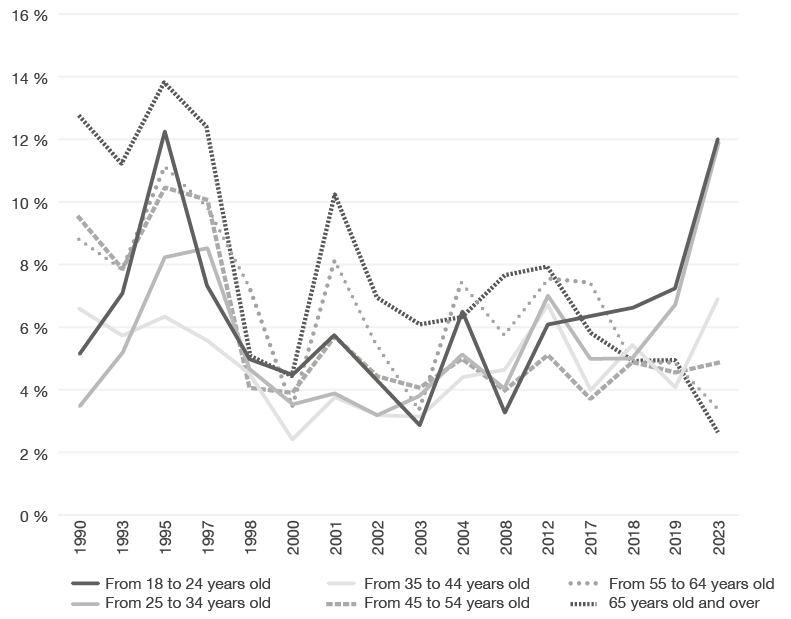
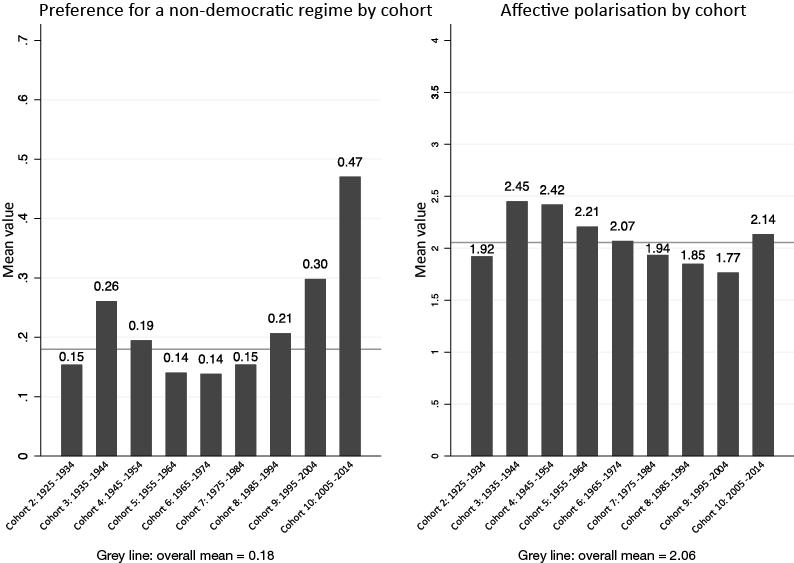
Spain has not undergone democratic backsliding in terms of institutional or legal mechanisms. However, a tendency can be observed among the Spanish population to favour non-democratic regimes. These attitudes are particularly prevalent in the younger age groups, among whom affective polarisation is also widespread (see Figures 1 and 2). It is therefore unlikely that polarisation will strengthen commitment to democratic norms in the way Gessler and Wunsch (2025) theorised. Affective polarisation, far from encouraging a joint mobilisation of the opposition, seems to lead to an acceptance of alternatives that avoid the disagreement inherent in democracy. In this context, polarisation would not act as a catalyst for renewed democratic engagement, but rather as a factor that would predispose people to accept less pluralistic forms of government.
We do not uphold, as Janssen and Turkenburg (2024: 2) have claimed, that moderate levels of polarisation are beneficial for democratic support; this is even less true in Spain, where political culture is rooted in “anti-politics” (Morán and Benedicto, 1995; Megías and Moreno, 2022, 2024). Feelings of party attachment have nothing to do with a sense of indifference towards democracy. We do not share the association between polarisation and party identification with a feeling of external political efficacy, the causes of which should be sought in the determinants of political disaffection. The perception of politics as a battlefield will increase disaffection and alienate citizens from politics (Aldrich, 2012; Megías and Moreno, 2022). After all, the “positive effects of polarisation [if any] depend on the well-functioning of democracy in countries threatened by polarisation’s potential ill-effects” (Russo, Franklin and Beyens, 2023). Nevertheless, we share the non-linear conception of the relationship between polarisation and democratic support held by Janssen and Turkenburg (2024), a position also developed for ideological polarisation (Torcal and Magalhães, 2022). In the case of Spain, however, we hold that the analysis of moderate levels of polarisation and democratic support must be analysed, firstly, based on the direct preference for a non-democratic system (as will be explained below); and secondly, by examining how polarisation interacts with other relevant variables, in particular, ideology and age.
It is also important to consider the interaction between polarisation and ideology. Previous research (Dalton, 2008; Hetherington, 2008) has shown that ideological polarisation can exacerbate the negative effects of affective polarisation on democratic support, while increasing support for far-right populist parties (Inglehart and Norris, 2017; Brug et al., 2021; Torcal and Magalhães, 2022). The radicalised discourse of these parties encourages illiberal attitudes in the electorate (Carey et al., 2022; Fossati, Muhtadi and Warburton, 2022; Svolik et al., 2023; Kaftan and Gessler, 2024). Polarisation ultimately undermines citizens’ ability to exercise democratic control, while privileging party loyalty over democratic principles.
On the other hand, age is a determining factor in the relationship between preference for non-democratic alternatives and polarisation. Younger cohorts have been shown to display lower levels of support for democracy than older generations (Norris, 1999; Foa and Mounk, 2016), while also having a greater propensity towards polarisation (Foa and Mounk, 2016; Mounk, 2018). On the one hand, these factors likely help to explain young people’s scepticism about democracy and their support for non-democratic alternatives (Belchior and Teixeira, 2024). On the other hand, they could account for how socialisation in strongly polarised political contexts may lead younger generations to perceive it as an inherent feature of the political system, thereby reducing their appreciation of democracy as a form of government. Nevertheless, it has also been found that older people tend to be less supportive of democracy as they approach the end of their lives (Lechler and Sunde, 2019; Huang, 2023). Despite their possible political differences, both younger and older age groups believe that an equitable distribution of income is an essential feature of democracy. In ageing societies, this belief in economic equality has a negative impact on support for democracy. However, this effect is unlikely to occur in Spain, given the features of political culture and socialisation under Franco’s dictatorship and people’s recall of it.
This leads to our third hypothesis (H3): Affective polarisation, in combination with age, is associated with a higher likelihood that young people will be sceptical of democracy and drawn to non-democratic forms of government.
In summary, we propose an explanatory model that situates preference for non-democratic alternatives in the intersection between polarisation, ideology and age, in order to better understand the determinants of democratic support in Spain. This model aims to overcome the limitations of unidimensional approaches and offers a more nuanced view of the relationship between polarisation and democracy. Spain is a particularly relevant case study given the distinctive features of its political culture, marked by anti-politics, which may modulate the relationship between affective polarisation and preferences for non-democratic alternatives.
Methodology, data
and estimates
Preference for a non-democratic regime
Our central dependent variable was the direct preference for a non-democratic regime. It was operationalised by the statement: “I would not mind living in an undemocratic country if it guarantees a better quality of life for me”. This formulation sought to capture a specific dimension of democratic support beyond superficial normative adherence to democratic principles. Instead of asking directly about having a preference for democracy as a political system, a statement was included that reflected individual willingness to trade democratic attributes for supposed tangible benefits in terms of material well-being. This operationalisation made it possible to translate abstract conceptions into concrete form with respect to the term “democracy” and whatever the respondent meant or understood it to mean. This approach is aligned with the criticism made by Torcal and Magalhães (2023) regarding the inadequacy of measures that are solely based on overt support for democracy, which may cause some problems concerning internal consistency and equivalence across cultures (Ariely and Davidov, 2011). By focusing on the potential acceptance of non-democratic alternatives conditional on improved quality of life, this approach involves a trade-off that mitigates social desirability bias in responses. It also filters out those respondents whose support for democracy is merely lip-service (Dalton, 1994; Inglehart, 2003) and captures a deeper, less idealised dimension of citizens’ commitment to democracy, exploring the tensions between democratic values and pragmatic considerations of individual well-being. As was seen for polarised voters who tolerate authoritarian tendencies or trade democratic principles for economic or partisan interests (Svolik, 2019), the path to authoritarianism does not lie in an explicit rejection of democracy, but in prioritising tangible outcomes over institutional procedures.
Independent variables: affective polarisation and moral frameworks
The operationalisation of affective polarisation proposed by Wagner (2021) was used here, given its usefulness in multi-party contexts such as Spain. This avoided underweighting smaller parties in vote share by calculating affective polarisation as the difference in weighted mean party affect compared to the weighted mean party affect for each respondent3. The equation was as follows:
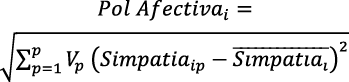
Where p is the party, i the individual interviewed and Simpatiaip the like/dislike score allocated to each party p by individual i. Vp represents each party’s share of the vote, measured as a ratio with a range from 0 to 14.
A comprehensive understanding of the preference for non-democratic regimes must go beyond analyses focused exclusively on institutional or socio-economic factors and must incorporate deep psychological predispositions. As Lasswell argued, individuals act on the basis of values deeply anchored in their subconscious (Lasswell, 1930, 1948). Aside from some cognitive shortcuts, people’s minds and behaviour differ from the view of an individual who makes decisions dispassionately by making a rational calculation of what is in their best interest (Westen, 2008). Individual perceptions are not only influenced by an objective calculation of benefits but are also shaped by psychological factors; therefore, perceptions are crucial to understanding democratic participation and satisfaction (Seimel, 2024). Values and moral frameworks, rather than rational calculations, play an important role in attitudinal processes by linking political preferences to notions of right and wrong (Clifford, 2019).
Lakoff’s (2016) view of moral politics is useful here. This theory postulates the existence of two basic moral models underlying political ideologies: the Strict Father and the Nurturant Parent models. The former emphasises paternal authority, discipline, self-discipline and the protection of moral order. In contrast, the latter focuses on empathy, responsibility towards others and the promotion of development and happiness. In this research we took into consideration two variables, operationalised through the degree of agreement with the statements: “The reason why some people do not progress in life is that they do not try hard enough” and “Success in life depends more on individual effort than on the family one is born into”.
Both captured adherence to certain values, including discipline, hierarchy and a clear distinction between right and wrong. People who have strongly internalised these principles may show a greater predisposition towards regimes that embody these characteristics. The inclusion of these explanatory variables permitted a deeper understanding of the psychological roots of the preference for non-democratic government systems. Especially in its pragmatic strand, the Strict Father model includes the idea of moral self-interest, where seeking one’s own prosperity is considered moral, assuming that this contributes to general welfare —an idea borrowed from Adam Smith—. From this perspective, the form of government may be considered secondary if a non-democratic system is perceived to be more effective in ensuring a better quality of life. The focus is thus on tangible results rather than political processes. It is therefore unsurprising that some leaders exploit this individualistic mindset by arguing that democratic norms aimed at equality or social protection are obstacles to individual freedom and self-sufficiency. This intensifies affective polarisation itself, grounded in the perception that the “other” is not only politically mistaken but also morally so.
This approach overcomes the limitations of one-dimensional analyses and captures the complexity of citizens’ attitudes towards democracy and its alternatives. It does so by addressing both individual psychological roots and intergroup dynamics, and by drawing on indicators of affective polarisation alongside the Strict Father framework.
The analysis also included other control variables used by the literature: socio-demographic (gender, age, educational level), economic (income, subjective social class) and political (ideology and nationalist sentiment —as a polarising item—). The appendices provide additional information on the formulation of the questions and descriptive statistics.
Data
The survey used in this study was CIS Barometer on Ideology and Polarisation ECIS 3480. It was conducted in October 2024 and provided us with the most comprehensive (n = 3928) and recent data on the object of research.
Analysis
Given the characteristics of the dependent variable, the expected approach would be to use a logistic model for “having a preference” versus “not having a preference” for an authoritarian regime. It should be noted, however, that the relationship between affective polarisation and democratic support is not linear, but negatively curvilinear (Janssen and Turkenburg, 2024). Our study drew on these precedents but shifted the focus towards direct expressions of preference for non-democratic regimes. For this we used a generalised additive model (GAM). The GAM analysis estimates smooth rather than parametric terms for the three variables of interest (age, polarisation and ideology), computing coefficients for a series of basic functions that may yield a more complex relationship than a purely linear one, as the prior literature and our descriptive statistics suggest (Ross, 2026). The smooth relationships estimated in the GAM analysis take a variety of forms that are fully determined by the data.
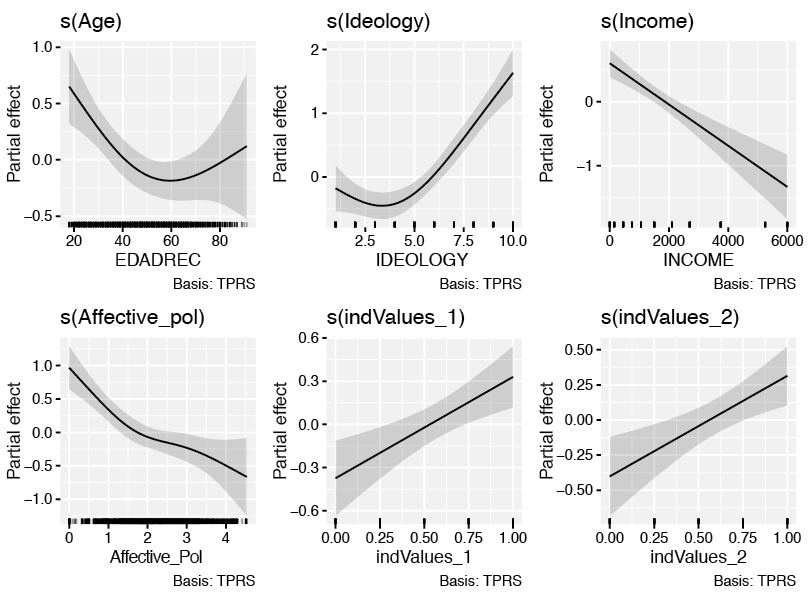
As can be seen in Figure 3, the variables of interest (ideology, affective polarisation and age) appear to display non-linear relationships with preference for non-democratic regimes, which justifies the need to conduct this type of analysis.
Results
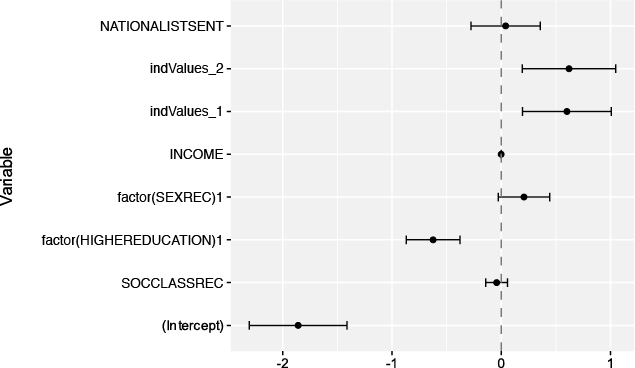
The results of the GAM analysis are presented in Table 1 and Figure 4 (which shows fixed effects). The first part shows the parametric coefficients, that is, the coefficients for the linear terms in the model. Thus, being male is associated with a greater preference for non-democratic regimes. The negative coefficients suggest that individuals with higher incomes and higher self-identified socio-economic status are less likely to favour authoritarian or non-democratic regimes, although significance was weak. For the explanatory variables linked to Strict Father morality (indValues_1 and indValues_2), we found that stronger beliefs about merit and individual responsibility were associated with greater preference for a non-democratic system of government (H2).
The second part of the model shows and assesses the significance of non-linear effects. The non-linear effect of ideology, with a Chi-square value of 16 145 and a significant p-value (< 0.05 *), suggests that the relationship between ideology and preference for authoritarianism was non-linear and adequately captured by the smoothing function, as was already apparent graphically, with effective degrees of freedom (edf) being 4930, indicating a complex relationship5. Similarly, the relationship between affective polarisation and preference for authoritarianism was equally complex and non-linear, with high significance (** p < 0.01). Finally, age, which also graphically showed a non-linear relationship, reinforced this, although it was not significant when considered separately.
But what happens when a more complex interaction takes place between these variables with non-linear relationships?
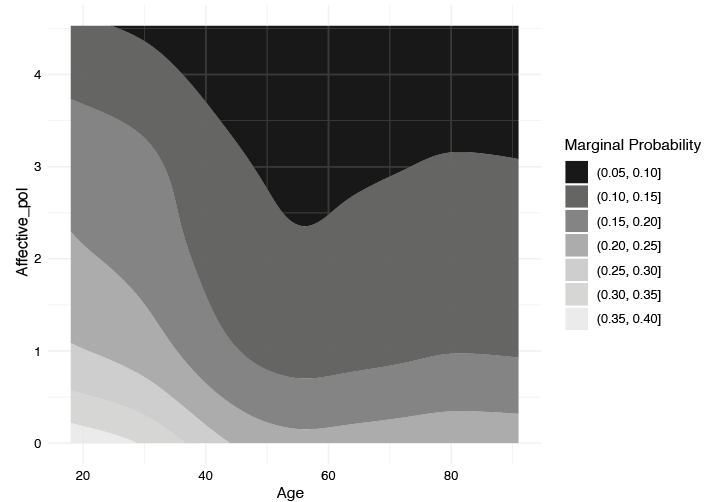
The interaction between age and affective polarisation pointed to a complex relationship, while the interaction between ideology and polarisation was somewhat simpler. These relationships are best examined graphically. Figures 5 and 6 display these interactions. The significant interaction between age and affective polarisation suggests that the effect of age on non-democratic regime preference varied depending on the level of affective polarisation and vice versa. Figure 5 provides an insight into the specific nature of this interaction.
Age alone showed little consistent effect, but its influence varied significantly when combined with the level of affective polarisation. Among individuals with low polarisation, preference for a non-democratic regime tended to decrease with age, whereas among those with moderate polarisation, it increased by between 0.15 and 0.25 in probability and remained stable with age. In contrast, high polarisation in young individuals was generally associated with lower preference. The most complex relationship was therefore observed at low and moderate levels of affective polarisation, where age appeared to have a more pronounced non-linear effect on authoritarian preference.
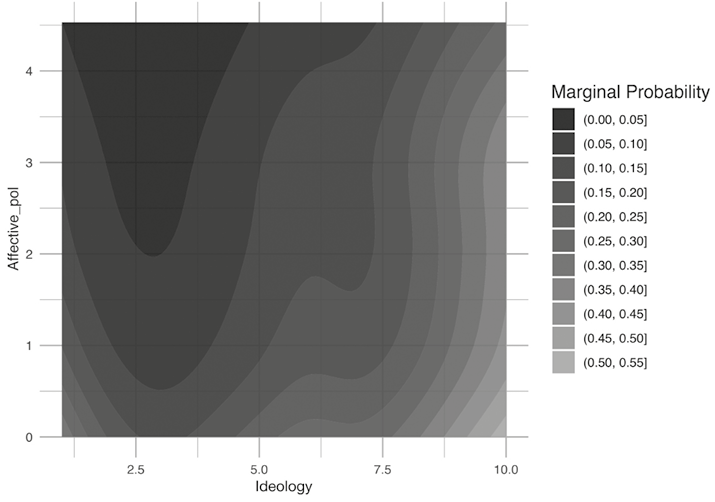
Figure 6 displays the joint effect of ideology and affective polarisation on the probability of preferring a non-democratic regime under certain circumstances. The lightest areas of the figure, indicating the highest marginal probability, appear at far-right ideological positions under both low and high affective polarisation. Low polarisation combined with self-placement on the far left is also associated with somewhat higher probabilities of preferring an authoritarian regime (light grey areas). High polarisation alone, however, does not predict greater preference for non-democratic regimes: this association emerges only in combination with self-placement on the right and far right.
It can be seen, therefore, that the probability tends to vary significantly across the ideological spectrum, indicating that we must take into account the crucial role that ideology plays in the relationship between polarisation and preference for alternatives to the democratic system.
Discussion
Although the proportion of people who would not be opposed to an authoritarian government under certain circumstances is gradually increasing, it remains low (see Figure 1). This gradual increase may indicate an unnoticed but progressive normalisation of authoritarianism, or at least of tolerance of or indifference towards regime type, somewhat as a trade-off for security and well-being.
This study started from the question as to whether the rise in the preference for authoritarian regimes is related to growing polarisation in contemporary democracies. The results indicate that affective polarisation influences people’s preference for non-democratic systems, a finding previously established in studies on ideological polarisation (Torcal and Magalhães, 2022). Our analysis confirms this for affective polarisation, when combined with right and far-right ideological self-placement (partially confirming H1).
The analysis also proved that there is a complex relationship between age and polarisation, which confirms H3. Young people are more willing to trade off democratic values, provided that this grants them higher welfare levels.
This finding speaks to the debate on post-materialist values (Inglehart, 1998), reflecting the tension between freedom and autonomy, on the one hand, and security and materialism, on the other, and its bearing on explanations of support for national-populist and far-right parties (Lagares, Pereira and Jaráiz, 2024) linked to preference for less democratic regimes. It also connects with “inverse post-materialism” (Bornschier, 2010; Inglehart and Norris, 2017) as part of the theories on the rise of the populist right.
The finding that young people show a greater willingness to trade off democratic values, provided that this entails material improvements, can be linked to the socialisation context of these cohorts. The impact of the 2008 economic crisis and the pandemic has shaped a context marked by a perceived end of social mobility, a chronic housing crisis and a parallel postponement of the age at which young people leave the family home. This may explain why younger generations are more willing to trade off democratic principles for improved material conditions provided by certain political options.
These results invite reflection on the age–polarisation relationship and on the effectiveness of democratic systems in neoliberal contexts, where the usefulness of public policies is questioned for their inability to solve the problems faced by both younger and older sections of the population (most strongly by young people). Populist forces and discourses operating in contexts of high affective polarisation amplify this dynamic.
Turning to the limitations of the analysis: although the proportion of explained variance (adjusted R-squared) is modest, suggesting that other factors not included in the model may have also influenced the preference for authoritarianism, our model was kept deliberately simple —parsimonious—with the aim of isolating and understanding the non-linear relationships and the crucial interaction between age and affective polarisation, as well as between ideology and affective polarisation, in the formation of attitudes conducive or prone to democratic backsliding. Specifically, we found that the effect of age on the preference for authoritarianism was not uniform, but varied significantly according to the level of affective polarisation of the individual. Similarly, the relationship between preference for authoritarianism and affective polarisation becomes more complex when ideology is taken into account. High probabilities of authoritarian preference were observed not only on the far right (where they were markedly higher), but also among respondents who placed themselves on the far left when polarisation levels were low. However, we observed a much stronger polarising effect when it was combined with self-placement on the right and far right.
Both age and ideology crucially modulate the effect of affective polarisation on authoritarian attitudes, as the smoothed GAM terms and figures reveal. Having a relatively parsimonious model has allowed us to focus on these interactive relationships, which could be obscured in a more complex model with additional predictors. The benefits in terms of conceptual clarity and the identification of these crucial mechanisms justify this parsimony in the model in this initial analytical approach to the analysis of affective polarisation as an active factor in shaping anti-democratic political attitudes, despite the modest explained variance. Future research could include additional predictors of preference for authoritarian views.
The article’s central contribution is that affective polarisation influences preference for non-democratic systems, and, specifically, that young people show a greater willingness to trade off democratic principles. These findings point to a serious and well-documented risk of rising anti-democratic attitudes linked to increasing affective polarisation in contemporary democracies. This highlights the need to pursue this research further, given its implications for the quality and maintenance of democracy.
Bibliography
Abramowitz, Alan I. (2010). The disappearing center: engaged citizens, polarization, and American democracy. New Haven: Yale University Press.
Abramowitz, Alan I. (2015). The New American Electorate: Partisan, Sorted, and Polarized. In: Thurber, James A. and Yoshinaka, Antoine (eds.). American Gridlock: The Sources, Character, and Impact of Political Polarization (pp. 19-44). Cambridge: Cambridge University Press. doi: 10.1017/CBO9781316287002.003
Aldrich, John (2012). Partisan Polarization and Satisfaction with Democracy. In: Shea, Daniel M. and Fiorina, Morris P. (eds.). Can We Talk? The Rise of Rude, Nasty, Stubborn Politics (pp. 121-141). Pearson.
Ariely, Gal and Davidov, Eldad (2011). “Can we Rate Public Support for Democracy in a Comparable Way? Cross-National Equivalence of Democratic Attitudes in the World Value Survey”. Social Indicators Research, 104(2): 271-286. doi: 10.1007/s11205-010-9693-5
Belchior, Ana M. da C. and Teixeira, Conceição P. (2024). “Breaking with Mainstream Politics while Engaging with Polarized: Determinants of Young Europeans’ Support for Democracy”. Journal of Youth Studies, 27(7): 986-1005. doi: 10.1080/13676261.2023.2187693
Bornschier, Simon (2010). Cleavage Politics and the Populist Right. Temple University Press. Available at: http://www.jstor.org/stable/j.ctt14btchr, access May 1, 2025.
Brewer, Mark D. and Stonecash, Jeffrey M. (2015). Polarization and the politics of personal responsibility. New York: Oxford University Press.
Broockman, David E.; Kalla, Joshua L. and Westwood, Sean J. (2023). “Does Affective Polarization Undermine Democratic Norms or Accountability? Maybe Not”. American Journal of Political Science, 67(3): 808-828. doi: 10.1111/ajps.12719
Brug, Wouter van der; Popa, Sebastian; Hobolt, Sara B. and Schmitt, Hermann (2021). “Democratic Support, Populism, and the Incumbency Effect”. Journal of Democracy, 32(4): 131-145. doi: 10.1353/jod.2021.0057
Campbell, James E. (2018). Polarized. Princeton University Press. doi: 10.2307/j.ctt1wf4cgv
Carey, John; Clayton, Katherine; Helmke, Gretchen; Nyhan, Brendan; Sanders, Mitchell and Stokes, Susan (2022). “Who Will Defend Democracy? Evaluating Tradeoffs in Candidate Support among Partisan Donors and Voters”. Journal of Elections, Public Opinion and Parties, 32(1): 230-245. doi: 10.1080/17457289.2020.1790577
Clifford, Scott (2019). “How Emotional Frames Moralize and Polarize Political Attitudes”. Political Psychology, 40(1): 75-91. doi: 10.1111/pops.12507
Dalton, Russell J. (1994). “Communists and Democrats: Democratic Attitudes in the Two Germanies”. British Journal of Political Science, 24(4): 469-493. doi: 10.1017/S0007123400006967
Dalton, Russell J. (2008). Citizen politics. Public opinion and political parties in advanced industrial democracies. SAGE Publications. (6th ed.).
Druckman, James N.; Green, Donald P. and Iyengar, Shanto (2023). “Does Affective Polarization Contribute to Democratic Backsliding in America?”. Annals of the American Academy of Political and Social Science, 708(1): 137-163. doi: 10.1177/00027162241228952
Erisen, Cengiz (2017). Political Behavior and the Emotional Citizen: Participation and Reaction in Turkey. London: Palgrave Macmillan UK.
Foa, Roberto S. and Mounk, Yascha (2016). “The Democratic Disconnect”. Journal of Democracy, 27(3): 5-17. doi: 10.1353/jod.2016.0049
Foa, Roberto S. and Mounk, Yascha (2017). “The Signs of Deconsolidation”. Journal of Democracy, 28(1): 5-15. doi: 10.1353/jod.2017.0000
Fossati, Diego; Muhtadi, Burhanuddin and Warburton, Eve (2022). “Why Democrats Abandon Democracy: Evidence from Four Survey Experiments”. Party Politics, 28(3): 554-566. doi: 10.1177/1354068821992488
Fuchs, Dieter; Guidorossi, Giovanna and Svensson, Peter (1995). Support for the Democratic System. In: Klingemann, H. D. and Fuchs, D. (eds.). Citizens and the State. Oxford University Press.
Gessler, Theresa and Wunsch, Natasha (2025). “A New Regime Divide? Democratic Backsliding, Attitudes Towards Democracy and Affective Polarization”. European Journal of Political Research: 1-25. doi: 10.1111/1475-6765.12751
Gidron, Noam; Adams, James and Horne, Will (2020). American Affective Polarization in Comparative Perspective. Cambridge University Press. doi: 10.1017/9781108914123
Graham, Matthew H. and Svolik, Milan W. (2020). “Democracy in America? Partisanship, Polarization, and the Robustness of Support for Democracy in the United States”. American Political Science Review, 114(2): 392-409. doi: 10.1017/S0003055420000052
Hetherington, Marc J. (2008). Turned Off or Turned On? How Polarization Affects Political Engagement. In: Red and Blue Nation? Consequences and Correction of America’s Polarized Politics (Issue 2006, pp. 1-51).
Huang, Kai P. (2023). “Support for Democracy in the Age of Rising Inequality and Population Aging”. Social Indicators Research, 166(1): 27-51. doi: 10.1007/s11205-023-03061-5
Inglehart, Ronald (1998). Modernización and posmodernización: el cambio cultural, económico and político en 43 sociedades. Madrid: Centro de Investigaciones Sociológicas.
Inglehart, Ronald (2003). “How Solid is Mass Support for Democracy - And How Can we Measure It?”. PS - Political Science and Politics, 36(1): 51-58. doi: 10.1017/S1049096503001689
Inglehart, Ronald and Norris, Pippa (2017). Trump, Brexit, and the Rise of Populism: Economic Have-Nots and Cultural Backlash. Faculty Research Working Paper Series. doi: 10.2139/ssrn.2818659
Iyengar, Shanto; Sood, Gaurav and Lelkes, Yphtach (2012). “Affect, Not Ideology”. Public Opinion Quarterly, 76(3): 405-431. doi: 10.1093/poq/nfs038
Iyengar, Shanto; Lelkes, Yphtach; Levendusky, Matthew; Malhotra, Neil and Westwood, Sean J. (2019). “The Origins and Consequences of Affective Polarization in the United States”. Annual Review of Political Science, 22: 129-146. doi: 10.1146/annurev-polisci-051117-073034
Janssen, Lisa (2024). “Sweet Victory, Bitter Defeat: The Amplifying Effects of Affective and Perceived Ideological Polarization on the Winner–loser Gap in Political Support”. European Journal of Political Research, 63(2): 455-477. doi: 10.1111/1475-6765.12625
Janssen, Lisa and Turkenburg, Emma (2024). “Breaking Free from Linear Assumptions: Unravelling the Relationship Between Affective Polarization and Democratic Support”. European Journal of Political Research: 1-15. doi: 10.1111/1475-6765.12725
Kaftan, Lea and Gessler, Theresa (2024). “The Democracy I Like: Perceptions of Democracy and Opposition to Democratic Backsliding”. Government and Opposition: 1-24. doi: 10.1017/gov.2024.12
Kingzette, Jon; Druckman, James N.; Klar, Samara; Krupnikov, Yanna; Levendusky, Matthew and Ryan, John B. (2021). “How Affective Polarization Undermines Support for Democratic Norms”. Public Opinion Quarterly, 85(2): 663-677. doi: 10.1093/poq/nfab029
Kreiss, Daniel and McGregor, Shannon C. (2024). “A Review and Provocation: On Polarization and Platforms”. New Media and Society, 26(1): 556-579. doi: 10.1177/14614448231161880
Lagares Diez, Nieves; Pereira López, María and Jaráiz Gulías, Erika (2024). “La construcción emocional de la extrema derecha en España Las elecciones autonómicas de Andalucía, Cataluña y Castilla and León”. Revista Internacional de Sociología, 82(4). doi: 10.3989/ris.2024.82.4.1302
Lakoff, George (2016). Moral Politics. University of Chicago Press. doi: 10.7208/chicago/97802
26411323.001.0001
Lasswell, Harold D. (1930). Psychopathology and politics. University Chicago Press.
Lasswell, Harold D. (1948). The structure and function of communication in society. In: Bryson, L. (ed.). The communication of ideas (pp. 37-51). New York: Harper and Row.
Lechler, Marie and Sunde, Uwe (2019). “Individual Life Horizon Influences Attitudes Toward Democracy”. American Political Science Review, 113(3): 860-867. doi: 10.1017/S0003055419000200
McCoy, Jennifer; Rahman, Tahmina and Somer, Murat (2018). “Polarization and the Global Crisis of Democracy: Common Patterns, Dynamics, and Pernicious Consequences for Democratic Polities”. American Behavioral Scientist, 62(1): 16-42. doi: 10.1177/0002764218759576
McCoy, Jennifer and Somer, Murat (2019). “Toward a Theory of Pernicious Polarization and How It Harms Democracies: Comparative Evidence and Possible Remedies”. The ANNALS of the American Academy of Political and Social Science, 681(1): 234-271. doi: 10.1177/0002716218818782
Megías, Adrián and Moreno, Cristina (2022). “Political Disaffection in Spain’s European Neighbours: a Stable Attitude?”. Revista Española de Investigaciones Sociológicas, 179: 103-124. doi: 10.5477/cis/reis.179.103
Megías, Adrián and Moreno, Cristina (2024). “Hidden Nationalism: The Nature and Configuration of Spanish Nationalism”. National Identities, 0(0): 1-20. doi: 10.1080/14608944.2024.2358534
Morán, María L. and Benedicto, Jorge (1995). La cultura política de los españoles: un ensayo de reinterpretación. Madrid: Centro de Investigaciones Sociológicas.
Mounk, Yascha (2018). El pueblo contra la democracia: por qué nuestra libertad está en peligro and cómo salvarla. Barcelona: Paidós. (1st ed.).
Norris, Pippa (1999). Critical Citizens: Global Support for Democratic Government. Oxford University Press.
Orhan, Yunus E. (2022). “The Relationship Between Affective Polarization and Democratic Backsliding: Comparative Evidence”. Democratization, 29(4): 714-735. doi: 10.1080/13510347.2021.2008912
Reiljan, Andres (2020). “Fear and Loathing across Party Lines’ (also) in Europe: Affective Polarisation in European Party Systems”. European Journal of Political Research, 59(2): 376-396. doi: 10.1111/1475-6765.12351
Rojo-Martínez, José M.; Crespo-Martínez, Ismael and Mora-Rodríguez, Alberto (2023). “Intergroup Emotional Dynamics: An Analysis of the Characteristics of Affectively Polarised Spanish Voters”. Revista Española de Investigaciones Sociológicas, 184: 105-123. doi: 10.5477/cis/reis.184.105
Ross, Noam (2026). Generalized additive models in R: a free interactive course.
Russo, Luana; Franklin, Mark and Beyens, Stefanie (2023). “From Ideological Congruence to Satisfaction with Democracy: How Leverage Can Mitigate the Ill-effects of Party Polarization”. Political Research Exchange, 5(1). doi: 10.1080/2474736X.2023.2195476
Sartori, Giovanni (1976). Parties and Party Systems: A Framework for Analysis. Cambridge: Cambridge University Press.
Seimel, Armin (2024). “Elite Polarization — The Boon and Bane of Democracy: Evidence from Thirty Democracies”. Electoral Studies, 90. doi: 10.1016/j.electstud.2024.102801
Simonovits, Gabor; McCoy, James and Littvay, Levente (2022). “Democratic Hypocrisy and Out-Group Threat: Explaining Citizen Support for Democratic Erosion”. Journal of Politics, 84(3): 1806-1811. doi: 10.1086/719009
Svolik, Milan W. (2019). “Polarization Versus Democracy”. Journal of Democracy, 30(3): 20-32. doi: 10.1353/jod.2019.0039
Svolik, Milan W.; Avramovska, Elena; Lutz, Johanna and Milaèiæ, Filip (2023). “In Europe, Democracy Erodes from the Right”. Journal of Democracy, 34(1): 5-20. doi: 10.1353/jod.2023.0000
Tajfel, Henri and Turner, John C. (1986). The Social Identity Theory of Intergroup Behavior. In: Worchel, S. and Austin, W. G. (eds.). Psychology of Intergroup Relation (pp. 7-24). Hall Publishers.
Torcal, Mariano and Magalhães, Pedro C. (2022). “Ideological Extremism, Perceived Party System Polarization, and Support for Democracy”. European Political Science Review, 14(2): 188-205. doi: 10.1017/S1755773922000066
Voelkel, Jan G.; Chu, James; Stagnaro, Michael N.; Mernyk, Joseph S.; Redekopp, Chrystal; Pink, Sophia L.; Druckman, James N.; Rand, David G. and Willer, Robb (2022). “Interventions Reducing Affective Polarization do not Necessarily Improve Anti-democratic Attitudes”. Nature Human Behaviour, 7(1): 55-64. doi: 10.1038/s41562-022-01466-9
Wagner, Markus (2021). “Affective Polarization in Multiparty Systems”. Electoral Studies, 69: 102-199. doi: 10.1016/j.electstud.2020.102199
Westen, Drew (2008). The Political Brain: The Role of Emotion in Deciding the Fate of the Nation – By Drew Westen. Public Affairs.
Appendices
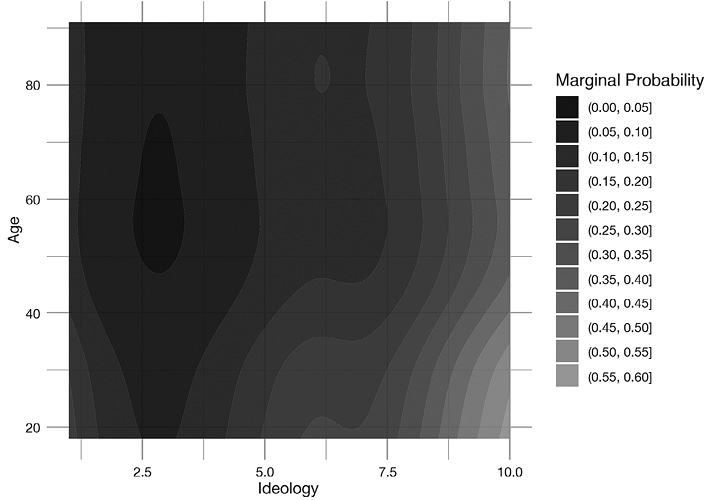
FIGURE A1. Probability of preference for a non-democratic regime (interaction between ideology and age)
Source: Prepared by the authors.
TABLE A1. Descriptive statistics
|
Variable |
N |
Mean |
SD |
Minimum |
Maximum |
Median |
|
SEX* |
3928 |
0.5414969 |
0.4983385 |
0 |
1 |
1 |
|
IDEOLOGÍA |
3804 |
4.8109884 |
2.3932975 |
1 |
10 |
5 |
|
Pol_Afectiva |
3928 |
2.0552364 |
1.0474737 |
0 |
4,6 |
2.039 |
|
EDAD |
3928 |
50.52 |
16.1448687 |
18 |
94 |
51 |
|
ESTUDIOS SUPERIORES |
3924 |
0.5344037 |
0.4988786 |
0 |
1 |
|
|
INCOME |
3223 |
1846.40 |
1222.034 |
0 |
6000 |
1500 |
|
CLASE_SOC |
3645 |
3.3676269 |
1.1543099 |
1 |
5 |
4 |
|
indValues_1 |
3909 |
0.5289716 |
0.3465289 |
0 |
1 |
0.75 |
|
indValues_2 |
3900 |
0.5630769 |
0.3308759 |
0 |
1 |
0.75 |
|
NATIONALISTSENT** |
3687 |
0.1885001 |
0.3911641 |
0 |
1 |
0.00 |
* Male (1), Female (0).
** Nationalist sentiment is operationalised on the basis of the “IDENTITY” variable, with categories 4 “More (Autonomous Community demonym) than Spanish” and 5 “Only (Autonomous Community demonym)” recoded into a dichotomous variable (0–1) as “non-Spanish nationalists” (1) and “the rest” (0).
Source: Prepared by the authors.
1 McCoy et al. (2018) warned of the risk of the “inability to make and implement effective policy decisions or the unilateral imposition of policies by the majority on the minority”.
2 See the report International Women’s Day 2025, available at: https://resources.ipsos.com/Download_the_IWD25_report.html, access May 1, 2025.
3 Affective polarisation was calculated for all respondents who reported some level of sympathy or affection for at least two parties.
4 For further discussion and information on this calculation, see Wagner (2021).
5 The edf (effective degrees of freedom) gives an idea of the complexity of the non-linear relationship that the smoothed term captured. An edf close to 1 suggests a nearly linear relationship, while a higher edf indicates a more curved and complex relationship. When interpreting GAM results, it is important to consider the edf value alongside the p-value in order to assess both the statistical significance and the nature of the relationship modelled by each smooth term.