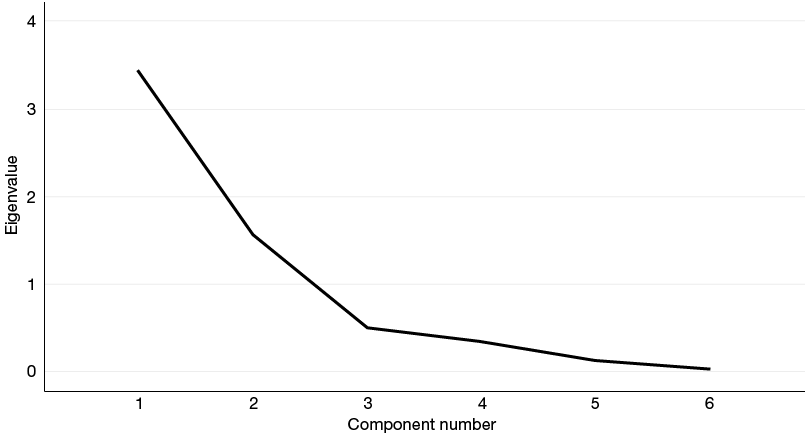
Figure 1. Factor Analysis Scree Plot
Source: Author’s own creation.
doi:10.5477/cis/reis.196.13-32
The Quality of Democracy in Spain, 1979-2024: An Overview
La calidad de la democracia en España: una perspectiva general (1979-2024)
Alex Tusell Collado
|
Key words Democratic Quality
|
Abstract Except for expert evaluations and citizen surveys, few studies have specifically examined the quality of democracy in Spain. This article analyzes its evolution between 1979 and 2024 using an index constructed through factor analysis. The results reveal a progressive decline since 2011. To identify the factors underlying this trend, a combined methodology is employed, integrating neural networks and structural equation modelling. The findings indicate that party system institutionalization, measured by electoral volatility, and, less robustly, economic growth, measured by GDP, exert a negative effect on democratic quality. Individualism and populism are also introduced as novel variables; however, neither these nor the other variables included in the model prove statistically significant. In the case of populism, the results suggest a possible endogenous relationship with democratic quality. |
|
Palabras clave Calidad democrática
|
Resumen Excepto auditorías de expertos y encuestas a la ciudadanía, apenas existen estudios específicos sobre la calidad democrática en España. Este artículo examina su evolución entre 1979 y 2024 mediante un índice elaborado con un análisis factorial. Los resultados revelan un deterioro progresivo desde 2011. Luego, para identificar los factores explicativos, se emplea una metodología combinada que integra redes neuronales y un modelo de ecuaciones estructurales. Los hallazgos indican que la institucionalización del sistema de partidos, –medida con la volatilidad electoral– y, de forma menos robusta, el crecimiento económico, –medido mediante el PIB–, influyen negativamente sobre la calidad democrática. Asimismo, se incorporan como novedad el individualismo y el populismo, que, junto con otras variables, no resultan significativas. En el caso del populismo, se detecta una posible relación endógena con la calidad democrática. |
Citation
Tusell Collado, Alex (2026). “The Quality of Democracy in Spain, 1979-2024: An Overview”. Revista Española de Investigaciones Sociológicas, 196: 13-32. (doi: 10.5477/cis/reis.196.13-32)
Alex Tusell Collado: Escuela Internacional de Doctorado (EIDUNED) | Estudis de Dret i Ciència Política (UOC) | atusell@uoc.edu
Introduction
The Spanish Constitution was adopted in 1978 during the third wave of democratization (Huntington, 1991). Since then, all major democracy indices have classified Spain as a full democracy. The country has experienced more than forty-five consecutive years of democratic government, the longest uninterrupted democratic period in its history.
Democracy is a subject of interest to both scholars and citizens. Political science’s interest in democracy has evolved alongside the history of democratic governance. With the global expansion of democracy, research has shifted from the study of democratization processes to the analysis of the performance of democratic regimes. A new line of research has emerged: the quality of democracy. Although evaluating democratic health is challenging, political science has addressed democratic value since the onset of the twenty-first century through a variety of approaches, most of which focus on Latin America. More recently, the analysis of autocratization processes has also been incorporated.
Nevertheless, the literature on democratic quality in Spain remains limited and is largely confined to assessments of democratic performance based on expert and citizen surveys. As a result, the factors influencing the health of Spanish democracy remain largely unexplored.
The primary objective of this study is to describe the evolution of democratic quality in Spain between 1979 and 2024. To this end, a democratic quality index is constructed using indicators corresponding to the different dimensions that make up the concept. Second, the article presents an exploratory empirical analysis of the factors that may influence democratic quality in order to identify the principal threats and challenges facing democracy in Spain.
To address these issues, the article is organized into five sections. Following the introduction, the second section provides a review of the literature on democratic quality and its dimensions, as well as on existing studies of democratic quality in Spain. It also synthesizes the main factors influencing democratic health, incorporating two variables of interest —individualism and populism— and summarizes autocratization processes and the impact of the COVID-19 pandemic crisis on democracy. The third section presents the construction of a democratic quality index for Spain using factor analysis for the 1979-2024 period. The fourth section assesses the factors affecting democratic quality in Spain in two stages: a) and exploratory neural network analysis, which is a machine learning technique, and b) the estimation of a structural equation model that confirms the results. Finally, the last section presents the main conclusions.
Democratic quality
The concept of democratic quality has been part of the research agenda since the early 2000s. It is a complex concept composed of multiple dimensions and there is no scholarly consensus on its definition or its constituent dimensions (Munck, 2016). This lack of agreement stems from the absence of a broadly accepted definition of democracy, given the wide diversity of theoretical approaches to its study (Coppedge, 2012). Defining democracy is a difficult task that involves multiple nuances (Alcántara and Paredes, 2020).
Most scholars agree that democratic quality can only be studied in countries with regimes that meet minimum democratic requirements (Altman and Pérez-Liñán, 2002; Morlino, 2007) based on Dahl’s (1956) conditions of polyarchy. In other words, hybrid regimes and autocracies are not suitable for assessing democratic quality.
The literature presents various theoretical approaches to the study of democratic quality and offers rankings based on indices. These approaches address different dimensions of democratic quality and use a variety of methodologies. For example, some studies focus on assessing the gap between an ideal model of democracy and its actual state in a given country, whereas others conduct cross-national comparisons using quantitative and qualitative methods or adopt a case study approach (Diamond and Morlino, 2005; Morlino, 2005).
Patterns of Democracy is one of the earliest political science works to address democratic quality. In this book, Lijphart (1999) argues that consensus democracies —characterized by higher levels of political and electoral participation, greater representation of women, higher levels of citizen satisfaction with government, and greater government responsiveness to the electorate— exhibit higher democratic quality than majoritarian democracies.
Dimensions of democratic quality
Perhaps the most important debate concerns the identification of the dimensions making up the concept of democratic quality. The literature offers various theoretical approaches that can be grouped into three main perspectives.
The first approach, focused on the “rules of the game”, is based on Dahl’s (1956) concept of polyarchy1. Dahl identified a set of institutional conditions required for polyarchy, and from this starting point, democratic quality is assessed through the evaluation of electoral institutions and processes. The procedural perspective focuses on the study of the rules and procedures governing the selection of rulers. Notable contributions include Mainwaring and Pérez-Liñán (2008), who assess democratic quality through the attributes of political rights and civil liberties, and Altman and Pérez-Liñán (1999), who examine the attributes of participation and effective competition. Subsequently, Altman and Pérez-Liñán (2002) add the dimension of civil rights.
The second approach holds that, in order to assess democratic quality, it is necessary to incorporate a perspective concerned with the control of power, thereby strengthening the republican component of democracy. The control of political power examines the system of rights and the institutions responsible for overseeing political authority, with the aim of ensuring the existence of legal constraints on government action (Bühlmann et al., 2012; O’Donnell, 2004a; Vargas-Machuca, 2006).
The dimension of political power control is operationalized through accountability, which can be horizontal or vertical. Horizontal accountability is exercised through institutions that have the capacity and authority to oversee and even sanction other state institutions (O’Donnell, 2004a, 2004b). Vertical accountability, in turn, is subdivided into electoral and societal forms. Electoral accountability operates through the reward or punishment of candidates in elections and therefore constitutes a retrospective action by the electorate (O’Donnell, 2004a). Social accountability is exercised between electoral periods through actions that are undertaken by distinct civil society groups or individuals, and it employs both formal and informal political participation mechanisms. This accountability complements both horizontal and electoral accountability (Smulovitz and Peruzzotti, 2000). Moreover, the three types of accountability are interrelated and mutually reinforcing (Barreda, 2014).
In the second perspective, the work of Diamond and Morlino (2004, 2005) is a key reference, as it proposes various dimensions for assessing democratic quality and analyzes how they are interrelated. The literature review also includes several studies adopting a procedural perspective that incorporate the control of political power (Barreda, 2011; Bühlmann et al., 2012; Levine and Molina, 2007; Morlino, 2007; Tusell Collado, 2015, 2023; Vargas-Machuca, 2006, 2012). Although it presents a critical approach, Munck’s (2016) reconceptualization of the concept of democratic quality is part of this perspective2.
Finally, the third approach assesses democracy’s responsiveness to social demands, that is, the performance of the democratic system. To this end, it incorporates substantive or outcome-oriented dimensions (Morlino, 2009). This perspective takes into account political objectives such as socioeconomic equality and social welfare. Some proposals include Escobar (2011), who suggests four procedural dimensions (legality, electoral quality, government transparency, and integrity) and three dimensions that combine procedural and substantive aspects (freedom, social rights, and citizen accessibility) and Valdebenito (2022), who includes the dimension of equality from a substantive perspective in order to compare democratic quality across Latin American countries. The dimension of responsiveness has also been proposed in relation to government responsiveness (Isaza, 2023).
Democratic quality in Spain
Since the adoption of the 1978 Constitution, Spain has been considered a democracy. Various indices, such as Polity V3 and the Economist Intelligence Unit4, classify it as a full democracy, and measures of democratic quality also indicate that Spain exhibits a high-quality democracy. For example, in 2024, Varieties of Democracy (V-Dem) ranked Spain 24th, above countries such as Italy, Japan, and Greece.
Despite the extensive literature on democratic quality, particularly in Latin American countries, references to Spain remain scarce. Most available studies are democratic performance audits based on citizen or expert perceptions, and there is a lack of research on the determinants of democratic quality in Spain.
Among studies based on citizen perceptions, the book Calidad de la democracia en España, una auditoria ciudadana stands out. It presents the results of a survey conducted in 2007 with the aim of assessing social perceptions of democratic quality. The study employs dimensions related to the three perspectives on democratic quality described above. The results show that citizens rate Spanish democracy at 5.12 out of 10. The dimensions of government legitimacy and effectiveness receive the highest ratings, while civil society and representation are the lowest-rated dimensions (Gómez et al., 2010).
Another example of a citizen audit is the report Los españoles y la calidad de la democracia. This study, based on surveys from the Centro de Investigaciones Sociológicas (CIS) conducted in 2007 and 2009, employs attributes from the three perspectives on democratic quality. In this case, citizens give Spanish democracy a failing score of 0.41 on a scale from 0 to 1. The lowest-rated dimensions are government responsiveness, the rule of law, and corruption, while the highest-rated dimensions are civil and political rights and participation (Palacios, 2016).
Using a survey based on thirty indicators from Morlino’s (2009) dimensions, Gómez and Palacios (2012) provide a snapshot of citizens’ perceptions. Their main conclusion is that political participation in Spain is very low and constitutes the principal deficit among the dimensions of democratic quality. Second, the results reveal low levels of confidence in the rule of law, particularly in the judicial system. Third, with regard to the dimension of equality, citizens perceive that justice is not administered equally to all. Finally, citizens perceive both weak control over political power and a poor correspondence between political decisions and the preferences of the majority of the population.
Among studies based on expert assessments, the work of Fundación Alternativas stands out. Since 2008, it has published an annual index of democratic quality in Spain, composed of 57 indicators covering both procedural and substantive dimensions. The index declined between 2008 and 2015. From that year onward, it entered a period of improvement that continued until 2022, when it reached a score of 6.4 out of 10, a level that was maintained in 2023 and 2024 (Penadés and Mateos, 2025).
The article by Escobar and Gómez (2014) also assesses the health of democracy in Spain through a survey of experts. In their analysis, Spanish democracy receives scores ranging from 5 to 6.5 on a scale from 0 to 10, although the results indicate a downward trend between 2008 and 2014. The dimensions of democratic quality rated most highly by experts are civil liberties and elections, whereas transparency, integrity, and accessibility receive the lowest ratings.
In summary, citizens’ assessments of democratic quality are less favorable than those of experts. Nevertheless, both the study by Fundación Alternativas (Penadés and Garmendía, 2024) and the article by Escobar and Gómez (2014) identify a decline in democratic quality beginning in 2008, although these scores have recovered in recent years. The literature does not provide studies that examine the factors that may improve or undermine the health of democracy quality in Spain.
Critiques of the concept of democratic quality
The concept of democratic quality presents challenges due to its theoretical complexity and the absence of a consensus definition. First, the degree of democratization in a country may be conflated with assessments of its democratic quality. Some authors argue that the purpose of democratic quality is to evaluate a country’s level of democratization at a given point in time (Vargas-Cullell, 2011). Other approaches hold that no clear distinction exists between democracy and democratic quality, viewing both as characteristics of the same phenomenon and arguing that democratic quality can be studied in all countries (Bühlmann et al., 2012; Munck, 2016).
Second, Vargas-Cullell (2011) argues that, in order to analyze democratic quality, it is necessary to exclude substantive dimensions and those related to accountability. The author maintains that both types of dimensions include normative attributes that distort the concept of minimal democracy. In addition, there are fewer indicators related to substantive dimensions than to procedural ones (Pulido, 2024).
Third, cross-national comparisons of democratic quality may be problematic. Democratic quality is more accurately analyzed through local or regional approaches, since some models are not sensitive to differences across countries and are therefore not suitable for comparative purposes (Altman and Pérez-Liñán, 2002). However, most indicators are state-based, and only a few operate at the local or regional level; these are also more recent developments (Pulido, 2024).
Finally, methodological challenges exist. The indicators commonly used to operationalize the dimensions of democratic quality raise issues of inconsistency with respect to the theoretical framework. This is due to the weak theoretical justification of such indicators (Mazzuca, 2007; Munck, 2013). Questions may also be raised about the consistency between the dimensions of democratic quality and their definition (Munck, 2016). In addition, indicators constructed through expert judgment may be biased due to issues of subjectivity. In this regard, questions may arise regarding how to ensure transparency in their construction and the independence of experts (Alcántara and Paredes, 2020).
Factors influencing democratic quality
Some comparative studies have examined the factors influencing democratic quality, although research on Spain remains limited. These factors may be grouped into three types: sociocultural, structural, and institutional. The following section summarizes some of the most prominent explanations, without aiming to be exhaustive, and introduces several additional insights.
Within sociocultural factors, the main premise is that social capital is a key factor in explaining democratic quality through the existence of social networks based on interpersonal trust. Social capital, insofar as it contributes to a better-informed citizenry and fosters participation in public debate, enhances society’s democratic accountability (Boix and Posner, 2000). In this regard, a civil society that is capable of articulating active political participation contributes to strengthening democracy (Fernández-Llebrez, 2012) and may be the most decisive factor (Tusell Collado, 2015). However, some studies have concluded that social capital does not impact democratic quality (Barreda, 2011).
Although the influence of individualism on democratic quality has not been previously studied, it can be considered a sociocultural factor and represents a novel contribution. From a philosophical perspective, individualism has been linked to a more uninformed citizenry, greater skepticism toward political action, and lower levels of political participation. Some studies have addressed individualism and its relationship with democracy. Howe (2017) argues that younger generations exhibit increasingly individualistic attitudes which, together with socioeconomic inequality, lead to greater disaffection with democratic mechanisms. Thus, individualism would have a negative effect on democratic quality.
Among structural explanations, two factors stand out. The first is economic growth, and some studies (Barreda, 2011; Mainwaring and Pérez-Liñán, 2008) argue that it contributes to improving democratic quality, although only moderately. Accordingly, economic crises have a negative impact on democratic quality (Bühlmann et al., 2012). Economic inequality is the second structural factor and is associated with lower levels of political engagement and reduced voter turnout. It has also been argued that in countries with higher levels of inequality, elites lack incentives to support democratic improvements for fear of losing their privileges (Crespo and Martínez, 2005). Other scholars have linked inequality to political polarization, the weakening of the rule of law, and weaker accountability (Bermeo, 2009; Hagopian, 2005).
Within institutional explanations, three factors stand out: party system institutionalization, party system fragmentation, and the decentralization of political power. The literature on democratic quality suggests that countries with higher levels of party institutionalization are associated with better democratic quality (Barreda, 2011; Mainwaring and Torcal, 2005). However, party institutionalization is not always decisive for democratic quality (Pérez-Talia, 2017), although this study is based on a comparative analysis of two countries. Regarding party system fragmentation —the second institutional factor— some studies conclude that multiparty systems have a negative impact on democratic quality, with the exception of longer-established presidential democracies (Mainwaring and Pérez-Liñán, 2008). With respect to the territorial organization of political power in Spain, Colino (2013) finds that regional decentralization does not have negative effects on the health of democracy.
In addition to the three types of explanations, populism can be added as a new analytical factor. Morlino and Raniolo (2021) argue theoretically that populism affects all dimensions of democratic quality5 and leads to its deterioration. In fact, the threat of populism to democracy is a topic of growing academic interest. For example, Palacios, Garrido and Martínez (2025) in a study on Spain, conclude that among younger individuals, populism —linked to polarization and conservative attitudes— leads to democratic disaffection.
The concept of autocratization is also of interest to political science, as it refers to the process of gradual democratic deterioration and constitutes a global trend in recent years. Several studies argue that democracies are experiencing a third wave of autocratization (Hellmeier et al., 2021; Lührmann and Lindberg, 2019; Nord et al., 2025), characterized by the gradual erosion of democratic attributes. This process unfolds within legal frameworks and involves setbacks in freedom of expression, increased governmental control over the media, and the proliferation of disinformation, all of which intensify political polarization. Deterioration is also evident in the freedom and impartiality of electoral processes (Hellmeier et al., 2021; Nord et al., 2025).
Finally, the crisis triggered by the COVID-19 pandemic extended beyond the health sphere, generating social, economic, and political implications, as well as affecting the exercise of fundamental rights. Social distancing from family and friends led to a decline in social interactions (Tezanos, 2022), a phenomenon that may be linked to the erosion of social capital, increased individualism, and rising social inequality. Moreover, the crisis had a significant impact on economic and labor activity, and several experts suggest that it increased political disaffection and populism. Another impact of the crisis was the restriction of fundamental rights, such as freedom of movement, residence, assembly, and demonstration (Tezanos, 2022). However, other studies argue that the pandemic cannot be associated with setbacks in democratic dimensions (Hellmeier et al., 2021).
Measuring democratic quality
Operationalization of democratic quality
In order to construct an index of Spanish democratic quality for the period ranging from 1979 to 2024, a procedural approach is adopted. From this perspective, three dimensions are selected: political rights and civil liberties, the rule of law, and participation. To these dimensions, horizontal and vertical accountability are added as attributes of political power control. Finally, the “equality” dimension is incorporated within the substantive approach as an outcome of democratic performance.
Once the six dimensions have been selected, the next step is to choose a quantitative indicator for each dimension with data available for the period 1979-2024. All variables were standardized to facilitate the factor analysis and to ensure that they are not distorted by asymmetries across the values.
Accordingly, the dimension of political rights and civil liberties is measured as the average of Freedom House’s political rights and civil liberties indicators, following the methodology employed in previous studies (Barreda, 2011; Levine and Molina, 2007). This variable was reverse-coded so that higher values correspond to higher levels of political rights and civil liberties. The second dimension, the rule of law, is operationalized using the V-Dem rule of law indicator, where higher scores reflect a better situation. The participation dimension is measured using parliamentary election turnout data compiled by the International Institute for Democracy and Electoral Assistance (IDEA). Regarding the dimensions related to the control of political power, horizontal accountability is operationalized using V-Dem’s political corruption index. The values of this variable were reverse-coded so that higher scores indicate lower levels of perceived political corruption. Vertical accountability is measured using IDEA’s press freedom indicator, for which higher values represent greater levels of press freedom. Finally, to operationalize the equality dimension, IDEA’s social group equality indicator was selected, for which higher scores indicate greater levels of equality.
Index of democratic quality in Spain
The Kaiser-Meyer-Olkin (KMO) test is a statistical measure used to assess the suitability of data for factor analysis. The KMO statistic ranges from 0 to 1, with values closer to 1 indicating greater appropriateness for factor analysis. For the six variables included in this study, the KMO score is 0.7, which is considered a moderate (Kaiser, 1974) or intermediate (López-Roldán and Fachelli, 2015) level for conducting factor analysis. Similarly, Barlett’s test is statistically significant (p < 0.001), confirming the suitability of factor analysis.
Factor analysis is a statistical data reduction technique used to determine whether one or more underlying factors exist within a data matrix measuring the same concept. It is an appropriate method when multiple interrelated variables are used (López-Roldán and Fachelli, 2015). Therefore, factor analysis is suitable for approximating the concept of democratic quality, as it is composed of multiple dimensions that are likely interrelated.
Using the data from the six indicators, a principal component factor analysis with maximum varimax rotation is conducted. First, Figure 1 shows the existence of two underlying factors that explain a large share of the variance in the six dimensions of democratic quality. The remaining factors display limited explanatory power, with eigenvalues below 1. Specifically, factor 1 accounts for 57.19 % of the variance and factor 2 accounts for 26.01 %. Together, both factors explain a high proportion of the total variance in the six dimensions, accounting for 83.20 % of the overall variance.
Table 2 shows that the variables loading on Factor 1, from highest to lowest, are rule of law (0.972), press freedom (0.949), political corruption (0.856), and voter turnout (0.793). The variables loading on Factor 2 are social group equality (0.888) and political rights and civil liberties (0.811).
These results indicate that any assessment of democratic quality must take into account the dimensions related to the control of political power, in line with previous studies (Barreda, 2011; Levine and Molina, 2007; O’Donnell, 2004a, 2004b; Tusell Collado, 2015, 2023; Valdebenito, 2022; Vargas-Machuca, 2006). Indeed, the indicator corresponding to the dimension of vertical accountability (press freedom) is the second-largest contributor to Factor 1.
To construct an index that integrates both factors, a composite index of democratic quality is developed to track its evolution since 1979. To this end, the scores for Factors 1 and 2 are weighted according to the proportion of variance explained by each factor, using the following formula:
Democratic quality=
0.687 ⋅Factor 1 + 0.313 ⋅Factor 2
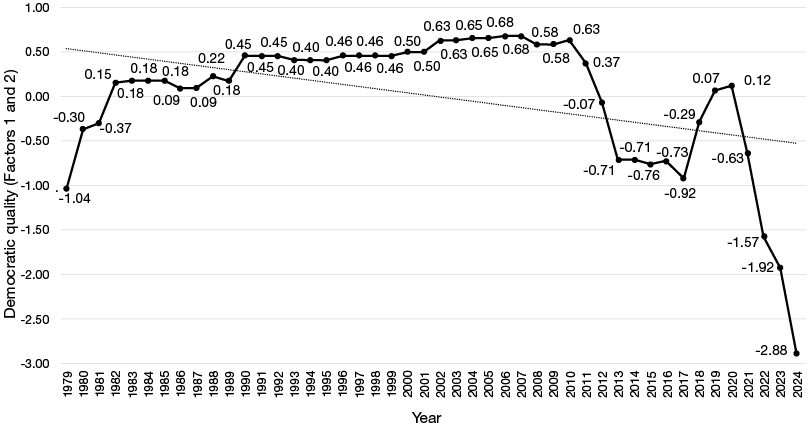
Figure 2 presents the scores for the Spanish democratic quality index derived from Factors 1 and 2 of the analysis. In 1982, the score was 0.15 and followed an upward trajectory until 2010, when it reached 0.63. From 2011 onward, the index experienced a sharp decline until 2018. Although the score recovered until 2020, it subsequently declined again, with 2022, 2023, and 2024 recording the lowest scores in the series.
These results are consistent with the findings of Escobar and Gómez (2014) and with the Fundación Alternativas index, since both identified a worsening of democratic quality over the 2008-2015 period. The findings are in line with those of recent studies on autocratization processes (Hellmeier et al., 2021; Lührmann and Lindberg, 2019; Nord et al., 2025). However, they diverge from the findings reported by Fundación Alternativas from 2015 onward. While the latter indicates a recovery in democratic quality, the results of the factor analysis point to a marked deterioration in recent years. Finally, Figure 2 shows a decline in democratic quality beginning in 2020, coinciding with the COVID-19 pandemic (Tezanos, 2022).
What explains democratic quality? Challenges for spanish democracy
Operationalization of explanatory factors
To determine the factors that influence democratic quality, the first step is to operationalize the explanatory factors. Within the sociocultural explanations, the “social capital” variable is measured using the “interpersonal trust” indicator from the World Values Survey (WVS), where higher values indicate greater trust in others. For the second sociocultural explanation, individualism, the WVS item on government versus individual responsibility is used. Lower values indicate greater reliance on government, whereas higher values are associated with greater individualism.
Regarding structural factors, economic growth is operationalized using the World Bank’s GDP per capita indicator (in constant prices). To mitigate potential endogeneity, this variable is lagged; that is, GDP per capita values for 1978 are used for 1979, and so on. The data are also standardized to prevent asymmetries in the distribution of the independent variables from affecting the analysis. The second structural factor in this study is economic inequality, measured using the World Bank’s Gini index. The higher the Gini index value, the greater the economic inequality.
Regarding institutional factors, two variables are considered: party system institutionalization and party system fragmentation. The first is operationalized using the electoral volatility indicator from the Quality of Government (QoG) dataset. Higher values indicate greater electoral volatility, meaning that a larger share of voters have changed their electoral preferences compared to the previous parliamentary elections. The second institutional variable —fragmentation of the party system— is measured using the effective number of parties indicator, also drawn from the QoG dataset. Higher values indicate greater fragmentation of the party system.
Finally, the new variable “populism” is operationalized using the percentage of votes for populist parties, as measured by the Authoritarian Populism Index. Higher values indicate a greater share of votes for populist parties.
To facilitate the statistical analysis, missing values for the indicators “interpersonal trust”, “government accountability” and the Gini index were imputed using the mean value of each respective indicator.
Results and analysis
The KMO test measures the correlation coefficients between variables. The result of this test for the seven independent variables is 0.3. This result indicates the absence of one or more underlying factors that explain their variability (Kaiser, 1974; López-Roldán and Fachelli, 2015). Therefore, data reduction techniques using explanatory factors are ruled out.
The next step is to determine whether parametric or non-parametric statistical techniques are more appropriate. Parametric techniques require that the data meet the assumptions of normality, homogeneity of variances, linearity, and independence, whereas non-parametric techniques are an alternative when these assumptions are not satisfied.
First, the results of the Shapiro-Wilk and Anderson-Darling tests indicate that none of the variables meets the assumption of normality. Second, only the independent variable, the Gini index, passes the homogeneity of variances test. The third test is the linearity test, whose results show that none of the independent variables is linear, except for the parameter, which also satisfies the homogeneity assumption. Finally, the Durbin-Watson test yields a value of 1.08, indicating that the explanatory variables are not independent and exhibit positive autocorrelation. Consequently, parametric statistical techniques are ruled out, and a non-parametric model is selected.
Therefore, machine learning models are used, in particular neural network analysis, a technique that is increasingly being applied in political science. The objective is to conduct an exploratory analysis to identify the hierarchical importance of the independent variables for the dependent variable (Wordliczek, 2023). This method is suitable for the exploratory examination of interactions between variables, as it allows the identification of complex patterns without the need to formulate prior hypotheses. It is also appropriate for prediction purposes. Specifically, the multilayer perceptron (Rumelhart, Hinton and Williams, 1986) is a type of neural network composed of an input layer, one or more hidden layers, and an output layer. It employs the backpropagation algorithm to reduce the difference between predicted and actual values, making it especially useful for non-parametric data.
To train this multilayer perceptron neural network, 52.18 % of the cases are used: 26.09 % are test cases (used during training) and 26.09 % are backup samples (used to evaluate the final neural network). Batch training is chosen because it minimizes the total error and is appropriate for small datasets, such as the one in this study, which covers a 46-year time series. Finally, the neural network architecture is defined automatically and includes a hidden layer in its design.
The results of this neural network model are shown in Table 4, which presents the relative importance of the independent variables. This allows us to identify which variables have the greatest impact on the prediction of the dependent variable. The variable with the greatest influence on democratic quality is electoral volatility, followed by GDP per capita.
However, the neural network results do not allow us to identify the direction of the relationship between the independent and dependent variables. To address this, Spearman’s rho test is used as a non-parametric measure of correlation. Its values range from -1 to 1, indicating negative or positive associations. The correlation between electoral volatility and democratic quality is -0.539, indicating a moderate negative association (95 % significance). The correlation between GDP per capita and democratic quality is -0.226, suggesting a weak negative association (90 % significance).
To confirm the exploratory patterns identified by neural network analysis, a partial least squares structural equation model (PLS-SEM) is employed. This technique is appropriate when variables do not meet the assumption of normality and is robust for small sample sizes and complex analyses with multiple constructs (Hair et al., 2017, 2019). Although the model explains 66 % of the variability of the dependent variable (R² = 0.66), the beta coefficient for populism is -1.734. Values greater than 1 typically indicate multicollinearity among independent variables. In this case, the variance inflation factors (VIF) confirm a correlation between populism and the effective number of parties, making it impossible to disentangle their specific effects. Furthermore, when the “populism” variable is excluded, the VIF values show that the effective number of parties also exhibits multicollinearity with other independent variables.
A model is constructed that excludes the independent variables “populism” and “effective number of parties”. This model explains 24 % of the variance in democratic quality (R² = 0.24). The results show that the significant parameters are electoral volatility —with a 95 % significance level— and GDP per capita —with a 90 % significance level—. The beta coefficients from the path analysis indicate that both variables have a negative effect on democratic quality, although the effect of electoral volatility is stronger.
The analyses conducted —which include an exploratory study using neural networks and a structural equation model— suggest that party system institutionalization, measured through electoral volatility, is the variable with the greatest influence on the variance of democratic quality. This conclusion aligns with previous research that identifies electoral volatility as a relevant factor in explaining differences in levels of democratic quality (Barreda, 2011). Higher electoral volatility is associated with lower levels of party system institutionalization. Taken together, these results indicate that party system stability is a prerequisite for strengthening democratic quality.
The influence of the economic growth variable —measured by GDP per capita— on democratic quality is very moderate and less robust than that of electoral volatility. Therefore, this result does not significantly contradict previous research that argues that economic growth favors democratic quality (Barreda, 2011; Mainwaring and Pérez-Liñán, 2008). However, the findings suggest that the relationship between economic growth and democratic quality is weaker, and that, in certain contexts, economic growth may have more complex implications for democracy. In this regard, some authors argue that modernization no longer guarantees democratic expansion and that certain autocratic regimes have achieved sustained improvements in economic performance, thereby gaining legitimacy (Foa, 2018).
Finally, the results of the structural equation model (PLS-SEM) suggest the existence of an endogenous relationship between populism and democratic quality, and that this relationship may be subject to tautological bias, as both variables may capture dimensions of the same phenomenon.
However, these results should be interpreted with caution given the small sample size, the nonlinear complexity of the relationship between the independent variables and democratic quality, and the fact that the findings cannot be directly generalized to other countries.
Conclusions
While the literature on democratic quality is extensive, specific studies on the Spanish case remain scarce and are mainly limited to audits aimed at evaluating the performance of the democratic system. Therefore, from a non-minimalist conception of democracy, a democratic quality index for Spain (1979-2024) is constructed using factor analysis based on six dimensions: political rights and civil liberties, the rule of law, participation, horizontal accountability, vertical accountability, and equality.
The results of the index reveal two distinct stages. Between 1982 and 2010, democratic quality remained at relatively stable levels, with a slight upward trend. However, from 2011 onward, a turning point is observed, marking the beginning of a progressive deterioration. This decline has intensified since 2020, coinciding with the impact of the COVID-19 pandemic, a period in which the lowest scores were recorded. This downward trajectory is consistent with the literature on autocratization processes, although it contrasts with reports from the Fundación Alternativas, which do not identify a similar deterioration in recent years.
The factor analysis also confirms the relevance of incorporating dimensions related to the control of political power in the study of democratic quality, in line with previous research.
The study then explores the factors that contribute to the variance in democratic quality, incorporating individualism —operationalized using the government accountability indicator— and populism —operationalized as the percentage of votes for populist parties— as novel variables. For this purpose, a methodology is employed that combines exploratory neural network analysis and a structural equation model (PLS-SEM), both of which are well suited to small samples and non-normal distributions.
The results show, firstly, that party system institutionalization —operationalized through electoral volatility— has a negative effect on democratic quality. This implies that instability or abrupt changes in electoral preferences are detrimental to democracy. Secondly, economic growth —measured by GDP— shows a negative, albeit weak and less robust, relationship with democratic quality. This suggests the need to further examine the complexity of this relationship and the mechanisms that may explain it. Finally, the newly introduced variables —individualism and populism— are not statistically significant; in the case of populism, a potential endogenous relationship is also detected.
Taken together, the findings suggest that Spanish democracy faces significant structural challenges. Party system instability emerges as a central factor in the deterioration of democratic quality, with visible effects on governability, polarization and the capacity to build stable majorities.
This work opens several avenues for future research. First, comparative studies with countries that share institutional and socioeconomic characteristics with Spain would be relevant, in order to identify common patterns in the evolution of democratic quality and the factors that explain its variability. Second, it would be useful to examine the mechanisms through which economic growth does not translate into improvements in democratic quality, and to assess whether democratic regression processes can coexist with sustained economic growth. Third, it would be valuable to broaden the analysis of the relationship between populism and democratic quality by incorporating alternative indicators and models that allow for a more precise treatment of the endogeneity problems identified. Finally, the application of advanced machine learning techniques and machine-based causal inference methods could enrich the study of democratic quality by enabling the exploration of nonlinear dynamics, complex interactions, and temporal patterns that are difficult to capture using traditional methods, ultimately complemented by qualitative case studies.
Bibliography
Alcántara, Manuel and Paredes, Ana M. (2020). “Discusión teórica sobre la calidad de la democracia en el contexto suramericano y ecuatoriano”. Analecta Política, 10(18): 11-35. doi: 10.18566/apolit.v10n18.a02
Altman, David and Pérez-Liñán, Aníbal (1999). “Más allá de la poliarquía: Una aproximación a la calidad de las democracias”. Revista Uruguaya de Ciencia Política, 11: 83-105.
Altman, David and Pérez-Liñán, Aníbal (2002). “Assessing the Quality of Democracy: Freedom, Competitiveness and Participation in Eighteen Latin American Countries”. Democratization, 9(2): 85-100. doi: 10.1080/714000256
Barreda, Mikel (2011). “La calidad de la democracia: Un análisis comparado de América Latina”. Política y Gobierno, 18(2): 265-295.
Barreda, Mikel (2014). “The Quality of Democratic Accountability: A Comparative View of Latin America”. Canadian Journal of Political Science, 47(2): 307-326. doi: 10.1017/S0008423914000432
Bermeo, Nancy (2009). “Does Electoral Democracy Boost Economic Equality?”. Journal of Democracy, 20(4): 21-35.
Boix, Carles and Posner, Daniel (2000). “Capital social y democracia”. Revista Española de Ciencia Política, 2: 159-185.
Bühlmann, Marc; Merkel, Wolfgang; Müller, Lisa and Weßels, Bernhard (2012). “The Democracy Barometer: A New Instrument to Measure the Quality of Democracy and its Potential for Comparative Research”. European Political Science, 11(4): 519-536. doi: 10.1057/eps.2011.46
Colino, César (2013). “El debate sobre la calidad democrática: Calidad democrática, crisis y reformas en el estado autonómico”. Informe Comunidades Autónomas, 2013: 37-69.
Coppedge, Michael (2012). Democratization and research methods. Cambridge: Cambridge University Press.
Crespo, Ismael and Martínez, María A. (2005). “La calidad de la democracia en América Latina”. Studia Politicae, 5: 5-35.
Dahl, Robert A. (1956). A Preface to Democratic Theory. Chicago and London: The University of Chicago Press.
Diamond, Larry and Morlino, Leonardo (2004). “The Quality of Democracy: An Overview”. Journal of Democracy, 15(4): 20-31.
Diamond, Larry and Morlino, Leonardo (2005). Assessing the quality of democracy. Baltimore: Hopkins Unervisity Press.
Escobar, Modesto (2011). “La calidad democrática: Una propuesta para su medición por expertos”. Revista Española de Investigaciones Sociológicas, 133: 58-80.
Escobar, Modesto and Gómez, Braulio (2014). “La democracia española evaluada por expertos (2008-2014)”. Documentación Social, 173: 15-36.
Fernández-Llebrez, Fernando (2012). “Humanismo, participación y ciudadanía cívica. Elementos para una democracia de calidad”. Revista Española de Ciencia Política, 30: 31-53.
Foa, Roberto S. (2018). “Modernization and Authoritarianism”. Journal of Democracy, 29(3): 129-140. doi: 10.1353/jod.2018.0050
Gómez, Braulio; Palacios, Irene; Pérez, Manuel and Vargas-Machuca, Ramón (2010). Calidad de la democracia en España, una auditoría ciudadana. Barcelona: Ariel España.
Gómez, Braulio and Palacios, Irene (2012). “Testing the Quality of Democracy: The Case of Spain”. European Political Science, 11(4): 492-508. doi: 10.1057/eps.2011.48
Hagopian, Frances (2005). “Derechos, representación y la creciente calidad de la democracia en Brasil y Chile”. Política y Gobierno, 12(1): 41-90.
Hair, Joseph F.; Hult, G. Tomas M.; Ringle, Christian M. and Sarstedt, Marko (2017). A primer on partial least squares structural equation modeling (PLS-SEM). Los Angeles, London, New Delhi, Singapore, Washington D. C. and Melbourne: Sage. Available at: https://eli.johogo.com/Class/CCU/SEM/_A%20Primer%20on%20Partial%20Least%20Squares%20Structural%20Equation%20Modeling_Hair.pdf, access March 20, 2025.
Hair, Joseph F.; Risher, Jeffrey J.; Sarstedt, Marko and Ringle, Christian M. (2019). “When to Use and How to Report the Results of PLS-SEM”. European Business Review, 31(1): 2-24. doi: 10.1108/EBR-11-2018-0203
Hellmeier, Sebastian; Cole, Rowan; Grahn, Sandra; Kolvani, Palina; Lachapelle, Jean; Lührmann, Anna; Maerz, Seraphine F.; Pillai, Shreeya and Lindberg, Staffan I. (2021). “State of the World 2020: Autocratization Turns Viral”. Democratization, 28(6): 1053-1074. doi: 10.1080/13510347.2021.1922390
Howe, Paul (2017). “Eroding Norms and Democratic Deconsolidation”. Journal of Democracy, 28(4): 15-29. doi: 10.1353/jod.2017.0061
Huntington, Samuel P. (1991). The third wave: Democratization in the late twentieth century. Norman and London: University of Oklahoma Press.
Isaza, Carolina (2023). “¿Es posible un gobierno que responda? Dilemas en los conceptos de calidad de la democracia”. Revista de Ciencia Política, 43(1): 73-92. doi: 10.4067/s0718-090x2023005000104
Kaiser, Henry F. (1974). “An Index of Factorial Simplicity”. Psychometrika, 39(1): 31-36. doi: 10.1007/BF02291575
Levine, Daniel and Molina, José E. (2007). “La calidad de la democracia en América Latina: Una visión comparada”. América Latina Hoy, 45: 17-46. doi: 10.14201/alh.2427
Lijphart, Arend (1999). Patterns of democracy. Government forms and performance in thirtysix countries. New Haven: Yale University Press.
López-Roldán, Pedro and Fachelli, Sandra (2015). Metodología de la investigación social cuantitativa. Universitat Autònoma de Barcelona. Available at: https://ddd.uab.cat/pub/caplli/2015/142928/metinvsoccua_cap3-11a2016v3.pdf
Lührmann, Anna and Lindberg, Staffan I. (2019). “A third wave of autocratization is here: What is new about it?”. Democratization, 26(7): 1095-1113.
doi: 10.1080/13510347.2019.1582029
Mainwaring, Scott and Torcal, Mariano (2005). “La institucionalización de los sistemas de partidos y la teoría del sistema partidista después de la tercera ola democratizadora”. América Latina Hoy, 41: 141-173. doi: 10.14201/alh.2442
Mainwaring, Scott and Pérez-Liñán, Aníbal (2008). “Regime Legacies and Democratization: Explaining Variance in the Level of Democracy in Latin America, 1978-2004”. Working Paper, 354. Kellogg Institute for International Studies. Available at: https://kellogg.nd.edu/documents/1664
Mazzuca, Sebastián (2007). Reconceptualizing Democratization: Access to Power Versus Exercise of Power. In: Munck, Gerardo L. (ed.). Regimes and Democracy in Latin America (pp. 39-50).
Cambridge: Springer. doi: 10.1093/oso/978019
9219896.003.0003
Morlino, Leonardo (2005). “Calidad de la democracia. Notas para su discusión”. Metapolítica, 9(39): 37-53.
Morlino, Leonardo (2007). “Explicar la calidad democrática: ¿Qué tal relevantes son las tradiciones autoritarias?”. Revista de Ciencia Política, 27(2): 3-22. doi: 10.4067/S0718-090X2007000300001
Morlino, Leonardo (2009). “La calidad de la democracia”. Claves de Razón Práctica, 193: 26-35.
Morlino, Leonardo and Raniolo, Francesco (2021). “Neopopulismo y calidad de la democracia”. Estancias. Revista de Investigación en Derecho y Ciencias Sociales, 1(1): 15-52.
Munck, Gerardo L. (2013). Conceptualizing the quality of democracy the framing of a new agenda for comparative politics. In: Mantilla, Sebastián (ed.). La calidad de la democracia perspectivas desde América Latina (pp. 11-58). Quito: CELAEP and Fundación Hanns Seidel.
Munck, Gerardo L. (2016). “What Is Democracy? A Reconceptualization of the Quality of Democracy”. Democratization, 23(1): 1-26. doi: 10.1080/13510347.2014.918104
Nord, Marina; Angiolillo, Fabio; Good-God, Ana and Lindberg, Staffan I. (2025). “State of the World 2024: 25 Years of Autocratization – Democracy Trumped?”. Democratization, 32(4): 839-864. doi: 10.1080/13510347.2025.2487825
O’Donnell, Guillermo (2004a). “Accountability horizontal: La institucionalización legal de la desconfianza política”. Revista Española de Ciencia Política, 11: 11-31.
O’Donnell, Guillermo (2004b). “The Quality of Democracy: Why the Rule of Law Matters”. Journal of Democracy, 15(4): 32-46. doi: 10.1353/jod.2004.0076
Palacios, Irene (2016). Los españoles y la calidad de la democracia. Madrid: Centro de Investigaciones Sociológicas. Available at: https://libreria.cis.es/libros/los-espanoles-y-la-calidad-de-la-democracia/9788474767087/
Palacios, Irene; Garrido, Antonio and Martínez, Antonia (2025). “How Polarization, Populist Attitudes, and Cultural Backlash Affect Citizens’ Support for Democracy: Evidence from Spain”. Revista Internacional de Sociología, 82(4): e246. doi: 10.3989/ris.2024.82.4.1304
Penadés, Alberto and Garmendía, Amuitz (2024). Informe sobre la Democracia en España 2023 La renuncia al centro. Madrid: Fundación Alternativas. Available at: https://fundacionalternativas.org/wp-content/uploads/2024/11/Digital_Informe-sobre-la-Democracia-en-Espana-2023_La-renuncia-al-centro-1.pdf, access March 7, 2025.
Penadés, Alberto and Mateos, Araceli (2025). Informe sobre la democracia en España 2024. Entre la fragmentación y el equilibrio. Madrid: Fundación Alternativas. Available at: https://fundacionalternativas.org/wp-content/uploads/2025/10/IDE_2024_WEB.pdf, access March 7, 2025.
Pérez-Talia, Marcos E. (2017). “La institucionalización partidista y su relación con la calidad de la democracia: Paraguay y Uruguay en perspectiva comparada”. Revista Mexicana de Ciencias Políticas y Sociales, 62(229): 297-330. doi: 10.1016/S0185-1918(17)30012-0
Pulido, Carlos (2024). “Los retos de medir la democracia: Una revisión de los índices de democracia”. Revista Española de Ciencia Política, 64: 155-178. doi: 10.21308/recp.64.06
Rumelhart, David E.; Hinton, Geoffrey E. and Williams, Ronald J. (1986). “Learning Representations by Back-propagating Errors”. Nature, 323(6088): 533-536. doi: 10.1038/323533a0
Smulovitz, Catalina and Peruzzotti, Enrique (2000). “Societal Accountability in Latin America”. Journal of Democracy, 11(4): 147-158. doi: 10.1353/jod.2000.0087
Tezanos, José F. (2022). Cambios sociales en tiempos de pandemia. Madrid: Centro de Investigaciones Sociológicas.
Tusell Collado, Alex (2015). “La calidad de la democracia y sus factores determinantes. Un análisis comparado de 60 países”. Política y Sociedad, 52(1): 179-204. doi: 10.5209/rev_POSO.2015.v1.n52.45786
Tusell Collado, Alex (2023). “Calidad de la democracia en América Latina, 2013-2018: Una clasificación con observaciones de conglomerado y dendrograma”. Estado & Comunes. Revista de Políticas y Problemas Públicos, 2(17): 39-56. doi: 10.37228/estado_comunes.v2.n17.2023.325
Valdebenito, Andrés (2022). “La calidad de la democracia en América Latina: Un estudio comparado de la democracia latinoamericana en el decenio 2009-2019”. Política. Revista de Ciencia Política, 60(1): 9-34. doi: 10.5354/0719-5338.2022.66304
Vargas-Cullell, Jorge (2011). “La calidad de la democracia y el estudio comparado de la democratización”. Revista Latinoamericana de Política Comparada, 5: 67-94.
Vargas-Machuca, Ramón A. (2006). “La calidad de la democracia”. Claves de Razón Práctica, 165: 34-41.
Vargas-Machuca, Ramón A. (2012). Cuando no bastan los principios: La democracia como modelo. In: Robles, Antonio and Vargas-Machuca, Ramón A. (eds.). La buena democracia: Claves de su calidad. Granada: Universidad de Granada.
Wordliczek, Łukasz (2023). “Neural Networks and Political Science: Testing the Methodological Frontiers”. Empiria. Revista de metodología de ciencias sociales, 57: 37-62. doi: 10.5944/empiria.57.2023.36429
Databases
Authoritarian Populism Index. Available at: https://populismindex.com, access December 18, 2025.
Banco Mundial. World Bank Open Data. Available at: https://datos.bancomundial.org/pais/espana, access December 18, 2025.
Democracy Barometer. Available at: https://democracybarometer.org/data-and-documentation, access December 18, 2025.
Economist Intelligence Unit. Democracy Index. Available at: https://www.eiu.com/n/content/the-eiu-update, access December 18, 2025.
Freedom House. Freedom in the World. Available at: https://freedomhouse.org/report/freedom-world, access December 18, 2025.
International Institute for Democracy and Electoral Assistance. Available at: https://www.idea.int/democracytracker/gsod-indices, access December 18, 2025.
Quality of Government. Available at: https://www.gu.se/en/quality-government/qog-data/data-downloads/standard-dataset, access December 18, 2025.
Polity5: Regime Authority Characteristics and Transitions Datasets. Available at: http://www.systemicpeace.org/inscrdata.html, access December 18, 2025.
Varieties of Democracy. Available at: https://www.v-dem.net/data/dataset-archive, access December 18, 2025.
World Value Survey. Available at: https://www.worldvaluessurvey.org/WVSDocumentationWVL.jsp, access December 18, 2025.
1 Dahl’s (1956) eight conditions of polyarchy are: freedom of association, freedom of expression, and freedom to vote; eligibility to run for office; the right of leaders to compete for support; access to diverse sources of information; free and fair elections; and institutions that ensure that government policy depends on the votes cast.
2 Munck (2016) proposes six attributes of democratic quality: elections as the sole means of access to power, competitive elections, proportional representation in elections, majority decision-making, civil rights, and socio-economic conditions.
3 In the Polity V index, Spain scores 9 between 1978 and 1981, and 10 from 1982 to the present, the maximum score in the index. By convention, a country is considered democratic if it scores 6 or higher. Unlike other democracy indices, Polity V provides a long time series, although it is relatively insensitive to variation and adopts an exclusively electoral conception of democracy.
4 The Economist Intelligence Unit classifies Spain as a full democracy, with a score of 8.13 out of 10 in 2024, above countries such as Greece, Portugal, and the United States. Since 2006, Spain has consistently scored above 8, with the exception of 2021, when it received a score of 7.9.
5 Morlino and Raniolo (2021) propose eight dimensions that constitute democratic quality: the rule of law, electoral accountability, horizontal accountability, turnout, competition, freedoms, social and economic equality, and responsiveness.
TABLE 1. Indicators for the dimensions of democratic quality
|
Dimension |
Indicator |
Source |
|
Political rights and civil liberties |
Average of political rights and civil liberties |
Freedom House |
|
Rule of law |
Rule of law |
V-Dem |
|
Participation |
Voter turnout |
IDEA |
|
Horizontal accountability |
Political corruption |
V-Dem |
|
Vertical accountability |
Press freedom |
IDEA |
|
Equality |
Social group equality |
IDEA |
Source: Author’s own creation.
Figure 1. Factor Analysis Scree Plot
Source: Author’s own creation.
TABLe 2. Factor analysis
|
Indicator |
Factor 1 |
Factor 2 |
Communalities |
|
Political rights and civil liberties |
-0.408 |
0.811 |
0.823 |
|
Rule of law |
0.972 |
0.070 |
0.949 |
|
Voter turnout |
0.793 |
-0.254 |
0.693 |
|
Political corruption |
0.856 |
0.193 |
0.770 |
|
Press freedom |
0.949 |
0.089 |
0.909 |
|
Social group equality |
0.241 |
0.888 |
0.848 |
Source: Author’s own creation.
Figure 2. Evolution of democratic quality in Spain
Source: Author’s own creation.
TABLE 3. Indicators of the explanatory factors of democratic quality
|
Explanation |
Factor |
Indicator |
Source |
|
Sociocultural |
Social capital |
Interpersonal trust |
World Value Survey |
|
Individualism |
Government responsibility |
World Value Survey |
|
|
Structural |
Economic growth |
GDP per capita |
World Bank |
|
Economic inequality |
Gini Index |
World Bank |
|
|
Institutional |
Party system institutionalization |
Electoral volatility |
QoG |
|
Party system fragmentation |
Effective number of parties |
QoG |
|
|
Populism |
Vote for populist parties |
Vote share of populist parties |
Authoritarian Populism Index |
Source: Author’s own creation.
TABLE 4. Importance of the independent variables in the multilayer perceptron neural network
|
Independent variable |
Importance |
Normalized importance |
|
Electoral volatility |
0.207 |
100 % |
|
GDP per capita |
0.200 |
96.5 % |
|
Effective number of parties |
0.165 |
79.7 % |
|
Gini Index |
0.150 |
72.3 % |
|
Vote share of populist parties |
0.111 |
53.7 % |
|
Interpersonal trust |
0.093 |
45 % |
|
Government responsibility |
0.073 |
35.3 % |
Source: Author’s own creation.
TABLE 5. Partial least squares structural equation model (PLS-SEM): Significant relationships
|
Relationship |
B |
t |
P-value |
|
Electoral volatility Democratic quality |
-0.255* |
0.496 |
0.013 |
|
GDP per capita Democratic quality |
-0.334** |
1.789 |
0.074 |
|
Government responsibility Democratic quality |
0.165 |
1.597 |
0.110 |
|
Interpersonal trust Democratic quality |
-0.202 |
1.468 |
0.142 |
|
Gini coefficient Democratic quality |
-0.144 |
1.132 |
0.258 |
|
R2 |
0.24 |
||
|
R |
0.145 |
||
* 95 % significance level. *** 90 % significance level.
Source: Author’s own creation.
RECEPTION: May 11, 2025
REVIEW: November 28, 2025
ACCEPTANCE: February 11, 2026