“I Don’t Like It, but the Alternative Terrifies Me”. Negative Voting and the Intersection of Gender and Generation in Spain
«No me gusta, pero la alternativa me aterra». El Voto Negativo y la intersección género-generación en España
Imanol Negral and Zakariae Cheddadi El Haddad
|
Key words Electoral Behaviour
|
Abstract This study analyses negative voting (NV) in Spain, a form of voting motivated by the rejection of a political choice perceived as a threat. Data from the Centre for Sociological Research (CIS) were used to examine two variants: partisan NV, aimed at preventing the victory of political parties: and programmatic NV, linked to the rejection of specific political proposals. The results showed that NV predominates among women, young cohorts, first-time voters and abstainers, and is marked by a misalignment between voting choice and party closeness or leadership preference. Ideological orientation influences how it is expressed: the left tends to lean towards the partisan form, while the centre-right favours the programmatic variant. Classical bipartisanship is the main beneficiary of NV. While partisan NV advantages the PSOE (especially among women); programmatic NV advantages the PP (principally among the older generations) and Vox (among older men). |
|
Palabras clave Comportamiento electoral
|
Resumen Este estudio analiza el voto negativo (VN) en España, un sufragio motivado por el rechazo a una opción política que se percibe como una amenaza. Utilizando datos del Centro de Investigaciones Sociológicas (CIS), se examinan dos variantes: el VN partidista, orientado a impedir el triunfo de partidos, y el programático, vinculado al rechazo de propuestas políticas específicas. Los resultados muestran que el VN predomina entre mujeres, jóvenes, votantes primerizos y abstencionistas, con una desalineación entre la elección del voto y la cercanía partidista o la preferencia de liderazgo. La orientación ideológica influye en su expresión, inclinándose la izquierda hacia el partidista, y el centro-derecha hacia el programático. Asimismo, el bipartidismo clásico es el principal beneficiado. El partidista favorece al PSOE –especialmente entre mujeres–, y el programático al PP –entre las generaciones mayores– y a Vox –entre los hombres mayores. |
Citation
Negral, Imanol; Cheddadi El Haddad, Zakariae (2026). “‘I Don’t Like It, but the Alternative Terrifies Me’. Negative Voting and the Intersection of Gender and Generation in Spain”. Revista Española de Investigaciones Sociológicas, 196: 53-78. (doi: 10.5477/cis/reis.196.53-78)
Imanol Negral: Universidad del País Vasco | imanol.negral@ehu.eus
Zakariae Cheddadi El Haddad: Universidad de Deusto | zakariasung@gmail.com
Introduction
In wildfire management, a firebreak involves burning land in a controlled manner to slow the spread of a larger fire. The rationale for this action is the preventive ability to preserve the whole, to the detriment of the value of the land sacrificed, the lesser of two evils. Similarly, in politics, not all voters go to the polls to support a particular party. Some do so out of rejection, to avoid perceived threats. This offers a powerful metaphor for understanding contemporary electoral motivations, for example, negative voting (NV), which implies that the ballot is not cast for something/someone, but against something/someone (Key, 1966).
In recent years, parties and citizens have resorted to confrontational discursive strategies, such as discrediting their opponents. This has been recently observed in both France and Germany, in an attempt to curb the rise of the radical right; and also in the United States, where antagonism has become a key electoral driver (Abramowitz and Webster, 2018). Several studies have examined phenomena that could be behind the increase in the NV, such as polarisation (Iyengar et al., 2012), party fragmentation (Rama et al., 2021), political disaffection (Torcal, 2014), the advance of the radical right (Harteveld et al., 2022), frustration over unfulfilled life expectations (Off et al., 2025) and perceptions of threats related to immigration and gender equality (Norris and Inglehart, 2019).
The Spanish case offers fertile ground for analysis. The breakdown of the two-party system in 2015, following the emergence of new parties in a climate of economic and institutional crisis, fostered the appearance of reactive attitudes (Orriols and Cordero, 2016). The Catalan conflict and the rise of Vox as a radical right-wing party intensified the confrontation (Ferreira, 2019), accompanied by greater polarisation (Miller, 2023), negative campaigning (Crespo et al., 2022) and emotional strain (Lagares et al., 2024). Highly charged moral issues and the role of social media have also been influential. However, it was the general elections of July 2023 that represented the climax of the growing tension. The Popular Party (PP) and Vox promised to “repeal Sanchismo” (a term used to refer to the style and policies associated with Pedro Sánchez, leader of the Spanish Socialist Workers’ Party [PSOE]), thus dismantling the progressive coalition government led by Sánchez. In response, the progressive bloc, made up of and Sumar (a left-wing electoral coalition), promoted a narrative intended to “stop the reactionary wave”, framing this as a threat to mobilise the electorate.
In this scenario, some key questions arise: Does NV have considerable electoral weight in Spain? What is the profile of those who engage in it? Which parties benefit from NV? How do gender and age influence its use? In addressing these questions, this study aims to: 1) empirically verify the presence of the NV, distinguishing between its partisan variant (preventing parties from winning elections) and its programmatic variant (opposing specific policies), and identifying the profile of each type of voter; 2) identify which parties benefit from each variant; and 3) analyse the impact of the intersection between gender and generation.
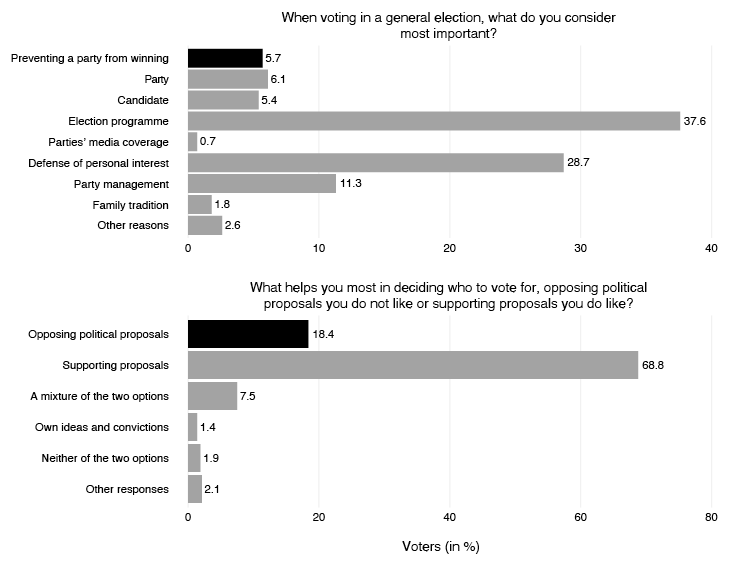
This demand-side empirical analysis draws on data from the Centre for Sociological Research (CIS) related to the 2023 general elections, in which NV played a significant role. The breakdown of NV was as follows: 5.7 % of voters used it in partisan terms and 18.4 % in programmatic terms. This behaviour was found to be more common among women, young cohorts, first-time voters and abstainers, as well as among those with a marked misalignment between voting choice and party closeness or leadership preference. Ideological orientation shaped its expression, with the left favouring partisan NV and the centre-right leaning towards programmatic NV. The data further indicated that partisan NV boosted support for the PSOE, in line with the orientation of negative partisanship (Rojo-Martínez, 2025), particularly among women. In contrast, the programmatic variant of NV strengthened the PP (among older generations) and Vox among older men, diverging from its structural electoral profile (Rama et al., 2021).
The article is organised into six sections. First, NV is conceptualised and contextualised by the Spanish case. The study’s expectations are also stated. Subsequently, the data and methods used are detailed, followed by the analysis of results. The article concludes with a discussion of findings, implications and avenues for future research.
The phenomenon of negative voting
The concept of negative voting is not new. Its roots date back to the Michigan School (Campbell et al., 1960), but the literature has paid less attention to it because it was considered the natural counterpart of the positive dimension. The literature has shown, however, that hostility towards the opposing party exerts an independent effect (Maggiotto and Piereson, 1977), pushing voters to take sides, to express it asymmetrically across dimensions, or to express only one (Ridge, 2022).
NV has recently gained weight in explaining electoral behaviour, operating through different mechanisms that activate feelings of animosity and give rise to voting dynamics such as partisan disdain (Rosema and Mayer, 2020), negative partisanship (Mayer and Russo, 2024) and affective polarisation (Iyengar et al., 2012). One of these is the instrumental mechanism, which is grounded in retrospective judgements about performance. It describes a conditional relationship between voters and parties that can turn into repulsion when expectations are not met (Huddy et al., 2015), generating feelings of disappointment, frustration or anger (Rico, et al., 2017). The identity-based approach, associated with intergroup categorisations, is more stable and profound than circumstantial aversion (Caruana et al., 2015). It can take the form of rejection displacing belonging as the primary motivation, producing avoidance or inhibition responses tied to mistrust (Lelkes, 2021). Nevertheless, it can also manifest as a categorical denial of the other (Medeiros and Noël, 2014), generating strong predispositions towards veto or repudiation, coupled with feelings of anxiety (Jaráiz et al., 2020) about the perception of decline, or exclusionary identity threats (Iyengar and Westwood, 2015). This logic reinforces lasting loyalty to the in-group and is relatively insensitive to programmatic or leadership changes. It also transforms intergroup distance in multiple areas of daily life as well as electoral victories or defeats into deeply personal experiences (Bankert, 2021). Finally, the affective mechanism, linked to political discrimination, mobilises intense emotions such as resentment, fear or hate of opposing parties, leaders or voters (Gidron et al., 2023).
Negativism has been widely studied in two-party contexts, where it is more visible (Anderson et al., 2022). However, it also manifests itself —and does so more intensely— in multi-party systems, such as those in southern Europe (Reiljan, 2020). In Spain, negative partisanship and affective polarisation have attracted substantial scholarly attention (Orriols and León, 2020; Torcal and Comellas, 2022; Rodríguez et al., 2022; Rojo-Martínez, 2025). Conversely, other expressions of negativity such as NV have lost prominence despite their earlier recognition (Kernell, 1977).
The literature defines NV as an electoral action driven primarily by rejection of rival actors, rather than by positive support for the option ultimately chosen (Fiorina and Shepsle, 1989). Although this form of voting may include a strategic aspect (the “lesser evil” or utility maximisation), its distinctive feature is that the voter seeks to neutralise “something” (a perceived threat) rather than promoting a preference. Therefore, NV responds more to an expressive over an instrumental logic (Huddy et al., 2015), but is based on three overlapping mechanisms (Garzia and Ferreira Da Silva, 2022): retrospective judgements on political performance, enduring ideological identities, and negative affective attitudes. Nevertheless, considering the Spanish case, NV can be understood as an incisive political practice: just as a firebreak is not built out of love of for scorched earth but to slow the advance of a larger fire, the negative voter goes to the polls not to win or build a project, but to prevent the opponent’s victory and/or to block a threatening political project (Lau, 1985).
The case study: Spain
During the 2015-2024 political cycle, and particularly after the 2023 general elections, a political culture of entrenchment emerged in Spain, marked by the mobilisation of voters who were increasingly focused on defeating their rivals and their projects (Crespo et al., 2022). The increasing significance of this phenomenon has been favoured by the transformation of the party system, highly charged political events and negative campaigns.
For decades, Spain was characterised by an imperfect two-party model, sustained by the PSOE and the PP. The crisis of representation following the Great Recession (Kriesi, 2014) and the emergence of parties such as Podemos (We can), Ciudadanos (Citizens) and Vox blurred this system, giving way to a fragmented pluralist one (Torcal and Montero, 2020). However, since 2019, party competition has followed a well-defined two-bloc logic (Simón, 2020), with significant intra-bloc competition and electoral flows between ideological families driven by discrepancies on moral issues. But in institutional terms, the main parties depend on forced alliances to secure electoral victories and form coalitions in which the PSOE creates alliances with government and investiture partners (although not always all of them); and the PP builds coalitions with Vox.
Recent political disputes have also marked a critical juncture. The pardons granted to Catalan independence movement leaders and agreements reached with regional parties have been interpreted by some sectors as illegitimate concessions undermining the constitutional order. This climate was reinforced by legislative controversies, notably the solo sí es sí (“only ‘yes’ means ‘yes’”) Law, which was instrumentalised to discredit the government; and the Democratic Memory Law, which drew criticism from conservative actors as a partisan reinterpretation of the past. These developments were compounded by perceptions of declining living conditions coupled with sectoral protests. These intensified discontent among the “losers of globalisation” (Kriesi et al., 2008): individuals facing economic and labour-market insecurity and a perceived loss of status in the face of the advance of post-material values.
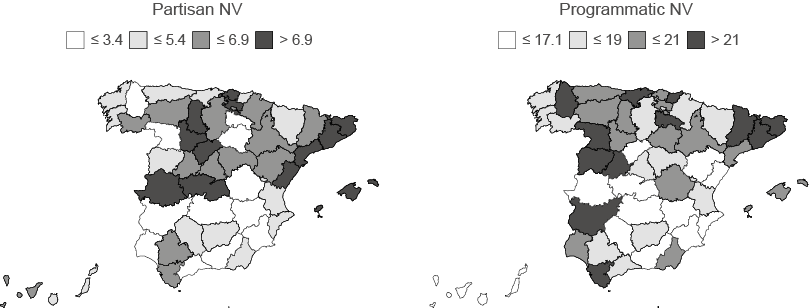
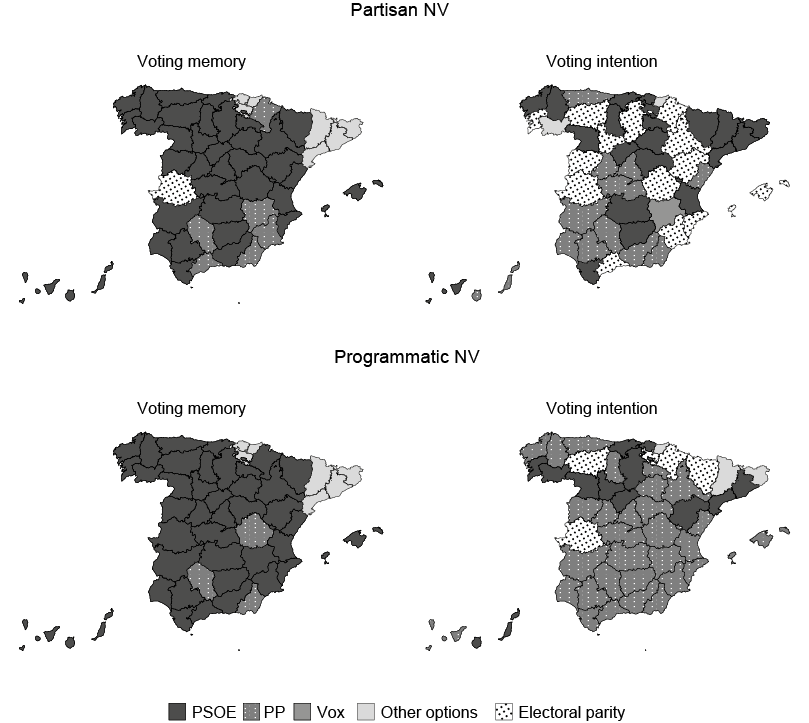
At the same time, negative campaigns have gained prominence in Spain, displacing persuasion based on specific proposals in favour of political antagonism (Crespo et al., 2022). This has reinforced the importance of emotions in electoral support, giving prominence to partisan aversion to political rivals (Crespo et al., 2025). The regional and local election of May 2023 reflected this trend. Framed by a narrative of “rescue” from alleged socialist decline, the PP wrested numerous governments from the PSOE through agreements with Vox, enabling its institutional consolidation. In response, Prime Minister Pedro Sánchez called an early election to mobilise the progressive electorate around the dichotomy of “move forwards or backwards”, while the right structured its campaign around the rejection of Sanchismo as a threat to the national interest. This revealed a shift in electoral motivations, with fear of the opponent’s victory becoming decisive (see Figure 1 and Figure B2 in Appendix B), allowing the PSOE-Sumar government to continue, although dependent on regional forces. The post-electoral period, however, failed to ease tensions. Controversies surrounding the Amnesty Law, the management of the catastrophic flooding in the Valencia region, and corruption scandals involving the PSOE sustained a climate of unrest in which political negativity persisted, warranting systematic analysis.
The general objective of this study is to explore the magnitude of NV modalities, as well as the profile of those voters who engage in them. The specific objectives are to identify its partisan orientation (PSOE, PP, Vox and Sumar) and its electoral impact according to the gender-generation intersection. Based on this, two analytical expectations are proposed.
The partisan orientation of the negative voter
Firstly, special attention is paid to the link between NV and party choice. The literature has shown that a high proportion of radical right voters are motivated by rejection (Harteveld et al., 2022), although the radical right itself also arouses strong antipathy across the electorate, surpassing other parties in disapproval ratings (Harteveld et al., 2019). This animosity partly reflects persistent social stigmatisation and regulatory sanctions targeting this ideological family (Alvarez-Benjumea and Valentim, 2024). However, its rise has not been counteracted by a cordon sanitaire in Spain (Turnbull-Dugarte, 2025). While cooperation with conservative forces has led its narrative to become normalised and increasingly accepted among centre-right voters (Field and Alonso, 2024), its influence on the public agenda and institutional presence have intensified resistance. Torcal (2023) showed that the presence of Vox has generated defensive and oppositional voting on the left. Against this backdrop, an analysis of Sumar becomes particularly relevant.
The expectation that part of Sumar’s electorate will vote negatively is plausible, given its ideological opposition to the radical right, its harnessing of discontent with the PSOE and its absorption of voters following Podemos’ loss of importance as a key ideological reference point on the left end of the political spectrum. Hostility towards the radical right can also be found among more moderate voters (Meléndez and Rovira Kaltwasser, 2021), which points to the PSOE’s role as a recipient of NV. Its consolidation as an “electoral refuge” amid the normalisation of the radical right, combined with its institutional strength and ideological centrality, has prompted strategic support from progressive voters.
Nonetheless, the literature shows that NV is not confined to the left, but also manifests itself on the right end of the political spectrum. Although its incidence is particularly pronounced among supporters of the radical right, it also operates among conservative voters. In the case of the PP, part of its support may be driven by rejection of the progressive bloc remaining in power, opposition to the PSOE’s agreements with pro-independence forces and its comparatively moderate profile compared to Vox, which makes it more acceptable to less radical conservatives. Similarly, NV among Vox supporters is plausible, as the party positions itself as a bulwark against the government, territorial decentralisation, immigration and feminism (Rama et al., 2021), while also mobilising against the PP for its complicity with the progressive consensus1. Therefore, it is pertinent to assess whether its support is grounded in exclusionary motivations towards progressive and regionalist actors.
This article assumes that NV is driven by a form of expressive and antagonistic partisanship aimed primarily at blocking an opposing political choice. Therefore, it is worth examining whether disruptive parties with anti-bipartisan discourses, such as Vox or Sumar, channel NV more intensely than traditional parties. Although established actors like the PSOE and the PP can also mobilise it instrumentally (Down and Han, 2024), given their role in fostering a policy of mutual exclusion. Expectation 1 (E1) examines whether NV constitutes a more salient mobilisation motive among supporters of disruptive parties than voters of traditional parties.
The gender backlash and generational realignment
This study also examines the relationship between NV and party choice, with particular consideration given to the role of gender-generation intersection.
The gender variable has traditionally been analysed in terms of the gender gap. Mid-twentieth-century research portrayed women as more conservative, which was explained by their greater religiosity, historically domestic roles, low labour market participation and limited political socialisation (Almond and Verba, 1963; Lipset, 1981). But from the 1980s onwards, this trend reversed as post-industrial transformations expanded access to education and employment, secularisation, and the diffusion of post-materialist values, all of which eroded traditional female conservatism, particularly among young people (Baxter and Lansing, 1980; Inglehart and Norris, 2000). The Great Recession interrupted this shift, causing frustration and dashed expectations. Perceived threats emerged associated with immigration, competition for existing resources, and equality and diversity policies (Norris and Inglehart, 2019), which some men have interpreted as status loss (Off et al., 2022). Recent research has thus identified an inverted gender gap, with women more closely aligned with progressive positions and men more inclined toward conservative and right-wing attitudes (Anduiza and Rico, 2024; Cordero et al., 2025).
Analysing the gender gap requires incorporating the generational variable as well. The literature identifies two approaches to explaining it: the age approach, linking life-cycle stages to increasing conservatism (Peterson et al., 2020); and the cohort approach, which attributes political attitudes to the socialisation context experienced during formative years (Inglehart, 1997). This study adopts the latter for its greater stability in accounting for political behaviour. Norris and Inglehart (2019) noted that generations socialised amid crisis, inequality and institutional disaffection tend to develop enduring progressive orientations, but authoritarian reactions may emerge among those perceiving social change as a threat to their status quo. Currently, a widening gendered generational gap is evident: young women increasingly embrace feminism, inequality reduction and democratic values (Ramírez-Dueñas and Cordero, 2025), while young men exhibit more authoritarian tendencies, institutional distrust and support for radical right options, reflecting frustration with postmodern social transformations (Milosav et al., 2025).
In this context, examining the intersection between gender and generation is crucial, as it illuminates differences in party preferences and negative mobilisation. Accordingly, Expectation 2 (E2) posits that voters motivated by NV respond to sociocultural conflicts, a tendency particularly pronounced among women and young men, albeit with opposing party orientations, as noted above.
Data and methodology
The study faced two main methodological challenges: the limited availability of suitable data for measuring NV, and the lack of standardisation in assessing the negative dimension of voting, given its multifaceted nature, which has produced varied measurement strategies (Mayer and Russo, 2024). A new procedure is introduced here, which contributes to broadening and enriching understanding of the phenomenon. NV is conceived as an electoral motivation driven by rejection, whether of political actors or policy content. The intention to prevent a party from winning and opposition to unwanted proposals are analytically distinguishable manifestations of the same construct. Despite differences in the object of rejection, both share a defining criterion: the centrality of prevention as the principle guiding voting decisions.
This research drew on data from two different CIS surveys, both conducted prior to the 2023 elections. Three dependent variables were employed. Two addressed the general premise and served as indicators for examining NV in its partisan and programmatic variants. The NV partisan variable was constructed from Study 3415 (CIS, 2023a), using the question “When voting in a general election, what do you consider most important?”. A binary variable was created based on the response options that distinguished between (1) Preventing a party from winning and (0) Other reasons underlying voting choices2 (see Figure B1 in Appendix B). The programmatic NV variable was based on Study 3416 (CIS, 2023b) and used the question “What helps you most in deciding who to vote for, opposing political proposals you do not like or supporting proposals you do like?”. Another binary variable was constructed which differentiated between (1) Opposing political proposals you dislike and (0) Other responses3 (see Figure B1). The dependent variable for the second and third premises was categorical and captured the declared vote intention in the 2023 general election, distinguishing between PSOE, PP4, Vox, Sumar and “Other voting options”5. Although some research has simplified party choice in multi-party contexts (Mayer, 2017), this study included the main parties to better reflect Spain’s primary and natural patterns of political competition.
In relation to the third Objective, the NV indicator and the gender-generation intersection are treated as the main independent variables. To construct the latter, age was recoded into two broad cohorts based on their context of political socialisation (Inglehart, 1997): individuals born before 1981 (Silent Generation, Baby Boomers and Generation X) and those born after 1981 (Millennials and Generation Z). For the Spanish case, the older cohort was socialised during democratic consolidation and displayed greater ideological and partisan stability (Geys et al., 2022). The younger cohort, by contrast, was exposed to economic crises, deprivation and austerity policies (Kriesi, 2014). These processes eroded party loyalty and fostered institutional disaffection, ultimately inclining younger generations towards populist narratives on both the left and the right (Rooduijn et al., 2016). This variable was operationalised by crossing age with gender, which resulted in four groups: (1) Older men, (2) Young men, (3) Older women and (4) Young women.
Empirical strategy
Different quantitative methods were used to achieve the proposed objectives and test the preliminary assumptions. First, binary logit models were estimated for Objective 1, and multinomial logit models for Objectives 2 and 3. The results were reported using Odds Ratios (ORs) and presented in the supplementary material (Tables B4 and B5 in Appendix B). The models were estimated separately for each type of NV and an interaction between the NV indicator and the gender-generation intersection was incorporated for the multinomial models. Average marginal effects (AMEs) were used to evaluate the substantive impact of these two reference variables in terms of probabilities. Additionally, as a visual complement, predicted probabilities are presented to estimate the level of occurrence of the events (see Figures B3 and B4 in Appendix B).
All models also included a common set of variables: the gender-generation intersection (reference category: older men), urban habitat (rural), high educational level (low), paid work (not working)6, high income (low), lower/middle subjective social class (high), previous electoral demobilisation7 (voted in previous election), ideological self-placement on the left-right scale8, the nexus between voting intention and partisan closeness—distinguishing perfect party alignment from dissonance—, and the nexus between voting intention and leadership as preferred prime minister9, differentiating between perfect alignment and misalignment. For more details on the descriptive statistics of all variables, see Tables A1, A2, and A3 in Appendix A.
Results
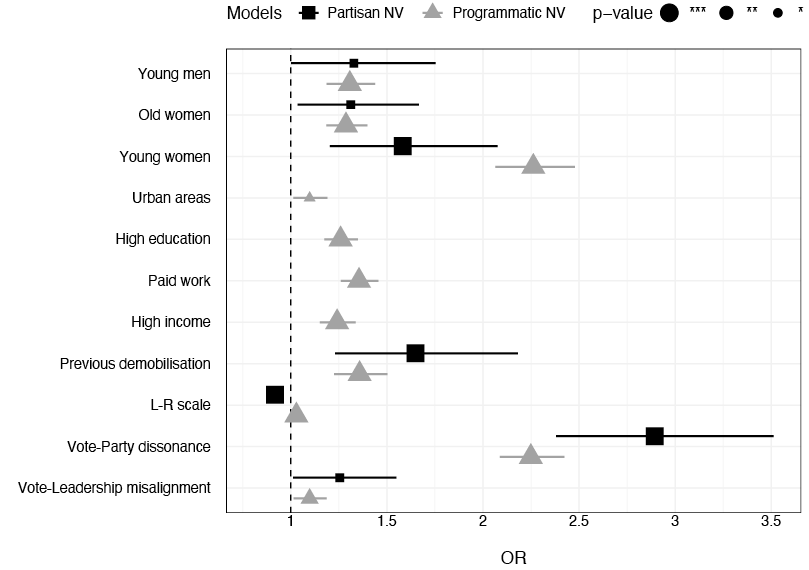
The binary logit models are summarised in Figure 2, which shows the ORs to the reference category. The results indicated that young people exhibited higher odds of engaging in NV, particularly women in its programmatic variant. In contrast, young men engaged in partisan NV, a pattern that was also observed among women in late adulthood. Living in urban areas, having a high level of education and income and being employed increased the odds of using in programmatic NV. Similarly, those who did not participate in previous elections displayed higher odds of engaging in NV (especially in the partisan form), which suggested that it mobilised abstainers and new voters. Ideological self-placement had different effects. Partisan NV was more frequent among individuals on the left, while the programmatic variant predominated in the centre-right. Finally, voters who mobilised behind NV revealed patterns of misalignment by not supporting either the party they felt closest to, or the party of their preferred presidential leader.
Once the profile of those who engaged in NV had been identified, their partisan orientation and the role of the gender-generation intersection were analysed.
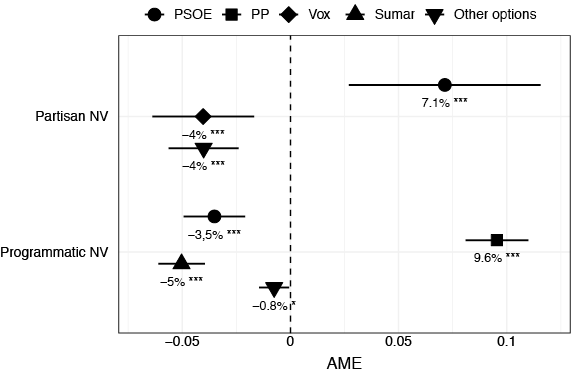
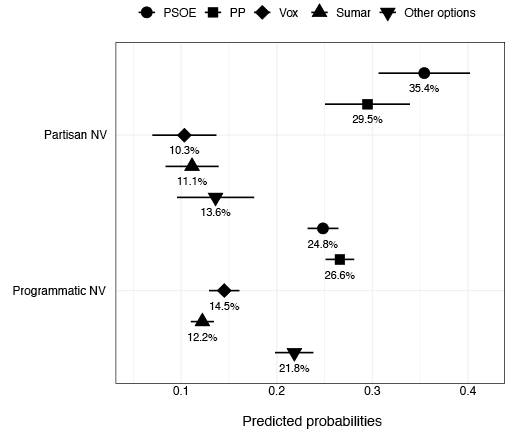
Figure 3 shows the statistically significant AMEs of the multinomial models that explained voting choice across NV types. The results indicated that partisan NV substantially increased the probability of voting for the PSOE (7.1) compared to those who did not vote for this reason. In contrast, this motivation reduced support for Vox and other options by 4 points. No significant effects were detected for the PP or Sumar, which entails that the motivations of negative voters were equivalent to those of the rest of the electorate. Consistent with these findings, Figure B3 shows the predicted probabilities, which indicated that a substantial part of the partisan NV (35.4 %) was concentrated on the PSOE. This suggested that it operated as a defensive tactic, since the PSOE was used as an electoral refuge against alternatives perceived as threatening.
In contrast, the programmatic NV variant followed a different pattern. As shown in Figure 3, this variant translated into a significant increase in the probability of voting for the PP (9.6), while support for the PSOE (3.5), Sumar (5) and others (0.8) decreased. No statistically significant effects were identified for Vox, indicating that, among their potential electorates, programmatic NV did not introduce differences compared to voting based on affinity to policy proposals. The data in Figure B3 reinforced this interpretation. The PP (26.6 %) has been most effective in harnessing programmatic NV, as it has emerged as the functional recipient for discontent by offering an alternative government capable of containing policies rejected by the progressive bloc.
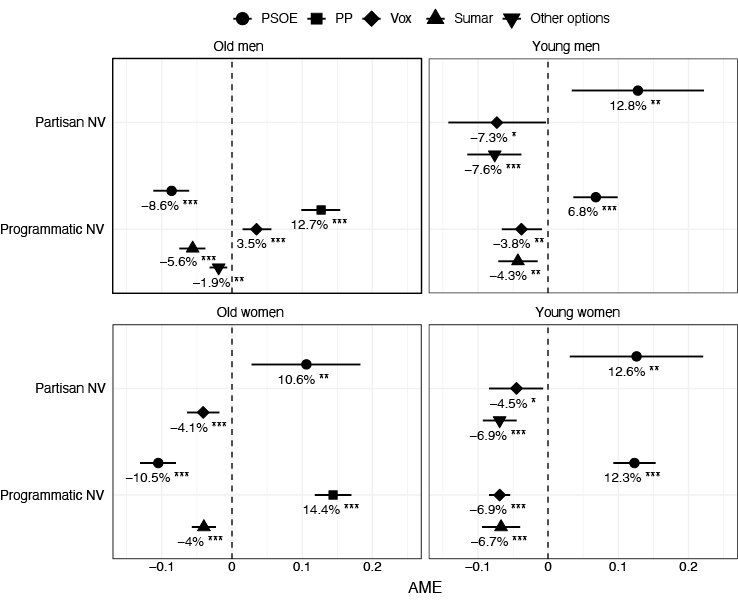
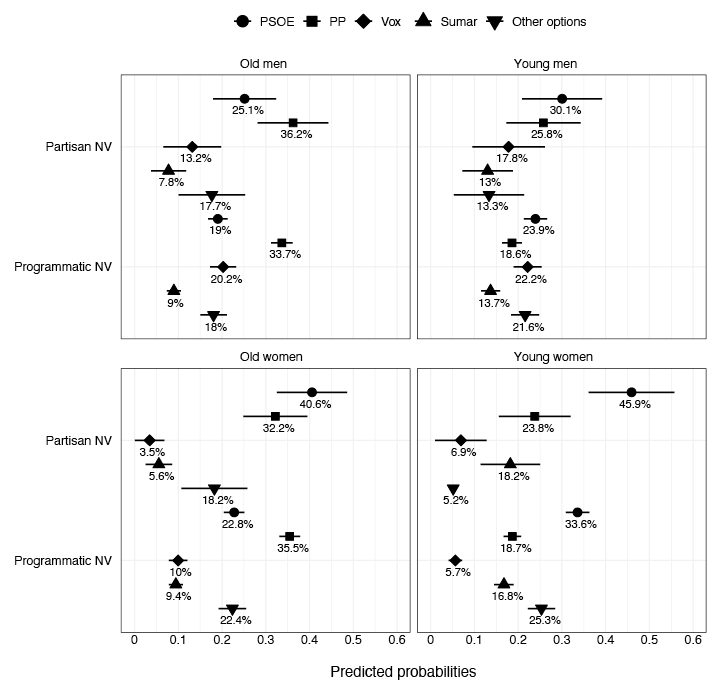
The analysis of the interaction between NV and the gender-generation intersection, however, showed a differentiated impact on voters’ party orientation. According to the data in Figure 4 programmatic NV among men in advanced adulthood were more likely to vote for the PP (12.7) and Vox (3.5), and with reduced support for the PSOE (8.6), Sumar (5.6) and other options (1.9). As can be seen in Figure 4, the PP emerged as the most likely recipient of NV among this group, acting as the backbone of programmatic discontent directed at the progressive bloc (33.7 % ). The latter is also channelled by Vox (20.2 % ), but without eroding the PP’s centrality.
For men in early adulthood, partisan and programmatic NV were associated with an increase in the probability of supporting the PSOE by 12.8 and 6.8 points, respectively. In contrast, partisan NV reduced the likelihood of voting for Vox (7.3) and smaller parties (7.6), while programmatic NV again reduced support for Vox (3.8) and Sumar (4.6). Figure B4 shows that competitiveness was high in this space. This finding is remarkable, given that young men were inclined towards Vox and Sumar (see Tables B4 and B5). This suggests that NV strategically shifted their support towards the PSOE, reinforcing its role as a party of restraint against ideological adversaries.
Among older women, partisan NV increased the probability of supporting the PSOE by 10.6 points, while reducing support for Vox (4.1). Conversely, programmatic NV increased the likelihood of voting for the PP by 14.4 points and reduced support for the PSOE (10.5) and Sumar (4). This highlights the coexistence of two uses of NV within the same generational and gender group: the partisan variant rewards the PSOE (40.6 %) over options perceived as threatening, while the programmatic variant favours the PP (35.5 %) in an attempt to limit rejected policies.
Finally, in the case of women in early adulthood, both partisan and programmatic NV were associated with an increase in the likelihood of voting for the PSOE, by 12.6 and 12.3 points respectively. At the same time, partisan NV reduced support for Vox (4.1) and other options (5.8), while programmatic NV reduced support for Vox (6.9) and Sumar (6.7). In accordance with Figure B4, the PSOE remained the most likely electoral choice, with estimated probabilities of 45.9 % for the partisan variant, and 33.6 % for the programmatic one. These patterns show that young women engaged in NV to contain adversaries or threatening policies by taking refuge in the PSOE.
Conclusions
Over the last decade, electoral contests in Spain have resembled trench warfare rather than a space for democratic deliberation. Politicians and citizens seem to agree on a common strategy: attacking the opponents’ guts rather than persuading their head. By focusing on NV, this study highlights a still underexplored phenomenon that is increasingly shaping contemporary electoral behaviour in Spain.
The empirical evidence found reveals three facts: 1) that NV has considerable electoral weight and a sharp voter profile; 2) that the main recipients are the major parties, although Vox captured it in specific segments; and 3) that gender and generation can help to understand its two forms regarding electoral mobilisation.
Firstly, based on the data, women and young people are the profiles that have the highest odds to engage in NV. Previous abstainers have shown greater propensity to use NV, which points to its function as a trigger of reactive mobilisation in contexts where there is a perceived threat, while first-time voters tend to use it as an initial form of political expression, exercising their right to vote based on what they do not support. Likewise, negative voters do not tend to support either the party they feel closest to or the party of their preferred leader, which reinforces their motivation. Lastly, ideology also matters: the left gravitates toward partisan NV, while the centre-right favours programmatic NV.
Secondly, and contrary to the initial expectation of an expressive and incisive form of NV among disruptive formations, partisan orientation (E1) shows that NV concentrates on the major parties, but responds to different architectures depending on its variant. Partisan NV benefits the PSOE, which acts as a bulwark against the radical right, while programmatic NV rewards the PP, consolidating its role as a functional outlet for discontent by positioning itself as a viable governing alternative to constrain the progressive bloc’s policies. On the contrary, Vox voters (except in specific segments) and, especially Sumar voters, seem to be motivated by factors other than NV. Nevertheless, and thirdly, the analysis from an intersectional perspective reveals divergent political trajectories between combinations of gender and generation (E2), which also contradict the initial assumptions. The results show that older men channel their vote towards the PP and Vox, and young people shift their support towards the PSOE, despite their structural inclination towards radical options. Women also follow two patterns. Older women opt for the PSOE to contain ideological options perceived as threatening, although they also support the PP, considering it effective in curbing policies they detest. The other pattern is of a more rebellious nature, where young women use it as a form of resistance to discourses considered exclusionary, taking refuge in the PSOE.
The findings point to a shift in electoral behaviour in Spain, with rejection emerging as a primary driver for many voters. From an institutional perspective, this raises significant challenges for democratic quality that warrant further investigation. NV functions as a firebreak, blocking perceived threats without necessarily building anything in its place. The representative link is thereby weakened, as parties can achieve electoral victories without consolidating public confidence in their programmes. By prioritising opposition over endorsement, NV reshapes party incentives towards delegitimising rivals at the expense of accountability, undermining citizens’ capacity to articulate constructive demands and parties’ ability to build consensus. Consequently, deliberation is giving way to narratives focused on disqualification, weakening pluralism, cooperation and tolerance. As things stand, ignoring this phenomenon would be like ignoring smoke before a fire.
Finally, some limitations should be acknowledged. First, the study relies on secondary data, where variables are constrained by pre-existing questionnaires, limiting methodological control. Second, the results have been drawn from two distinct surveys, with no overlap between respondents despite the fact that they were conducted at the same time. Third, reliance on pre-existing surveys makes it difficult to incorporate socio-political variables that could further explain NV, such as attitudinal factors (resentment towards post-material issues), experiential factors (performance evaluations) or affective-emotional factors (fear of change). These remain avenues for future research. Two socio-political variables were included (misalignment indicators based on party closeness and preferred prime ministerial leadership), although these fell outside the primary focus of the study. Their relevance suggests they merit dedicated analysis in future research.
Nonetheless, this article is a significant starting point for future research, both in terms of tracking NV in Spain in other fields or election types and in comparative analyses of similar political contexts. For instance, in France, the rise of Rassemblement National (National Rally) prompted the creation of the Nouveau Front Populaire (New Popular Front), a coalition conceived as a bulwark against the radical right illustrating the structural logic of NV. Similar dynamics has also been identified in Germany, where the growth of Alternative für Deutschland (Alternative for Germany) and the decline of the social-democratic party may have enabled Die Linke (The Left) to mobilise NV.
All in all, this study demonstrates that NV in Spain is not a marginal phenomenon. It may have emerged as an underground force, but it is capable of reshaping political and electoral competition, redefining alliances and deciding contests.
Bibliography
Abramowitz, Alan I. and Webster, Steven (2018). “Negative partisanship: Why Americans Dislike Parties but Behave Like Rabid Partisans”. Political Psychology, 39: 119-135. doi: 10.1111/pops.12479
Almond, Gabriel A. and Verba, Sydney (1963). The Civic Culture: Political Attitudes and Democracy in Five Nations. New Jersey: Princeton University Press.
Alvarez-Benjumea, Amalia and Valentim, Vicente (2024). “The Enforcement of Political Norms”. British Journal of Political Science, 54(4): 1043-1066. doi: 10.1017/S0007123423000716
Anderson, Cameron D.; McGregor, R. Michael and Stephenson, Laura B. (2022). “Us Versus Them: Do the Rules of the Game Encourage Negative Partisanship?”. European Journal of Political Research, 61(4): 1060-1079. doi: 10.1111/1475-6765.12485
Anduiza, Eva and Rico, Guillem (2024). “Sexism and the Far-Right Vote: The Individual Dynamics of Gender Backlash”. American Journal of Political Science, 68(2): 478-493. doi: 10.1111/ajps.12759
Bankert, Alexa (2021). “Negative and Positive Partisanship in the 2016 U.S. Presidential Elections”. Political Behavior, 43(4): 1467-1485. doi: 10.1007/s11109-020-09599-1
Baxter, Sandra and Lansing, Marjorie (1980). Women and politics: The invisible majority. University of Michigan Press.
Campbell, Angus; Converse, Philip E.; Miller, Warren E. and Stokes, Donald E. (1960). The American Voter. New Jersey: John Wiley & Sons.
Caruana, Nicholas J.; McGregor, R. Michael and Stephenson, Laura B. (2015). “The Power of the Dark Side: Negative Partisanship and Political Behaviour in Canada”. Canadian Journal of Political Science/Revue Canadienne de Science Politique, 48(4): 771-789. doi: 10.1017/S0008423914000882
CIS (2023a). Encuesta flash elecciones generales 2023. Study 3415. Madrid: Centro de Investigaciones Sociológicas.
CIS (2023b). Estudio metodológico sobre las tendencias de definición/decisión de voto a lo largo de la campaña electoral de julio de 2023. Study 3416. Madrid: Centro de Investigaciones Sociológicas.
Cordero, Guillermo; Ramírez-Dueñas, José M. and Sánchez, Sara (2025). “La brecha ideológica de género en la Generación Z en España”. Revista Española de Ciencia Política, 67: 69-99. doi: 10.21308/recp.67.03
Crespo-Martínez, Ignacio; Garrido-Rubia, Antonio and Rojo-Martínez, José Miguel (2022). “El uso de las emociones en la comunicación político-electoral”. Revista Española de Ciencia Política, 58: 175-201. doi: 10.21308/recp.58.06
Crespo-Martínez, Ignacio; Mora-Rodríguez, Alberto and Rojo-Martínez, José Miguel (2025). “The Emotional Consequences of Negative Personalist Framing in the 2023 Spanish General Election”. Frontiers in Political Science, 7, 1603646. doi: 10.3389/fpos.2025.1603646
Down, Ian and Han, Kyung-Joon (2024). “Affective polarization and strategic voting in Britain”. Journal of Elections, Public Opinion and Parties, 35(4): 781-803. doi: 10.1080/17457289.2024.2337422
Ferreira, Carles (2019). “Vox como representante de la derecha radical en España: Un estudio sobre su ideología”. Revista Española de Ciencia Política, 51: 73–98. doi: 10.21308/recp.51.03
Field, Bonnie N. and Alonso, Sonia (2024). “Cracking the door open: Governing alliances between mainstream and radical right parties in Spain’s regions”. Revista Española de Ciencia Política, 64: 37-64. doi: 10.21308/recp.64.02
Fiorina, Morris P. and Shepsle, Keneth A. (1989). “Is Negative Voting an Artifact?”. American Journal of Political Science, 33(2): 423-439. doi: 10.2307/2111154
Garzia, Diego and Ferreira Da Silva, Frederico (2022). “Negativity and Political Behavior: A Theoretical Framework for the Analysis of Negative Voting in Contemporary Democracies”. Political Studies Review, 20(2): 282-291. doi: 10.1177/14789299211000187
Geys, Benny; Heggedal, Tom-Reiel and Sørensen, Rune J. (2022). “Age and Vote Choice: Is There a Conservative Shift among Older Voters?”. Electoral Studies, 78. doi: 10.1016/j.electstud.2022.102485
Gidron, Noam; Adams, James and Horne, Will (2023). “Who Dislikes Whom? Affective Polarization between Pairs of Parties in Western Democracies”. British Journal of Political Science, 53(3): 997-1015. doi: 10.1017/S0007123422000394
Harteveld, Elco; Dahlberg, Stefan; Kokkonen, Andrej and Brug, Wouter van der (2019). “Social Stigma and Support for the Populist Radical Right: An Experimental Study”. Scandinavian Political Studies, 42(3-4): 296-307. doi: 10.1111/1467-9477.12153
Harteveld, Elco; Mendoza, Philip and Rooduijn, Matthijs (2022). “Affective Polarization and the Populist Radical Right: Creating the Hating?”. Government and Opposition, 57(4): 703-727. doi: 10.1017/gov.2021.31
Huddy, Leonie; Mason, Lilliana and Aarøe, Lene (2015). “Expressive Partisanship: Campaign Involvement, Political Emotion, and Partisan Identity”. American Political Science Review, 109(1): 1-17. doi: 10.1017/S0003055414000604
Inglehart, Ronald (1997). Modernization and postmodernization: Cultural, economic, and political change in 43 societies. New Jersey: Princeton University Press.
Inglehart, Ronald and Norris, Pippa (2000). “The Developmental Theory of the Gender Gap: Women’s and Men’s Voting Behavior in Global Perspective”. International Political Science Review, 21(4): 441-463. doi: 10.1177/0192512100214007
Iyengar, Shanto; Sood, Gaurav and Lelkes, Yphtach (2012). “Affect, Not Ideology: A Social Identity Perspective on Polarization”. Public Opinion Quarterly, 76(3): 405-431. doi: 10.1093/poq/nfs038
Iyengar, Shanto and Westwood, Sean J. (2015). “Fear and Loathing Across Party Lines: New Evidence on Group Polarization”. American Journal of Political Science, 59(3): 690–707. doi: 10.1111/ajps.12152
Jaráiz, Erika; Lagares, Nieves and Pereira, María (2020). “Emociones y decisión de voto: Los componentes de voto en las elecciones generales de 2016 en España”. Revista Española de Investigaciones Sociológicas, 170: 115–136. doi: 10.5477/cis/reis.170.115
Kernell, Samuel (1977). “Presidential Popularity and Negative Voting: An Alternative Explanation of the Midterm Congressional Decline of the President’s Party”. The American Political Science Review, 71(1): 44-66. doi: 10.2307/1956953
Key, Vladimir O. (1966). The Responsible Electorate: Rationality in Presidential Voting 1936-1960. Cambridge: Harvard University Press.
Kriesi, Hanspeter (2014). The Political Consequences of the Economic Crisis in Europe: Electoral Punishment and Popular Protest. In: Bartels, L. and Bermeo, N. (eds.). Mass Politics in Tough Times. Opinions, Votes, and Protest in the Great Recession (pp. 297-333). Oxford: Oxford University Press.
Kriesi, Hanspeter; Grande, Edgar; Lachat, Romain; Dolezal, Martin; Bornschier, Simon and Frey, Timotheos (2008). West European Politics in the Age of Globalization. New York: Cambridge University Press.
Lagares, Nieves; Pereira, María and Jaráiz, Erika (2024). “La construcción emocional de la extrema derecha en España Las elecciones autonómicas de Andalucía, Cataluña y Castilla y León”. Revista Internacional de Sociología, 82(4). doi: 10.3989/ris.2024.82.4.1302
Lau, Richard R. (1985). “Two Explanations for Negativity Effects in Political Behavior”. American Journal of Political Science, 29(1): 119-138. doi: 10.2307/2111215
Lelkes, Yphtach (2021). “What Do We Mean by Negative Partisanship?”. The Forum, 19(3): 481-497. doi: 10.1515/for-2021-2027
Lipset, Seymour Martin (1981). Political Man: The Social Bases of Politics. Baltimore: Johns Hopkins University Press.
Maggiotto, Michael A. and Piereson, James E. (1977). “Partisan Identification and Electoral Choice: The Hostility Hypothesis”. American Journal of Political Science, 21(4): 745-767. doi: 10.2307/2110735
Mayer, Sabrina J. (2017). “How Negative Partisanship Affects Voting Behavior in Europe: Evidence from an Analysis of 17 European Multi-party Systems with Proportional Voting”. Research & Politics, 4(1): 2053168016686636. doi: 10.1177/2053168016686636
Mayer, Sabrina J. and Russo, Luana (2024). “What One Is Not: A New Scale to Measure Negative Party Identity in Multiparty Systems”. Quality & Quantity, 58(3): 2887-2906. doi: 10.1007/s11135-023-01793-7
Medeiros, Mike and Noël, Alain (2014). “The Forgotten Side of Partisanship: Negative Party Identification in Four Anglo-American Democracies”. Comparative Political Studies, 47(7): 1022-1046. doi: 10.1177/0010414013488560
Meléndez, Carlos and Rovira Kaltwasser, Cristóbal (2021). “Negative Partisanship Towards the Populist Radical Right and Democratic Resilience in Western Europe”. Democratization, 28(5): 949-969. doi: 10.1080/13510347.2021.1883002
Miller, Luis (2023). Polarizados: La política que nos divide. Ediciones Deusto.
Milosav, Ðorde; Dickson, Zachary; Hobolt, Sara B.; Klüver, Heike; Kuhn, Theresa and Rodon, Toni (2025). “The Youth Gender Gap in Support for the Far Right”. Journal of European Public Policy, 33(2): 444-468. doi: 10.1080/13501763.2025.2481181
Norris, Pippa and Inglehart, Ronald (2019). Cultural Backlash: Trump, Brexit, and Authoritarian Populism. New York: Cambridge University Press.
Off, Gefjon; Charron, Nicholas and Alexander, Amy (2022). “Who Perceives Women’s Rights as Threatening to Men and Boys? Explaining Modern Sexism among Young Men in Europe”. Frontiers in Political Science, 4. doi: 10.3389/fpos.2022.909811
Off, Gefjon; Alexander, Amy and Charron, Nicholas
(2025). “Is There a Gender Youth Gap in Far-right Voting and Cultural Attitudes?”. European Journal of Politics and Gender. doi: 10.1332/25151
088Y2025D000000077
Orriols, Lluís and Cordero, Guillermo (2016). “The Breakdown of the Spanish Two-Party System: The Upsurge of Podemos and Ciudadanos in the 2015 General Election”. South European Society and Politics, 21(4): 469-492. doi: 10.1080/13608746.2016.1198454
Orriols, Lluís and León, Sandra (2020). “Looking for Affective Polarisation in Spain: PSOE and Podemos from Conflict to Coalition”. South European Society and Politics, 25(3-4): 351-379. doi: 10.1080/13608746.2021.1911440
Peterson, Johnathan C.; Smith, Kevin B. and Hibbing, John R. (2020). “Do People Really Become More Conservative as They Age?”. The Journal of Politics, 82(2): 600-611. doi: 10.1086/706889
Rama, José; Cordero, Guillermo and Zagórski, Piotr (2021). “Three Is a Crowd? Podemos, Ciudadanos and Vox: The End of Bipartisanship in Spain”. Frontiers in Political Science, 3, 688130. doi: 10.3389/fpos.2021.688130
Rama, José; Zanotti, Lisa; Turnbull-Dugarte, Stuart J. and Santana, Andrés (2021). The Rise of the Spanish Populist Radical Right. London: Routledge.
Ramírez-Dueñas, José María and Cordero, Guillermo (2025). “¿Consolidación o retroceso? Explorando las actitudes sociales hacia la diversidad sexual en España (1980-2022)”. Empiria. Revista de metodología de ciencias sociales, 64. doi: 10.5944/empiria.64.2025.45200
Reiljan, Andres (2020). “‘Fear and Loathing across Party Lines’ (also) in Europe: Affective Polarisation in European Party Systems”. European Journal of Political Research, 59(2): 376-396. doi: 10.1111/1475-6765.12351
Rico, Guillem; Guinjoan, Marc and Anduiza, Eva (2017). “The Emotional Underpinnings of Populism: How Anger and Fear Affect Populist Attitudes”. Swiss Political Science Review, 23(4): 444–461. doi: 10.1111/spsr.12261
Ridge, Hannah M. (2022). “Enemy Mine: Negative Partisanship and Satisfaction with Democracy”. Political Behavior, 44(3): 1271-1295. doi: 10.1007/s11109-020-09658-7
Rodríguez, Isabel; Santamaría, Diego and Miller, Luis (2022). “Electoral Competition and Partisan Affective Polarisation in Spain”. South European Society and Politics, 27(1), 27-50. doi: 10.1080/13608746.2022.2038492
Rojo-Martínez, José Miguel (2025). “Partidismo negativo, derecha radical y voto: Un análisis de su relación en el contexto de las elecciones generales españolas de 2023”. Revista Española de Ciencia Política, 67: 41-68. doi: 10.21308/recp.67.02
Rooduijn, Mattihjs; van der Brug, Wouter and De Lange, Sarah L. (2016). “Expressing or Fuelling Discontent? The Relationship Between Populist Voting and Political Discontent”. Electoral Studies, 43: 32–40. doi: 10.1016/j.electstud.2016.04.006
Rosema, Martin and Mayer, Sabrina J. (2020). Measuring party attachments with survey questionnaires. In: Oscarsson, Henrik and Holmberg, Sören (eds.). Research Handbook on Political Partisanship (pp. 123-140). Edward Elgar Publishing. doi: 10.4337/9781788111997.00015
Simón, Pablo (2020). “Two-bloc Logic, Polarisation and Coalition Government: The November 2019 General Election in Spain”. South European Society and Politics, 25(3–4): 533–563. doi: 10.1080/13608746.2020.1857085
Torcal, Mariano (2014). “The Incumbent Electoral Defeat in the 2011 Spanish National Elections: The Effect of the Economic Crisis in an Ideological Polarized Party System”. Journal of Elections, Public Opinion and Parties, 24(2): 203-221. doi: 10.1080/17457289.2014.891598
Torcal, Mariano (2023). De votantes a hooligans: La polarización política en España. Madrid: Los Libros De La Catarata.
Torcal, Mariano and Comellas, Josep M. (2022). “Affective Polarisation in Times of Political Instability and Conflict. Spain from a Comparative Perspective”. South European Society and Politics, 27(1): 1-26. doi: 10.1080/13608746.2022.2044236
Turnbull-Dugarte, Stuart J. (2025). “Public Support for the Cordon Sanitaire: Descriptive Evidence from Spain”. Party Politics, 31(4): 761-769. doi: 10.1177/13540688241246141
Appendix
Appendix A. Data information
Table A1. Descriptive statistics of the dependent variables
|
Variables |
Categories |
N |
|
|
Study 3415 |
Study 3416 |
||
|
Partisan NV |
Preventing a party from winning (1) |
492 |
|
|
Other reasons (0) |
8,096 |
||
|
Programmatic NV |
Opposing political proposals you dislike (1) |
4,849 |
|
|
Other responses (0) |
21,548 |
||
|
Vote |
PSOE |
2,334 |
7,491 |
|
PP |
2,297 |
6,850 |
|
|
Vox |
799 |
2,641 |
|
|
Sumar |
1,019 |
4,003 |
|
|
Other options |
658 |
2,202 |
|
Source: CIS.
Table A2. Descriptive statistics of the independent variables
|
Variable |
Categories |
N |
|
|
Study 3415 |
Study 3416 |
||
|
Gender-generation intersection |
Older men |
3,078 |
9,353 |
|
Young men |
1,411 |
4,688 |
|
|
Older women |
3,165 |
9,135 |
|
|
Young women |
1,144 |
3,882 |
|
Source: CIS.
Table A3. Descriptive statistics of the control variables
|
Variables |
Categories |
N |
|
|
Study 3415 |
Study 3416 |
||
|
Size of locality population |
Rural (0) |
1,661 |
4,761 |
|
Urban (1) |
7,137 |
22,297 |
|
|
Education level |
Low/medium (0) |
4,602 |
14,011 |
|
High (1) |
4,136 |
12,883 |
|
|
Main activity |
Does not work (0) |
3,514 |
9,930 |
|
Paid work (1) |
5,278 |
17,117 |
|
|
Income |
Low: ≤ 1,800 euros (0) |
2,746 |
8,549 |
|
High: > 1,800 euros (1) |
5,638 |
17,260 |
|
|
Subjective social class |
Lower/middle class (1) |
7,985 |
24,720 |
|
Upper class (0) |
480 |
1,448 |
|
|
Previous electoral mobilisation |
Voted (0) |
7,787 |
23,709 |
|
Demobilisation (1) |
923 |
3,076 |
|
|
L-R scale |
8,437 |
26,252 |
|
|
Vote choice-Party closeness alignment |
Alignment (0) |
5,639 |
18,657 |
|
Dissonance (1) |
1,347 |
4,195 |
|
|
Vote choice-Leadership preferred alignment |
Alignment (0) |
5,625 |
18,052 |
|
Misalignment (1) |
1,293 |
4,491 |
|
Source: CIS.
Appendix B. Supplementary material
Figure B1. Reasons for voting in the 2023 general election
Source: Based on CIS data.
Figure B2. Geographical distribution of the winning party based on 2019 election vote recall and 2023 voting intention of negative voters
Note: Electoral parity refers to the absence of a clear winner due to evenly distributed support, primarily between the PSOE and the PP.
Source: Based on CIS data.
Table B1. ORs from binary logit models
|
Variable |
Partisan NV |
Programmatic NV |
|
Young men |
1.33* (.17) |
1.31*** (.06) |
|
Older women |
1.31* (.14) |
1.29*** (.05) |
|
Young women |
1.58*** (.17) |
2.26*** (.06) |
|
Urban areas |
.91 (.13) |
1.10* (.05) |
|
High education |
1.09 (.12) |
1.26*** (.04) |
|
Paid work |
1.09 (.12) |
1.35*** (.04) |
|
High income |
.93 (.13) |
1.24*** (.05) |
|
Lower/middle social class |
.75 (.21) |
.94 (.08) |
|
Previous electoral demobilisation |
1.65*** (.17) |
1.36*** (.06) |
|
L-R scale |
.92*** (.02) |
1.03* (.01) |
|
Vote choice-Party closeness dissonance |
2.89*** (.12) |
2.25*** (.05) |
|
Vote choice-Leadership misalignment |
1.26* (.13) |
1.10** (.05) |
|
Intercept |
.07*** (.30) |
.07*** (.11) |
|
Nagelkerke’s Pseudo R2 |
.06 |
.07 |
|
Observations |
6,178 |
20,278 |
Note: ∗∗∗ p < 0.001; ∗∗ p < 0.01; ∗ p < 0.05.
Source: Based on CIS data.
Table B2. AMEs for party choice by NV variant
|
NV |
PSOE |
PP |
Vox |
Sumar |
Others |
|
Partisan NV |
.07*** (.03) [.02; .11] |
.01 (.03) [.02; .06] |
.04*** (.01) [.06; .01] |
.007 (.02) [.04; .02] |
.04*** (.01) [.05; .02] |
|
Programmatic NV |
.03*** (.01) [.04; .02] |
.09*** (.01) [.08; .11] |
.002 (.01) [.01; .007] |
.05*** (.01) [.06; .03] |
.007* (.004) [.01; .0006] |
Note: ∗∗∗ p < 0.001; ∗∗ p < 0.01; ∗ p < 0.05.
Source: Based on CIS data.
Table B3. AMEs for party choice by NV variant and gender-generation interaction
|
NV |
Gender-generation |
PSOE |
PP |
Vox |
Sumar |
Others |
|
Partisan NV |
Older men |
.005 (.05) [.08; .07] |
.06 (.05) [.02; .14] |
.02 (.03) [.07; .02] |
.007 (.04) [.07; .05] |
.02 (.02) [.06; .003] |
|
Young men |
.12** (.06) [.03; .22] |
.01 (.06) [.07; .10] |
.07* (.04) [.14; .003] |
.004 (.05) [.08; .08] |
.07*** (.02) [.11; .03] |
|
|
Older women |
.10** (.05) [.02; .18] |
.01 (.05) [.08; .06] |
.04*** (.01) [.06; .01] |
.02 (.03) [.07; .01] |
.02 (.02) [.05; .002] |
|
|
Young women |
.12** (.06) [.03; .22] |
.04 (.05) [.12; .03] |
.04* (.02) [.08; .007] |
.03 (.05) [.05; .11] |
.06*** (.02) [.09; .04] |
|
|
Programmatic NV |
Older men |
.08*** (.02) [.11; .06] |
.12*** (.02) [.09; .15] |
.03*** (.01) [.01; .05] |
.05*** (.01) [.07; .03] |
.01** (.01) [.03; .007] |
|
Young men |
.06*** (.02) [.03; .09] |
.02 (.02) [.01; .04] |
.03** (.02) [.06; .009] |
.04** (.02) [.07; .01] |
.006 (.01) [.02; .10] |
|
|
Older women |
.10*** (.02) [.13; .08] |
.14*** (.02) [.11; .17] |
.004 (.01) [.009; .01] |
.04*** (.01) [.05; .02] |
.003 (.01) [.01; .008] |
|
|
Young women |
.12*** (.02) [.09; .15] |
.002 (.02) [.02; .02] |
.06*** (.01) [.08; .05] |
.06*** (.02) [.09; .04] |
.01 (.01) [.003; .02] |
Note: ∗∗∗ p < 0.001; ∗∗ p < 0.01; ∗ p < 0.05.
Source: Based on CIS data.
Figure B3. Predicted probabilities for party choice by NV variant
Source: Based on CIS data.
Figure B4. Predicted probabilities for party choice by NV variant and gender-generation interaction
Source: Based on CIS data.
Table B4. Multinomial models for party choice by partisan NV and gender-generation interaction
|
PSOE |
PP |
Vox |
Sumar |
|||||||
|
Variable |
PP |
Vox |
Sumar |
Others |
Vox |
Sumar |
Others |
Sumar |
Others |
Others |
|
Partisan NV |
1.22 (.26) |
.78 (.39) |
.95 (.37) |
.58 (.42) |
.63*** (.38) |
.77 (.37) |
.47* (.43) |
1.22 (.46) |
.75 (.48) |
.61***(.48) |
|
Young men |
1.10 (.12) |
2.51*** (.13) |
2.30*** (.13) |
2.29*** (.17) |
2.29*** (.13) |
2.10*** (.12) |
2.09*** (.17) |
.92 (.14) |
.91 (.17) |
1.00 (.18) |
|
Older women |
.88* (.08) |
.45*** (.13) |
.70*** (.11) |
.78* (.15) |
.52*** (.13) |
.80** (.11) |
.88 (.15) |
1.54*** (.14) |
1.71*** (.17) |
1.11 (.16) |
|
Young women |
.71*** (.11) |
.64*** (.16) |
1.49*** (.12) |
.77 (.19) |
.91 (.16) |
2.09*** (.12) |
1.08 (.19) |
2.31*** (.17) |
1.20 (.21) |
.52*** (.20) |
|
Part. NV * Young men |
.53 (.43) |
.45 (.56) |
.62 (.52) |
.28* (.68) |
.85 (.56) |
1.16 (.53) |
.52 (.70) |
1.37 (.63) |
.61 (.73) |
.45*** (.73) |
|
Part. NV * Older women |
.62 (.34) |
.33 (.73) |
.61 (.52) |
.76 (.57) |
.54 (.73) |
.98 (.52) |
1.22 (.59) |
1.83 (.82) |
2.28 (.83) |
1.25*** (.68) |
|
Part. NV * Young women |
.50* (.40) |
.40 (.70) |
.84 (.48) |
.17** (.88) |
.79 (.72) |
1.67 (.51) |
.34 (.91) |
2.10 (.76) |
.43 (1.04) |
.20*** (.93) |
|
Urban areas |
.99 (.08) |
1.04 (.12) |
1.15 (.10) |
.61*** (.13) |
1.06 (.12) |
1.16 (.10) |
.62*** (.14) |
1.10 (.13) |
.58*** (.15) |
.53*** (.15) |
|
High education |
1.04 (.07) |
.72*** (.10) |
1.38*** (.09) |
1.30** (.12) |
.69*** (.10) |
1.33*** (.09) |
1.25* (.13) |
1.91*** (.11) |
1.80*** (.13) |
.94 (.13) |
|
Paid work |
1.40*** (.07) |
2.00*** (.11) |
1.69*** (.09) |
1.46*** (.13) |
1.43*** (.11) |
1.21** (.09) |
1.04 (.13) |
.85 (.12) |
.73** (.14) |
.86 (.14) |
|
High income |
1.19** (.07) |
.98 (.11) |
.96 (.09) |
1.19 (.14) |
.82* (.11) |
.80** (.09) |
1.00 (.14) |
.98 (.12) |
1.22 (.15) |
1.24 (.15) |
|
Lower/middle social class |
.55*** (.14) |
.66** (.20) |
1.25 (.20) |
.82 (.23) |
1.21 (.18) |
2.29*** (.18) |
1.50* (.22) |
1.90*** (.22) |
1.24 (.24) |
.65* (.25) |
|
Previous electoral demobilisation |
1.30** (.12) |
1.27 (.16) |
.73** (.16) |
1.03 (.21) |
.97 (.16) |
.56*** (.16) |
.79 (.21) |
.57*** (.18) |
.81 (.21) |
1.41 (.22) |
|
Vote-Party dissonance |
.74*** (.09) |
.81* (.12) |
.43*** (.12) |
1.04 (.13) |
1.10 (.12) |
.58*** (.12) |
1.41*** (.13) |
.53*** (.15) |
1.29* (.14) |
2.42*** (.15) |
|
Vote-Leadership misalignment |
.62*** (.12) |
3.33*** (.12) |
1.93*** (.12) |
55.77*** (.15) |
5.39*** (.13) |
3.13*** (.13) |
90.26*** (.16) |
.58*** (.13) |
16.74*** (.15) |
28.85*** (.15) |
|
Intercept |
1.47** (.17) |
.35*** (.25) |
.22*** (.24) |
.05*** (.31) |
.24*** (.24) |
.15*** (.23) |
.03*** (.31) |
.62* (.28) |
.14*** (.33) |
.23*** (.34) |
|
Nagelkerke’s Pseudo R2 |
.33 |
|||||||||
|
Observations |
4,075 |
2,740 |
2,990 |
2,590 |
2,739 |
2,989 |
2,589 |
1,654 |
1,254 |
1,504 |
Note: ∗∗∗ p < 0.001; ∗∗ p < 0.01; ∗ p < 0.05.
Source: Based on CIS data.
Table B5. Multinomial models for party choice by programmatic NV and gender-generation interaction
|
PSOE |
PP |
Vox |
Sumar |
|||||||
|
Variable |
PP |
Vox |
Sumar |
Others |
Vox |
Sumar |
Others |
Sumar |
Others |
Others |
|
Programmatic NV |
1.97*** (.09) |
1.68*** (.13) |
.82*** (.13) |
.84** (.17) |
.85 (.12) |
.42*** (.13) |
.43*** (.17) |
.49*** (.15) |
.50*** (.17) |
1.03 (.17) |
|
Young men |
.93 (.07) |
2.87*** (.08) |
2.06*** (.07) |
1.88*** (.11) |
3.09*** (.08) |
2.22*** (.07) |
2.03*** (.11) |
.72*** (0.08) |
.66*** (.11) |
.91 (.10) |
|
Older women |
.87*** (.05) |
.48*** (.08) |
.75*** (.06) |
.76*** (.09) |
.55*** (.08) |
.86** (.06) |
.88 (.09) |
1.57*** (.08) |
1.61*** (.10) |
1.02 (.09) |
|
Young women |
.80*** (.07) |
1.16 (.09) |
1.95*** (.07) |
1.23* (.12) |
1.44*** (.09) |
2.44*** (.08) |
1.54*** (.12) |
1.69*** (.09) |
1.07 (.13) |
.63*** (.12) |
|
Prog. NV * Young men |
.43*** (.16) |
.37*** (.18) |
.73* (.19) |
.72 (.25) |
.85 (.18) |
1.69*** (.19) |
1.68** (.25) |
1.98*** (.20) |
1.97*** (.24) |
1.00 (.25) |
|
Prog. NV * Older women |
1.02 (.12) |
.82 (.20) |
1.13 (.18) |
1.28 (.23) |
.80 (.19) |
1.11 (.18) |
1.25 (.23) |
1.39 (.22) |
1.57* (.25) |
1.13 (.24) |
|
Prog. NV * Young women |
.36*** (.14) |
.15*** (.23) |
.62*** (.17) |
.82 (.24) |
.42*** (.23) |
1.74*** (.18) |
2.27*** (.25) |
4.19*** (.24) |
5.46*** (.28) |
1.30 (.24) |
|
Urban areas |
.94 (.05) |
.96 (.06) |
1.16*** (.06) |
.67*** (.08) |
1.02 (.06) |
1.23*** (.06) |
.71*** (.08) |
1.21*** (.07) |
.70*** (.08) |
.58*** (.08) |
|
High education |
1.24*** (.04) |
.68*** (.06) |
1.44*** (.05) |
1.18** (.07) |
.55*** (.06) |
1.16*** (.05) |
.95 (.07) |
2.11*** (.06) |
1.73*** (.08) |
.82*** (.07) |
|
Paid work |
1.24*** (.04) |
1.87*** (.06) |
1.52*** (.05) |
1.63*** (.07) |
1.51*** (.06) |
1.22*** (.05) |
1.32*** (.08) |
.81*** (.06) |
.87* (.08) |
1.08 (.07) |
|
High income |
1.28*** (.04) |
1.00 (.06) |
1.04 (.05) |
1.47*** (.08) |
.85*** (.06) |
.88** (.05) |
1.24*** (.08) |
1.03 (.06) |
1.46*** (.08) |
1.42*** (.08) |
|
Lower/middle social class |
.56*** (.08) |
.75** (.12) |
1.18 (.11) |
.84 (.14) |
1.34*** (.11) |
2.12*** (.10) |
1.50*** (.14) |
1.58*** (.13) |
1.12 (.15) |
.71** (.14) |
|
Previous electoral demobilisation |
1.19*** (.07) |
1.62*** (.08) |
.80*** (.08) |
1.03 (.12) |
1.36*** (.08) |
.67*** (.08) |
.86 (.12) |
.50*** (.09) |
.64*** (.12) |
1.28** (.12) |
|
Vote-Party dissonance |
.73*** (.05) |
.60*** (.07) |
.49*** (.06) |
.86** (.08) |
.82*** (.08) |
.67*** (.07) |
1.17** (.08) |
.82** (.08) |
1.44*** (.08) |
1.75*** (.08) |
|
Vote-Leadership misalignment |
.37*** (.09) |
5.34*** (.07) |
5.94*** (.06) |
137.82*** (.10) |
14.41*** (.09) |
16.04*** (.09) |
371.91*** (.16) |
1.11* (.06) |
25.80*** (.10) |
23.20*** (.09) |
|
Intercept |
1.26** (.10) |
.28*** (.14) |
.19*** (.13) |
.02*** (.19) |
.22*** (.14) |
.15*** (.13) |
.02*** (.19) |
.70** (.16) |
.08*** (.20) |
.11*** (.19) |
|
Nagelkerke’s Pseudo R2 |
.39 |
|||||||||
|
Observations |
12,680 |
9,024 |
10,408 |
8,486 |
8,330 |
9,714 |
7,792 |
5,958 |
4,032 |
5,520 |
Note: ∗∗∗ p < 0.001; ∗∗ p < 0.01; ∗ p < 0.05.
Source: Based on CIS data.
1 For example, Vox’s departure from regional governments shared with the PP in July 2024, in response to the reception of migrant minors.
2 These included “Party”, “Candidate”, “Electoral programme”, “Party’s media coverage”, “The party best defends your interests”, “Party’s management capacity”, “Family tradition” and “Other reasons”.
3 These included “Supporting the political proposals they like”, “A mixture of the two options”, “Has their own ideas”, “Neither of the two options” and “Other responses”. Declared abstainers were excluded.
4 It also included UPN.
5 It included non-state parties such as ERC, Junts, CUP, EAJ-PNV, EH Bildu, BNG, CCa, NC-BC, TE, as well as the item Other party, Blank vote and Null vote. Declared abstainers were excluded.
6 The “Not working” category includes “unemployed”, “retired”, “pensioner”, “student”, “unpaid domestic work” and “other situations” items.
7 The “Previous electoral demobilisation” category includes the responses “abstention”, “not of voting age” and “not eligible to vote”.
8 This variable is not included in the multinomial model.
9 Those who selected “None” were classified within “Misalignment”.